Catch-Up Bookkeeping in the UAE: Scope and Pricing Factors
M Maria September 30, 2026 12 min read
Has your business fallen months behind on bookkeeping, leaving you unsure what has been recorded, what is missing, and how much it will cost to fix?
Catch-up bookkeeping UAE services help businesses bring overdue financial records up to date. The work can range from entering missing transactions and reconciling bank accounts to correcting classifications and preparing reliable financial reports. The scope and cost depend largely on how many months are outstanding, the condition of the existing records, transaction volume, number of accounts and level of cleanup required.
Let’s look at what catch-up bookkeeping involves, what affects the scope and pricing, and how businesses can prepare for the process.
What Is Catch-Up Bookkeeping?
Catch-up bookkeeping is the process of bringing a business’s accounting records up to date after bookkeeping has fallen behind.
For example, a company may have complete bookkeeping up to December but no records entered from January through June. A catch-up project would cover the missing six-month period and bring the books to the latest required date.
The work may involve:
Recording missing sales and purchase transactions
Entering bank transactions
Reconciling bank accounts
Reviewing accounts receivable and payable
Checking invoices and receipts
Correcting account classifications
Recording expenses and other business transactions
Reviewing VAT-related transactions where applicable
The exact work depends on how incomplete or disorganised the existing books are.
Why Do UAE Businesses Fall Behind on Bookkeeping?
Bookkeeping backlogs can happen for several reasons. Delays do not necessarily mean that a business has poor financial practices. Sometimes the accounting workload simply grows faster than the available internal resources.
Common reasons include:
1. Rapid business growth
A growing company may suddenly have more sales, suppliers, employees, bank transactions and expenses to record.
The accounting process that worked for a small business may become difficult to maintain as transaction volume increases.
2. Staff changes
When an accountant or finance employee leaves, bookkeeping responsibilities may temporarily remain unattended.
A replacement may also need time to understand the company’s accounting system and historical records.
3. Business owner manages the books
Some small businesses initially manage bookkeeping themselves.
As the business becomes more active, owners may prioritise customers, sales and operations while financial records gradually fall behind.
4. Missing documents
Invoices, receipts, bank statements or supplier records may not be stored consistently.
This makes bookkeeping more than a simple data-entry exercise because missing information has to be identified before transactions can be properly recorded.
5. System or software changes
Moving from spreadsheets to accounting software, changing accounting systems or reorganising the chart of accounts can create temporary gaps.
Historical transactions may need to be reviewed before the new system provides reliable reports.
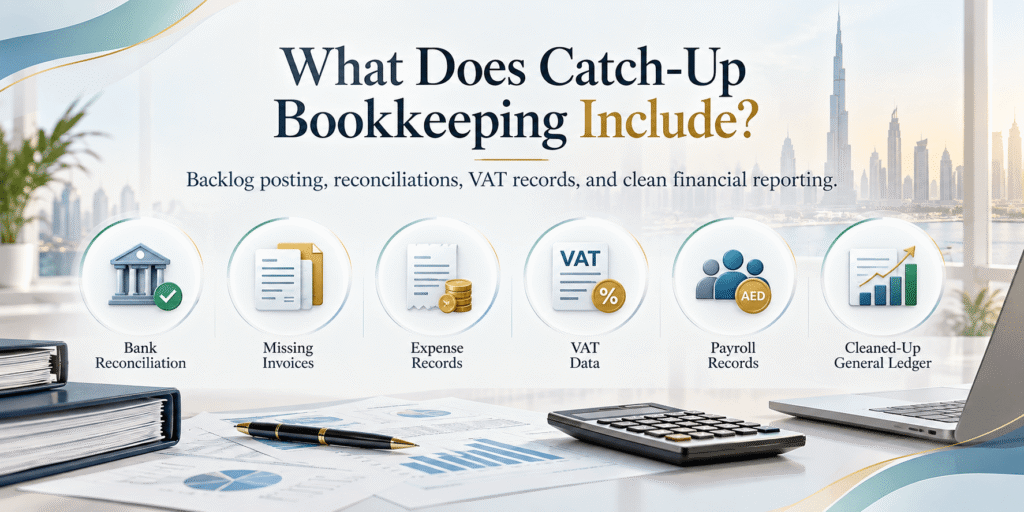
What Does a Catch-Up Bookkeeping Project Include?
The scope of backlog accounting UAE work should be established before the project begins. A typical catch-up project may include several stages.
Review of the existing books
The first step is understanding how much work is actually outstanding. The review may identify:
Last completed bookkeeping period
Number of months behind
Bank accounts requiring reconciliation
Outstanding customer and supplier balances
Existing VAT records
Available invoices and receipts
Unrecorded transactions
Previous accounting errors
Existing financial reports
This initial review helps determine whether the project is mainly about data entry or requires deeper bookkeeping cleanup UAE work.
Transaction recording
Missing transactions are then entered into the accounting system. Depending on the business, these can include:
Sales invoices
Purchase invoices
Operating expenses
Bank receipts
Bank payments
Transfers between accounts
Credit notes
Customer receipts
Supplier payments
Other business-related transactions
The objective is to build a complete accounting record for the overdue period.
Bank reconciliation
Bank reconciliation is an important part of catch-up bookkeeping.
The accounting records should be compared with the relevant bank statements to identify differences. A reconciliation can reveal:
Transactions missing from the books
Duplicate entries
Incorrect amounts
Unrecorded bank charges
Unidentified receipts
Unpresented transactions
Transfers recorded incorrectly
If several months are outstanding, each relevant period may need to be reviewed rather than simply reconciling the latest bank statement.
Accounts receivable and payable review
Customer and supplier balances should also be checked. For receivables, the business may need to determine which customer invoices remain unpaid and whether payments have been correctly allocated.
For payables, supplier invoices and payments may need to be matched so that outstanding balances are accurate. This can help management understand what customers owe the business and what the business still owes suppliers.
What If Records Are Missing?
Missing documents can make a catch-up project more complicated.
For example, a bank payment may appear in the statement but there may be no invoice or receipt supporting the transaction.
Rather than guessing the nature of the expense, the business should identify the missing documentation and determine what additional information is needed.
A useful missing-document list may include:
Missing Information
Possible Source
Bank statement
Bank portal
Sales invoice
Sales team / invoicing system
Supplier invoice
Supplier
Expense receipt
Employee / business owner
Customer payment details
Bank statement / customer records
Supplier payment details
Bank statement / supplier records
Payroll information
Payroll records
VAT documentation
Accounting and tax records
This process helps separate genuine bookkeeping work from information that the business still needs to provide.
How Much Does Catch-Up Bookkeeping Cost in the UAE?
There is no single price for catch-up bookkeeping. The cost depends on the actual scope of work rather than simply the number of months involved.
A business that is six months behind with 50 transactions per month may require considerably less work than another business that is only three months behind but has hundreds of transactions each month across several bank accounts.
For this reason, businesses should request pricing based on the condition and volume of their records.
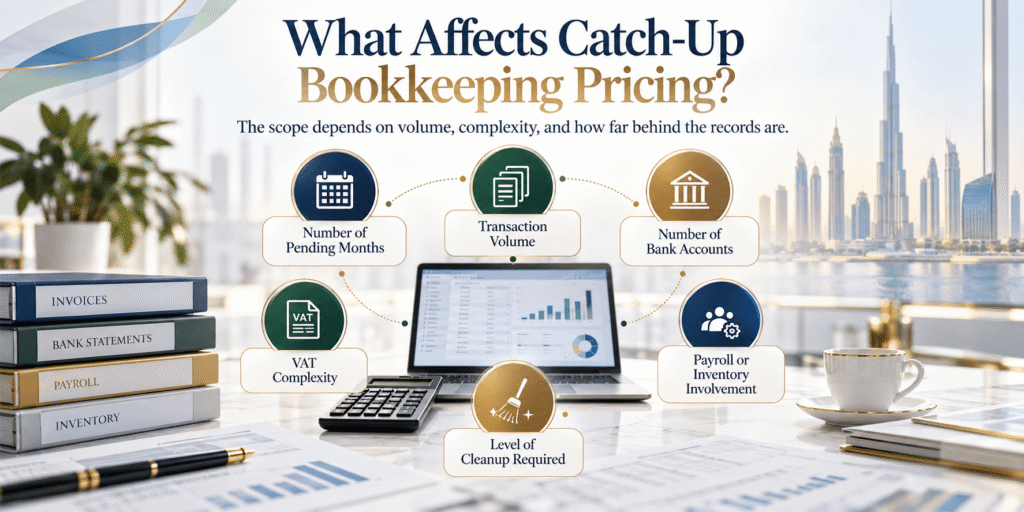
Key Factors That Affect Catch-Up Bookkeeping UAE Pricing
1. Number of months outstanding
The longer the bookkeeping backlog, the more transactions and reconciliations may need to be reviewed. However, months alone should not be used to estimate the complete workload.
2. Transaction volume
Transaction volume is one of the most important pricing factors. A business with a large number of daily sales, purchases and bank transactions can require significantly more processing than a business with relatively few monthly transactions.
3. Number of bank accounts
Each additional bank account can increase the reconciliation workload. Businesses may have:
Operating bank accounts
Savings accounts
Credit cards
Payment gateway accounts
Foreign currency accounts
Petty cash accounts
All relevant accounts may need to be reviewed for the catch-up period.
4. Quality of existing records
If the previous bookkeeping is reasonably organized, catch-up work may mainly involve recording missing transactions and completing reconciliations. If the existing books contain errors, duplicated transactions or inconsistent classifications, additional cleanup may be required.
5. Availability of supporting documents
Well-organized invoices, receipts, bank statements and other records can make the project more efficient. Missing documentation can increase the time required because transactions may need to be investigated before they can be classified correctly.
6. Accounting software
The accounting system being used can also affect the work. Businesses may use cloud accounting software, desktop systems or spreadsheets. A catch-up project may require additional work when records have to be transferred, reorganized or imported into a different accounting system.
7. VAT requirements
If the business is VAT registered, bookkeeping may also need to support VAT reporting. Transactions may need to be reviewed for the appropriate VAT treatment, and VAT records should be consistent with the accounting records.
8. Level of cleanup required
There is a difference between catch-up bookkeeping and bookkeeping cleanup. Catch-up bookkeeping focuses on bringing missing periods up to date. Cleanup may involve correcting historical errors, reviewing account classifications, resolving unreconciled balances and investigating unusual transactions. A project requiring both can therefore have a wider scope.
Catch-Up Bookkeeping vs Regular Bookkeeping
These services solve different problems.
Catch-Up Bookkeeping
Regular Bookkeeping
Addresses overdue records
Keeps current records updated
Often covers historical periods
Usually works on the current period
May require cleanup
Focuses on ongoing accuracy
Can involve backlog investigation
Follows an established process
Usually project-based
Usually recurring
A business that has completed catch-up work should ideally establish a regular bookkeeping routine afterwards.
Otherwise, the same backlog can develop again.
What Businesses Should Prepare Before Starting
Good preparation can reduce unnecessary delays. Before starting a catch-up project, businesses should gather:
Bank statements
Provide statements covering the complete period requiring review.
Sales records
Provide sales invoices, receipts, payment reports or other sales documentation.
Purchase records
Supplier invoices and expense receipts should be collected and organised.
VAT information
If VAT registered, provide relevant VAT returns and supporting records so that the bookkeeping can be checked against previous filings.
Payroll records
Where payroll transactions need to be recorded, provide the relevant payroll information and supporting records.
Existing accounting files
Provide access to the accounting software, spreadsheets or other accounting records used during the backlog period.
Previous financial reports
Earlier balance sheets, income statements, trial balances and other reports can help identify opening balances and historical discrepancies.
How to Scope a Catch-Up Bookkeeping Project
Before agreeing to a price, businesses can ask for a clear scope. The scope should ideally identify:
Period covered – for example, January to June.
Accounting system – software or spreadsheet currently used.
Bank accounts – number of accounts requiring reconciliation.
Supporting documents – what records are available.
VAT status – whether VAT records and returns need review.
Cleanup requirements – whether historical errors need correction.
Reporting requirements – whether management reports or financial statements are required.
Outstanding questions – transactions requiring clarification from the business.
Final deliverables – what will be completed at the end of the project.
This gives both the business and bookkeeping provider a clearer understanding of the work.
What Should Be Checked After Catch-Up Bookkeeping?
Completing transaction entry is not necessarily the final step. The business should review whether the books now provide a reliable picture of its financial position. A post-cleanup review can include:
Bank reconciliation
Accounts receivable balances
Accounts payable balances
VAT-related accounts
General ledger balances
Revenue classification
Expense classification
Fixed asset records
Loans and financing balances
Owner or shareholder transactions
Suspense or unreconciled accounts
Profit and loss statement
Balance sheet
The exact review depends on the business and the agreed scope.
Why Up-to-Date Books Matter for UAE Businesses
Current bookkeeping gives management more useful financial information. When records are several months behind, business owners may struggle to answer basic questions such as:
How much cash is available?
Which customers have overdue balances?
How much does the company owe suppliers?
What are the current operating expenses?
Is the business generating a profit?
Are there unusual transactions that need attention?
Are financial records ready for tax or other compliance work?
The UAE Ministry of Finance notes that businesses need to understand the financial information and records they must maintain for Corporate Tax purposes. The FTA also provides specific requirements concerning accounting records and commercial books.
For businesses subject to Corporate Tax, accurate accounting records are therefore not simply useful for management reporting; they can also support tax compliance and the preparation of Corporate Tax information.
When Should a Business Consider Catch-Up Bookkeeping?
A business may want to address its bookkeeping backlog when:
Several months of transactions remain unrecorded.
Bank accounts have not been reconciled.
Financial reports are outdated.
VAT records need to be brought into line with the accounting system.
Management cannot determine current receivables or payables.
A Corporate Tax filing deadline is approaching.
An accountant or finance employee has left.
Historical accounting errors need to be investigated.
The business is preparing for an audit or financial review.
The earlier a backlog is assessed, the easier it can be to determine whether the business needs simple catch-up work or a broader bookkeeping cleanup.
How Ripple Can Help With Catch-Up Bookkeeping in the UAE
Ripple Accounting, Tax & Advisory provides accounting and bookkeeping support for UAE businesses that need help bringing their financial records up to date.
For a catch-up project, the work can be structured around the business’s actual backlog and accounting requirements rather than using the same process for every company.
Relevant support can include:
Catch-up bookkeeping
Transaction recording
Bank reconciliation
Accounts receivable and payable review
General ledger review
VAT-related bookkeeping support
Financial reporting
Accounting cleanup
Corporate Tax-related accounting preparation
Compliance review
Ongoing bookkeeping support
If your books are several months behind, start with a review of the period, transaction volume, bank accounts and available supporting documents. Contact Ripple Accounting, Tax & Advisory for a tailored catch-up bookkeeping assessment and discuss the scope and pricing for your business.
Email: info@uaetaxcompliance.ae
Phone: +971 52 356 5409
WhatsApp: +971 4 250 0833
Frequently Asked Questions
1. What is catch-up bookkeeping in the UAE?
Catch-up bookkeeping is the process of bringing overdue accounting records up to date. It can involve recording missing transactions, reconciling accounts, reviewing balances and correcting bookkeeping issues.
2. How much does catch-up bookkeeping cost in the UAE?
There is no fixed price. Cost can depend on the number of months outstanding, transaction volume, number of bank accounts, document availability, accounting software and the amount of cleanup required.
3. Can six months of overdue bookkeeping be completed at once?
It can be possible, but the workload depends on the volume and condition of the records. A business with six months of organised records may require less cleanup than one with missing documents and unreconciled accounts.
4. What records are needed for catch-up bookkeeping?
Common records include bank statements, sales invoices, supplier invoices, expense receipts, payment records, payroll information, VAT records where applicable and existing accounting files.
5. Should a business continue regular bookkeeping after catch-up work?
Usually, establishing an ongoing bookkeeping process after clearing the backlog can help prevent the records from becoming overdue again. The appropriate frequency depends on the business’s transaction volume and accounting requirements.
Conclusion
Catch-up bookkeeping is more than entering old transactions into accounting software. The scope can include transaction recording, reconciliations, document review, account cleanup and preparation of reliable financial reports. For UAE businesses, the final cost depends on factors such as the number of overdue months, transaction volume, bank accounts, document availability, accounting system and level of cleanup required. A clear scope before work begins can help the business understand what needs to be completed and what information it must provide.
Disclaimer: This article provides general information about catch-up bookkeeping in the UAE and is not accounting, tax or legal advice for a specific business. The scope of bookkeeping and any related tax or compliance work depends on the business’s circumstances, accounting records and applicable UAE legislation. Businesses should obtain professional advice where specific accounting, VAT, Corporate Tax or regulatory issues require assessment.
Is your construction project still profitable after you account for actual spending, outstanding purchase orders, subcontractor commitments, and the cost of completing…
Could your business explain every employee’s salary payment, deduction, overtime amount, and leave adjustment if an employee or regulator asked for proof?…





0 Comments