UAE Tax Residency Certificate Requirements: Documents and Eligibility
Are you planning to apply for a UAE Tax Residency Certificate but unsure which documents you need or whether you qualify? Understanding…
Read article
Businesses registered for VAT in the UAE can recover input tax on many business expenses, but not every VAT payment is recoverable. The UAE VAT system blocks input tax recovery on specific expenses that are considered personal or non-business in nature. Motor vehicles used for personal purposes and certain entertainment expenses are among the most common areas where businesses make costly VAT mistakes. Understanding the rules on blocked input tax UAE is essential for maintaining compliance with the UAE VAT legislation and avoiding errors during Federal Tax Authority (FTA) audits. Incorrect VAT claims can result in assessments, administrative penalties, and additional tax liabilities.
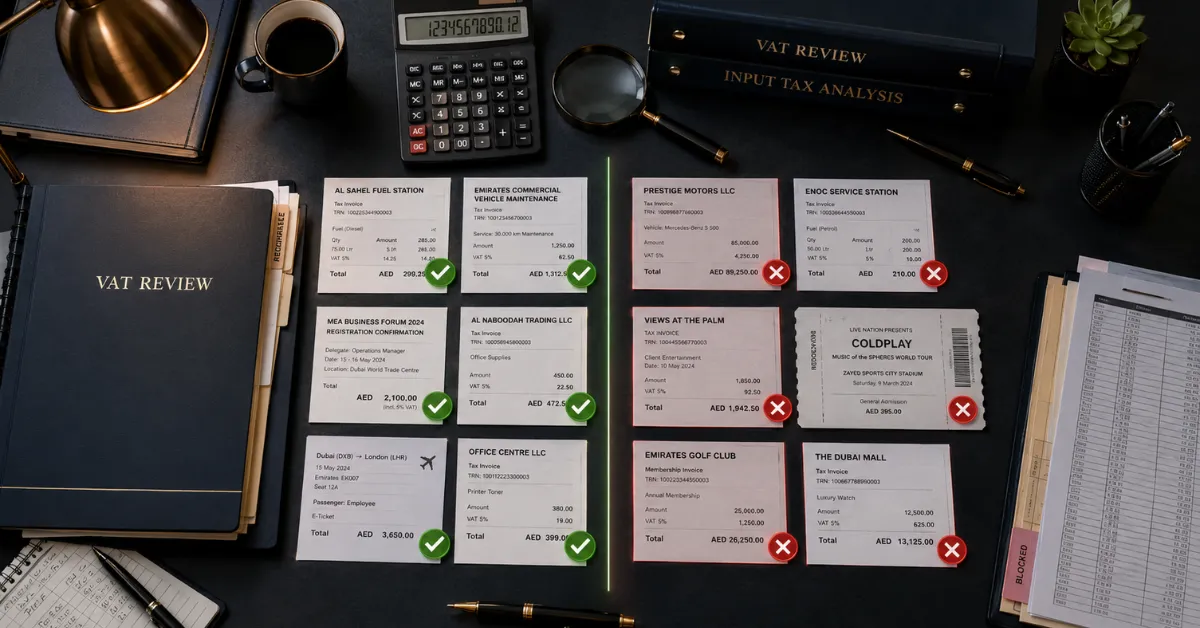
Blocked input tax refers to VAT paid on specific goods or services that cannot be recovered by a VAT-registered business, even if the business has a valid tax invoice. These restrictions are set out in the UAE VAT legislation to prevent businesses from claiming VAT on expenses that mainly provide a personal benefit or are not directly connected with making taxable business supplies.
Input tax recovery is only available when all legal conditions are met. If an expense falls under the blocked input tax rules, the VAT becomes a cost to the business rather than a recoverable amount.
Understanding the difference between recoverable and blocked input tax helps businesses prepare accurate VAT returns and reduce compliance risks.
| Recoverable Input Tax | Blocked Input Tax |
|---|---|
| Related to taxable business activities | Related to personal or restricted use |
| Meets UAE VAT recovery conditions | Specifically restricted under UAE VAT rules |
| Supported by valid tax documentation | Cannot be claimed even with a valid invoice if blocked by law |
| Included in VAT recovery calculations | Treated as a business expense instead of recoverable VAT |
The blocked input tax rules protect the integrity of the UAE VAT system by ensuring that businesses recover VAT only on genuine business expenses.
These rules help to:
For finance teams and business owners, understanding these restrictions is just as important as knowing when VAT recovery is allowed.
A VAT-registered business can recover input tax only when the purchase supports taxable business activities and all legal recovery conditions are satisfied. Recovering VAT without meeting these requirements may result in adjustments during an FTA review.
Businesses should ensure the following conditions are met before claiming input tax:
Meeting all these conditions improves VAT compliance and reduces the likelihood of disputes with the FTA.
Input tax cannot be recovered when one or more recovery conditions are not met.
Common situations include:
Businesses should review every expense carefully before including it in their VAT return.
Motor vehicles are one of the most misunderstood areas of UAE VAT compliance. Many businesses assume VAT paid on every company vehicle is recoverable. However, UAE VAT legislation limits recovery where passenger vehicles are available for personal use.
The purpose for which the vehicle is acquired and how it is actually used determine whether VAT recovery is allowed.
For VAT purposes, a motor vehicle generally includes passenger vehicles designed to transport people on public roads.
Examples include:
Commercial vehicles designed mainly for transporting goods or providing specific services may be treated differently under the VAT rules.
Businesses should evaluate each vehicle based on its design, intended use, and actual business purpose rather than assuming all vehicles receive the same VAT treatment.
The UAE blocks VAT recovery on certain motor vehicles because they are commonly available for private or personal use.
VAT recovery is generally restricted where a passenger vehicle is available for:
The restriction applies even when the vehicle is owned or leased by the business. The deciding factor is whether the vehicle provides a personal benefit rather than being used exclusively for qualifying business activities.
For example, if a company purchases a luxury sedan for a managing director who also uses it for family trips and commuting, the VAT on that vehicle is generally treated as blocked input tax.
By contrast, a delivery company using vehicles solely to transport customer goods as part of its business operations may qualify for VAT recovery, provided all legal conditions are satisfied.
Although VAT recovery is restricted for many passenger vehicles, certain vehicles used exclusively for qualifying business activities may still be eligible for input tax recovery. Businesses should assess each vehicle based on its actual use and maintain supporting documentation to demonstrate that the recovery conditions have been met.
Examples of vehicles that may qualify include:
Businesses claiming VAT on these vehicles should maintain:
Keeping comprehensive documentation strengthens VAT recovery claims and helps demonstrate compliance if the FTA requests supporting evidence during a VAT audit.
The UAE VAT rules restrict input tax recovery on passenger motor vehicles that are available for personal use. Even if the vehicle is registered in the company’s name, VAT may still be blocked if employees, directors, or owners can use it for non-business purposes.
Businesses should evaluate how each vehicle is used before claiming VAT. Incorrect claims may lead to adjustments during an FTA audit.
VAT is generally not recoverable on:
Before recovering VAT, businesses should maintain clear records demonstrating that a vehicle is used solely for qualifying business activities.
Personal use is one of the main reasons why input tax becomes blocked. If goods or services provide a personal benefit rather than supporting taxable business activities, VAT recovery is generally not permitted.
Understanding what constitutes personal use helps businesses avoid incorrect VAT claims and improve compliance with UAE VAT requirements.
Personal use refers to the use of business assets or services for private purposes rather than business operations.
Common examples include:
For example, if a company vehicle is regularly used by an employee to take family members on weekend trips, the related VAT generally falls under blocked input tax.
Some businesses use the same vehicle for both business and private purposes. This mixed use increases VAT compliance risks because the vehicle is no longer used exclusively for qualifying business activities.
Businesses should carefully review:
Maintaining accurate mileage logs, travel records, and company policies can help demonstrate the intended business use of vehicles during an FTA review.
Entertainment expenses are another major category where businesses commonly make VAT recovery errors. Under the UAE VAT rules, input tax on entertainment provided to non-employees is generally not recoverable because these expenses do not directly contribute to making taxable supplies.
Businesses should distinguish between genuine business operating expenses and hospitality or entertainment costs before claiming VAT.
Some employee-related expenses may qualify for VAT recovery where they are required by law or provided as part of normal business operations. However, recreational or social entertainment may be subject to VAT restrictions depending on the circumstances.
Examples include:
Businesses should review each expense individually to determine whether VAT recovery conditions are met.
VAT is generally blocked on entertainment provided to customers, suppliers, business partners, or other non-employees.
Common examples include:
These expenses are usually considered to provide hospitality rather than directly supporting taxable business supplies.
Businesses should understand which expenses commonly fall within the blocked input tax rules before preparing VAT returns.
Examples include:
Reviewing expense categories regularly helps reduce VAT errors and supports accurate tax reporting.
The following examples illustrate how VAT recovery may apply to common business expenses.
| Business Expense | Recoverable? | Reason |
|---|---|---|
| Commercial delivery van | Yes | Used exclusively for taxable business activities |
| Construction truck | Yes | Commercial vehicle supporting business operations |
| Taxi used for passenger transport | Yes | Operated as part of taxable business services |
| Director’s luxury passenger car | No | Available for personal use |
| Employee commuting vehicle | No | Used for private travel |
| Client dinner | No | Entertainment provided to non-employees |
| Concert tickets for customers | No | Hospitality expense |
| Hotel for employee business travel | Generally Yes | Business-related travel subject to recovery conditions |
| Personal fuel | No | Private consumption |
| Business conference registration | Generally Yes | Supports business activities if recovery conditions are met |
Each expense should be assessed based on its purpose, supporting documentation, and applicable UAE VAT recovery rules.

Strong documentation is essential for supporting VAT recovery claims. During an FTA audit, businesses should be able to demonstrate that expenses relate directly to taxable business activities.
Businesses should retain:
Maintaining complete records not only supports VAT recovery but also strengthens overall tax compliance.
Many VAT adjustments occur because businesses misunderstand the blocked input tax rules or fail to maintain proper documentation.
The most common mistakes include:
Regular internal VAT reviews, clear company policies, and proper record keeping help businesses reduce compliance risks and prepare accurate VAT returns.
Incorrectly claiming blocked input tax can expose a business to VAT adjustments during an FTA review. If input tax is recovered on expenses that do not qualify under the UAE VAT rules, the business may be required to repay the tax and could face administrative penalties in accordance with the applicable tax procedures and legislation.
Common risks include:
To reduce these risks, businesses should review expense claims carefully before filing VAT returns and maintain complete supporting documentation.
Following good VAT compliance practices helps businesses reduce errors and improve the accuracy of VAT returns.
Recommended best practices include:
Consistent compliance practices help businesses avoid costly corrections and prepare for FTA reviews with confidence.
A wholesale trading company purchases delivery vans used exclusively to transport products to customers across the UAE. Since the vehicles support taxable business activities and the company maintains complete documentation, the VAT paid on these vehicles may be recoverable, provided all recovery conditions are met.
A consultancy purchases a luxury passenger car for its managing director. The vehicle is used for client meetings during the week and family travel on weekends. Because the vehicle is available for personal use, the VAT is generally treated as blocked input tax.
A construction company acquires heavy trucks used only for transporting building materials between project sites. As the vehicles are commercial in nature and used solely for business operations, input tax recovery may be permitted when the legal requirements are satisfied.
A marketing agency hosts clients at expensive restaurants and sporting events to strengthen business relationships. Although these expenses relate to business networking, VAT on client entertainment is generally not recoverable under the UAE VAT rules.
It depends on how the vehicle is used. VAT recovery is generally restricted for passenger vehicles that are available for personal use. Commercial vehicles used exclusively for qualifying business activities may be eligible for input tax recovery if all legal conditions are met.
VAT on fuel generally follows the VAT treatment of the related vehicle. If the vehicle qualifies for input tax recovery, the associated fuel expenses may also qualify, subject to the applicable VAT recovery rules and supporting documentation.
Luxury passenger vehicles that are available for personal use generally fall within the blocked input tax rules. Businesses should assess the intended use of each vehicle before claiming VAT.
Personal use includes activities that are not directly connected with business operations, such as home-to-office commuting, family travel, shopping trips, holidays, and other private journeys.
In most cases, VAT on entertainment provided to customers, suppliers, or other business guests is not recoverable because it falls under the blocked input tax provisions.
Yes. Commercial delivery vehicles used exclusively for transporting goods as part of taxable business activities may qualify for VAT recovery, while many passenger vehicles available for personal use do not.
Businesses should retain valid tax invoices, supplier contracts, purchase records, vehicle registration documents, mileage logs, fuel receipts, maintenance records, accounting records, and VAT return documentation to support recovery claims.
If a business incorrectly claims blocked input tax, the FTA may require repayment of the VAT, make adjustments during an audit, and apply administrative penalties where appropriate.
Managing UAE VAT rules can be challenging, especially when dealing with blocked input tax, motor vehicles, entertainment expenses, and input tax recovery. Ripple Accountants provides expert VAT advisory, VAT registration, VAT return filing, input tax reviews, VAT health checks, FTA audit support, and ongoing compliance assistance. Our experienced tax professionals help businesses apply the correct VAT treatment, maintain proper documentation, and reduce compliance risks. Contact us today at +971 52 356 5409, +971 4 250 0833 (WhatsApp), or email info@uaetaxcompliance.ae to discuss your VAT compliance requirements.
Understanding the blocked input tax UAE rules is essential for every VAT-registered business. While many business expenses qualify for input tax recovery, passenger motor vehicles used for personal purposes and client entertainment expenses are common areas where VAT recovery is restricted.
Disclaimer: This article is for general informational purposes only and should not be considered tax, legal, or financial advice. UAE VAT laws, regulations, and FTA guidance may change over time. Businesses should refer to the latest applicable legislation or consult a qualified UAE VAT professional before making tax decisions.
Tell us a little about your business and our UAE tax experts will get back to you with clear, practical answers — no obligation.
 Corporate Tax
Are you planning to apply for a UAE Tax Residency Certificate but unsure which documents you need or whether you qualify? Understanding…
Read article Corporate Tax
Do you need a UAE Tax Residency Certificate for a local administrative requirement or to claim benefits under a double taxation agreement?…
Read article Bookkeeping
How can UAE businesses ensure employees receive the correct salary every month? Payroll involves more than adding basic pay and allowances. Employers…
Read articlePage 1 of 58
Book a free consultation and get clear answers for your business.
0 Comments