Input VAT vs Output VAT UAE: A Practical Guide
Do you know the difference between the VAT your business charges customers and the VAT it pays on business expenses? Understanding input…
Read article
If the FTA requested your accounting records tomorrow, would you be confident that every number could be explained?
For UAE SMEs, accounting errors do not always appear as obvious mistakes. A missing invoice, unreconciled bank balance, incorrect VAT entry or unsupported expense can remain unnoticed for months.
An accounting health check UAE businesses perform proactively can identify these weaknesses before they create larger financial or compliance problems. It is a structured review of bookkeeping records, tax-related information, reconciliations and supporting documents. The objective is not to prepare for an FTA audit alone, but to ensure that the company’s financial records are accurate, complete, consistent and properly supported.

An accounting health check is a structured review of a company’s financial records to identify errors, inconsistencies, missing information and weaknesses in accounting controls.
It is similar to a financial “check-up.” Instead of waiting until an issue appears during an FTA review, tax filing or financial audit, the business reviews its records in advance.
An accounting health check may examine:
For a UAE business, this review can be particularly useful before Corporate Tax filing, during an accountant change, after a period of rapid growth, or when management suspects that bookkeeping records are incomplete.
Small businesses often focus on sales, customers and daily operations. Accounting reviews may be postponed until the end of the financial year or close to a tax deadline.
That approach can create unnecessary pressure. A regular accounting review UAE businesses conduct can help identify problems while they are still relatively easy to correct.
The following 20 tests provide a practical framework for reviewing your accounting records.
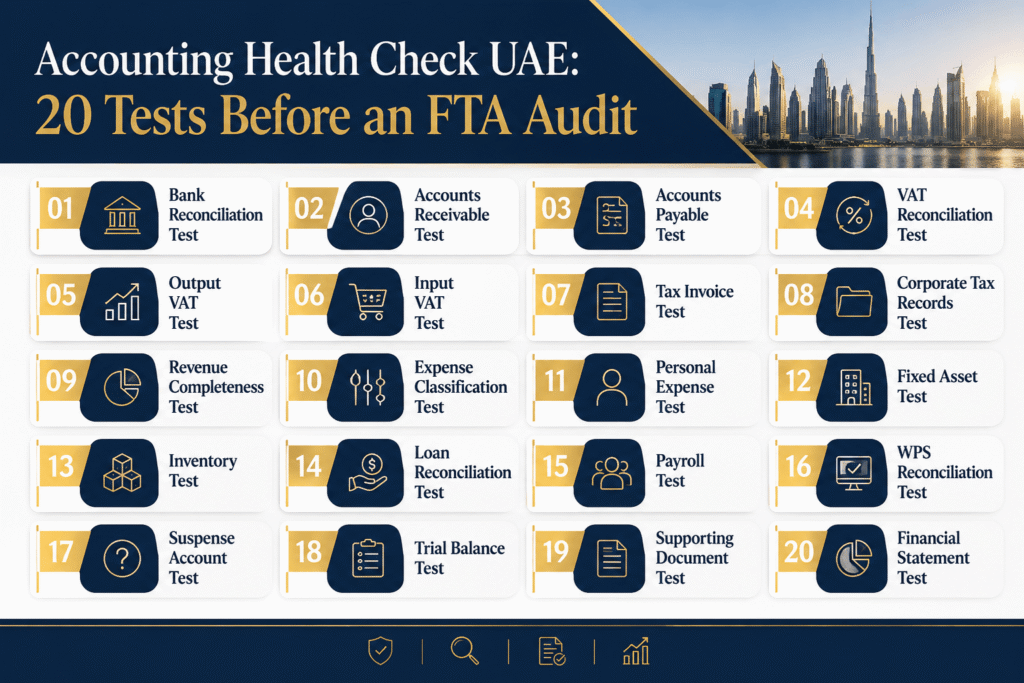
Start with your bank accounts.
Compare the balance recorded in the accounting system with the actual balance shown on bank statements.
Look for:
Every business bank account should be reconciled regularly.
If the accounting balance does not agree with the bank statement, investigate the difference rather than simply adjusting the balance.
Next, review customer balances.
Ask:
An inaccurate receivables ledger can make a business appear financially stronger or weaker than it actually is.
For example, a customer balance that has remained outstanding for several years may require management review rather than simply being carried forward indefinitely.
Review supplier balances in the same way.
Compare the accounting records with supplier statements where available.
Check for:
This helps confirm whether liabilities shown in the financial statements are accurate.
For VAT-registered businesses, compare VAT records with submitted VAT returns. Review:
If the accounting system shows a VAT balance that does not agree with previous returns, investigate the difference.
A VAT reconciliation should be part of routine bookkeeping rather than something performed only at year-end.
Review sales transactions to determine whether VAT has been recorded appropriately.
Check whether:
Businesses operating across different emirates or dealing with imports, exports or international customers may require additional review because VAT treatment can vary depending on the transaction.
Review purchases and expenses on which input VAT has been recorded.
Check whether the accounting records are supported by appropriate tax invoices and whether the VAT treatment is appropriate.
Pay particular attention to:
Do not assume that every VAT amount appearing on a supplier invoice automatically results in a recoverable input VAT claim.
Select a sample of sales and purchase invoices and review their supporting information.
Check whether invoices are:
A well-organized invoice trail makes it easier to explain transactions if questions arise later.
Review whether accounting records provide sufficient information to support the company’s Corporate Tax position.
Check:
The FTA has specific record-keeping requirements for taxpayers. Businesses should ensure that relevant records are maintained for the applicable retention period.
One important bookkeeping errors UAE test is determining whether all business income has been recorded.
Compare accounting revenue against other evidence, such as:
For an online business, for example, accounting revenue should be reviewed against payment gateway and marketplace records where relevant.
Review whether expenses have been posted to appropriate accounts.
For example:
Correct classification improves the quality of financial reporting and tax analysis.
SMEs, particularly owner-managed businesses, should check whether personal expenses have been mixed with business expenses.
Examples could include:
These transactions should be appropriately identified and accounted for rather than being treated automatically as deductible business expenses.
Compare the fixed asset register with the accounting records.
Review:
If a company purchased computers, vehicles, or equipment during the year, confirm that those assets are properly recorded.
Businesses holding inventory should compare accounting records with inventory information.
Check:
Inventory errors can affect both the balance sheet and reported profitability.
A physical stock count may also be appropriate depending on the nature and size of the business.
If the company has loans, compare accounting balances with lender statements.
Check:
A common mistake is recording the entire loan repayment as an expense even though part of the payment may represent repayment of principal.
Payroll records should agree with accounting entries and actual salary payments.
Review:
For UAE businesses subject to WPS requirements, payroll and salary payment records should also be reviewed for consistency.
Where applicable, compare payroll records with WPS-related salary payments and bank records.
The objective is to identify differences between:
Payroll calculation → Salary file/payment → Bank transaction → Accounting entry
Any unexplained difference should be investigated.
This can be especially important for businesses with a large number of employees.
Check whether unexplained balances remain in suspense or miscellaneous accounts. A suspense account should not become a permanent storage location for unidentified transactions.
For example, if an AED 8,000 bank receipt has been sitting in a suspense account for several months, the business should determine what the receipt relates to and record it appropriately.
Review the trial balance for unusual balances.
Look for:
The trial balance is a useful checkpoint before preparing financial statements.
Ask a simple question:
Can the business prove the transaction?
For significant transactions, supporting evidence may include:
The FTA has emphasized the importance of maintaining accounting records and supporting documents for tax purposes. Businesses should ensure that their records are organized and retrievable when required.
Finally, review the financial statements as a whole.
Check whether the:
are consistent with the underlying accounting records.
Management should be able to explain significant movements in revenue, expenses, assets and liabilities.
If the financial statements contain numbers that management cannot explain, the accounting records may require further investigation.
Finding an error is only the first step.
A useful correction process is:
Identify → Investigate → Document → Correct → Reconcile → Review tax impact
Do not simply delete or overwrite historical transactions without maintaining an appropriate accounting trail.
For example, if a duplicate expense was recorded, identify both entries, confirm which one is incorrect, make the appropriate correction and retain documentation explaining the adjustment.
If an error may affect a previously submitted VAT or Corporate Tax return, the business should assess the relevant correction requirements and obtain professional advice where necessary.
There is no single schedule suitable for every business, but a practical approach for SMEs is:
An additional health check can be useful when:
An accounting health check is not the same as an FTA audit. An accounting health check is a proactive review carried out by the business or its professional advisers to identify potential accounting and compliance weaknesses.
An FTA audit is an official tax authority process.
A health check cannot guarantee that the FTA will not identify an issue. However, maintaining accurate books, organized supporting documentation and appropriate accounting controls can help a business respond more effectively if information is requested.
The goal should therefore be continuous compliance rather than preparing only when an audit becomes possible.
The quality of accounting records has become increasingly important for UAE businesses managing VAT and Corporate Tax obligations. The Federal Tax Authority has issued specific guidance and decisions relating to accounting records and commercial books. Businesses should therefore keep themselves informed about current requirements rather than relying on outdated bookkeeping practices.
In particular, FTA Decision No. 4 of 2026 addresses rules and requirements concerning information contained in accounting records and commercial books.
Businesses should review the latest official FTA requirements and ensure that their accounting systems and document-retention processes are appropriate for their circumstances.
Ripple Accountant can help UAE businesses review their accounting records and identify potential bookkeeping issues before they become larger financial or compliance problems. Our support can include reviewing bank reconciliations, general ledger balances, receivables and payables, VAT records, supporting documents, and financial reports. We can also help businesses identify unusual transactions, missing records and reconciliation differences, and organize their accounting information for ongoing reporting and compliance.
If you are unsure whether your books are accurate or ready for a tax or financial review, contact Ripple Accountant today to discuss an accounting health check for your UAE business.
An accounting health check is a structured review of a company’s financial records, reconciliations, tax-related information and supporting documentation to identify errors and weaknesses.
Basic accounting checks should be performed monthly, while a more comprehensive review can be performed quarterly or annually. An additional review may be useful before major tax, financing or business events.
Common problems include unreconciled bank accounts, duplicate transactions, missing invoices, incorrect expense classifications, unsupported transactions, VAT reconciliation differences and inaccurate customer or supplier balances.
No. A health check can identify potential weaknesses and improve record quality, but it does not guarantee that an FTA review will not identify an issue.
They can be reviewed as part of an overall accounting health check because both depend on reliable underlying accounting records. However, VAT and Corporate Tax have different rules and should be assessed according to their respective requirements.
The exact requirements depend on the business and applicable tax rules, but records can include invoices, receipts, bank statements, accounting ledgers, financial statements, tax records, contracts and other documents supporting business transactions.
An accounting health check UAE businesses perform regularly can provide an important layer of protection against avoidable bookkeeping and compliance problems. Rather than waiting for an error to be discovered during tax preparation, an audit or a financial review, businesses can proactively examine their records.
Disclaimer: This article is provided for general informational and educational purposes only. The information in this article should not be considered legal, tax, accounting, or financial advice. Businesses should review their specific circumstances and consult a qualified UAE accounting or tax professional and, where appropriate, the Federal Tax Authority before making tax, accounting or compliance decisions.
Tell us a little about your business and our UAE tax experts will get back to you with clear, practical answers — no obligation.
 VAT
VAT
Do you know the difference between the VAT your business charges customers and the VAT it pays on business expenses? Understanding input…
Read article VAT
VAT
Are small VAT return mistakes creating more work for your finance team than the VAT filing itself? For VAT-registered businesses in the…
Read article Compliance
Are you sure your construction payroll shows not only who was paid, but also which site and project incurred the labor cost?…
Read articlePage 4 of 45
Book a free consultation and get clear answers for your business.
0 Comments