VAT Registration for UAE Freelancers and Consultants: Requirements and Process
Are you working independently as a freelancer or consultant in the UAE and wondering whether you need to register for VAT? Operating…
Read article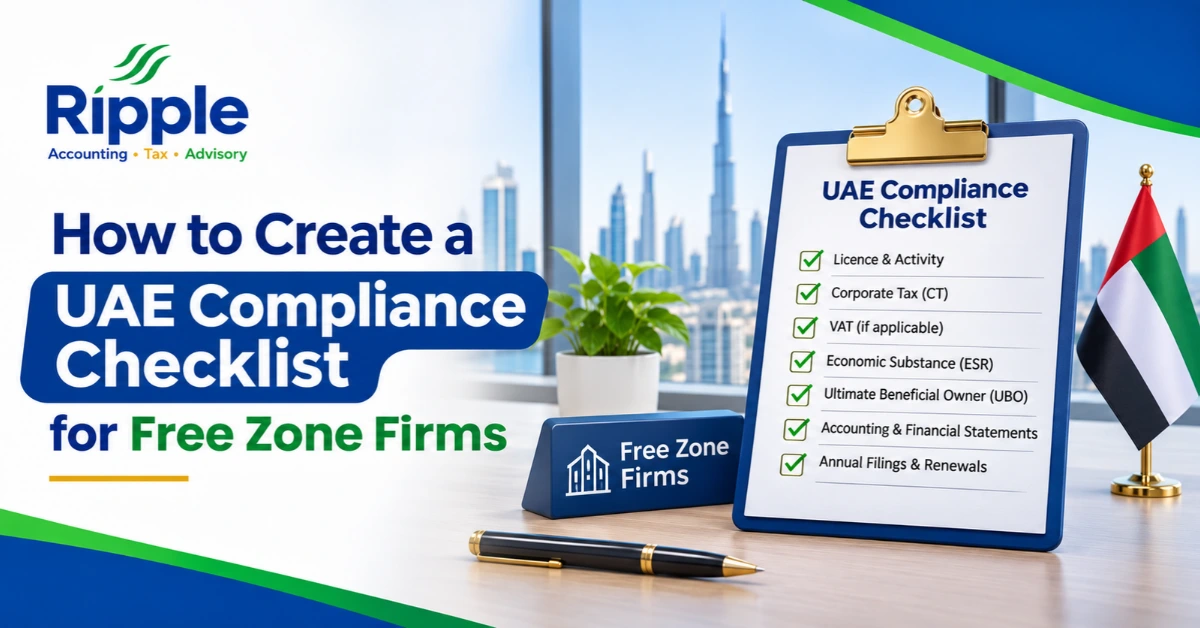
Running a free zone company in the UAE offers access to international markets, business-friendly infrastructure, and attractive investment opportunities. However, obtaining a trade licence is only the beginning. Companies must also manage tax registrations, accounting records, ownership disclosures, licence renewals, and other regulatory responsibilities. A practical UAE Compliance Checklist helps business owners track these obligations, organise important documents, and avoid missing filing deadlines. It also makes it easier to identify which rules apply to the company’s activities, legal structure, and free zone authority.
Free zone companies do not all follow identical compliance procedures. A business registered with IFZA may have different authority-specific requirements from a company operating under DMCC, DAFZA, ADGM, Shams, or RAKEZ. Federal tax and other applicable UAE laws must also be considered.
A free zone company must follow the requirements of its licensing authority and comply with relevant UAE federal legislation. These responsibilities can include trade licence renewal, Corporate Tax registration, VAT filing, accounting, beneficial ownership records, and employment procedures.
Without a central checklist, business owners may overlook deadlines or assume that their free zone status removes obligations that still apply to them.
A structured compliance process helps companies:
It is important to understand the difference between authority-specific and federal requirements. Free zone authority requirements may include licence renewals, office or facility arrangements, company register updates, and financial statement submissions. Federal compliance requirements may include Corporate Tax, VAT where applicable, AML obligations for businesses within scope, and beneficial ownership rules.
For example, a Dubai-based trading company may need to renew its licence with its free zone authority while separately maintaining accounting records and meeting its Federal Tax Authority obligations.
Your UAE compliance checklist should cover both areas.
The following ten areas provide a practical starting point. A company should adjust the checklist according to its activities, legal structure, tax status, and licensing authority.
Every free zone company should monitor its trade licence and confirm that it continues to meet the conditions set by its licensing authority.
An expired licence can affect business operations, banking arrangements, immigration services, and other administrative processes.
Your checklist should include:
Companies should also confirm that their actual business operations match their approved licence activities. A business that starts offering new services or trading different products may need an activity amendment or additional approval.
Corporate Tax is a major part of UAE corporate compliance. Free zone companies generally fall within the UAE Corporate Tax framework, even when they expect to benefit from the 0% rate available to qualifying Free Zone Persons.
However, free zone registration does not automatically make all company income eligible for the 0% rate.
A company must meet the applicable conditions to qualify as a Qualifying Free Zone Person (QFZP). These include requirements relating to qualifying income, adequate substance, transfer pricing, and other conditions under the Corporate Tax rules.
Your checklist should include:
For example, a free zone consultancy may receive income from several types of customers. It should review the nature of each activity and the applicable Corporate Tax rules instead of assuming that all revenue qualifies for the 0% rate.
Important: QFZP status involves specific financial reporting and audit conditions. Companies should check the latest FTA decisions and applicable requirements for their tax period.
Free zone companies must also assess their VAT responsibilities. Operating in a free zone does not automatically exempt a business from VAT.
The standard VAT registration threshold is generally ₨? No, UAE dirham thresholds apply: mandatory registration is generally required when taxable supplies and imports exceed AED 375,000 over the relevant period. Voluntary registration may be available when the applicable threshold of AED 187,500 is met.
Some designated zones receive special VAT treatment for qualifying transactions involving goods. This treatment does not mean every transaction or service supplied by a company in a free zone is outside the VAT system.
Your checklist should include:
For example, a free zone trading company importing goods and selling them to UAE customers should review customs documents, import VAT, and the VAT treatment of each sale.
Ripple Accountants provides VAT registration and filing support for businesses that need help managing their VAT responsibilities.
Anti-Money Laundering (AML) compliance is another important area for businesses that fall within the UAE’s AML framework. Not every free zone company has identical AML responsibilities. Requirements depend on the company’s activities, whether it operates in a regulated sector or qualifies as a Designated Non-Financial Business or Profession (DNFBP), and the relevant supervisory authority.
The UAE introduced a new AML legal framework through Federal Decree-Law No. 10 of 2025 and Cabinet Resolution No. 134 of 2025. Businesses within scope should review the applicable requirements under the updated framework.
Your checklist should include, where applicable:
Companies should not treat AML compliance as a simple annual document exercise. It requires suitable procedures and ongoing attention.
UAE companies must assess their beneficial ownership responsibilities and maintain accurate ownership information in line with the applicable rules. A beneficial owner is generally the natural person who ultimately owns or controls a legal entity, directly or indirectly, or exercises ultimate effective control.
Cabinet Decision No. 109 of 2023 sets out the UAE’s beneficial ownership procedures. Companies should review the rules and any applicable exemptions when preparing their ownership records.
Your checklist should include:
For example, if a company changes shareholders or introduces a new corporate shareholder, it should review whether the change affects its UBO information and notify the relevant authority as required.
Accurate accounting records support almost every area of UAE compliance. Companies need reliable financial information to prepare tax returns, monitor performance, respond to authority requests, and support audit procedures.
Even a free zone company with limited transactions should maintain organised records.
Your checklist should include:
Audit requirements can differ between free zones and company types. QFZPs must also consider the relevant Corporate Tax financial statement requirements.
Ripple Accountants can support businesses through accounting and bookkeeping services, helping them maintain organised records for tax reporting and financial reviews.
Businesses should understand the current position of the UAE Economic Substance Regulations (ESR) rather than automatically adding an annual ESR filing to every compliance calendar.
The UAE cancelled ESR notification and reporting requirements for financial years ending after 31 December 2022. However, companies remain responsible for relevant obligations relating to earlier financial years, including outstanding information requests and applicable penalties.
Your checklist should include:
This prevents businesses from confusing historical ESR requirements with current Corporate Tax obligations.
Good corporate governance helps a free zone company maintain clear ownership, management responsibilities, and decision-making records. Companies should keep their corporate documents organised and ensure that the information submitted to their licensing authority remains accurate.
Your checklist should include:
These practices can also help when banks, auditors, investors, or regulators request company information.
Free zone companies involved in importing, exporting, warehousing, or distributing goods may have additional customs responsibilities.
Their requirements depend on the type of goods, customs procedures, destination markets, and the free zone’s arrangements.
Your checklist should include, where applicable:
The AEO programme may offer trade facilitation benefits to eligible businesses that meet the relevant customs and supply chain security requirements. It is not a general compliance requirement for every free zone company.
Companies employing staff must also monitor employment, immigration, and payroll responsibilities. Requirements may vary according to the free zone, employment arrangement, and applicable labour and immigration rules.
Your checklist should include:
Keeping employee records organised helps prevent administrative delays and supports a smoother renewal process.
Although many UAE free zone companies share common federal obligations, each authority may have its own administrative procedures and filing requirements.
Here are examples of authorities businesses should consider:
Do not assume that a requirement imposed by one authority applies in exactly the same way to another. Always confirm the latest procedures with the relevant free zone authority.
A compliance checklist becomes more useful when you connect it to a calendar. This allows the company to assign responsibilities and prepare documents before deadlines arrive.
Corporate Tax and VAT deadlines depend on the relevant tax period and filing rules. Add the actual due dates to your calendar rather than relying on a generic annual schedule.
Even established businesses can overlook important obligations. The following mistakes are worth checking when reviewing your compliance position. Assuming free zone companies are automatically exempt from Corporate Tax: Review QFZP eligibility and applicable tax rules instead of assuming all income receives the 0% rate.
A regular compliance review helps identify these issues before they become more difficult to resolve.
A checklist should reflect your company’s actual obligations, not simply copy a generic list from another business.
Follow these four steps to build a practical system.
Start by recording your free zone, licence activities, legal structure, shareholders, and operating model. Identify the federal and authority-specific requirements that apply.
Give each compliance responsibility to a suitable person. For example, the finance team can manage bookkeeping and tax records, while the HR or administration team can monitor employee documentation and licence renewals.
Record each deadline, responsible person, required document, and completion status. Set reminders early enough to allow time for document preparation and corrections.
Review the checklist at regular intervals and whenever the company changes its activities, ownership, legal structure, or tax position. Update it when the relevant authority introduces new procedures or regulations.
Managing accounting, tax, and reporting responsibilities can become difficult when a business handles everything internally. Ripple Accountants supports UAE businesses with practical accounting and compliance services that help them maintain organised financial records and manage applicable obligations.
Our support includes:
You can visit UAE Tax Compliance to explore Ripple’s accounting and tax services, or review the accounting and bookkeeping support available through Ripple.
UAE free zone companies may need to manage licence renewals, Corporate Tax, VAT where applicable, accounting records, beneficial ownership information, employment requirements, and authority-specific filings. The exact obligations depend on the company’s activities, structure, and regulatory status.
Generally, yes. Free zone companies fall within the UAE Corporate Tax framework and must assess their registration and filing obligations. Qualifying Free Zone Persons may benefit from a 0% rate on qualifying income if they meet the required conditions.
No. Free zone status does not automatically exempt a company from VAT. Businesses must assess their taxable supplies, imports, registration thresholds, and the VAT treatment of their transactions.
Not necessarily. Audit requirements depend on the relevant free zone authority, applicable company rules, and tax status. Companies seeking QFZP treatment must also consider the specific audited financial statement requirements under Corporate Tax rules.
AML obligations depend on the company’s business activities and whether it falls within the scope of the relevant legislation. Businesses within scope may need customer due diligence, risk assessments, record-keeping, internal controls, and applicable reporting procedures.
Companies should assess the applicable beneficial ownership rules and maintain required ownership information. They must also review reporting procedures, relevant exemptions, and requirements for notifying the licensing authority about changes.
The UAE cancelled ESR notification and reporting requirements for financial years ending after 31 December 2022. However, businesses may still need to address historical obligations, outstanding requests, and applicable penalties for earlier periods.
Depending on the breach, a company may face administrative penalties, tax consequences, licence-related issues, or regulatory action. Maintaining accurate records and monitoring deadlines helps reduce these risks.
Review the checklist regularly and whenever the company changes its activities, ownership, legal structure, or regulatory status. Also update it when the relevant authority or UAE legislation introduces new requirements.
A successful free zone business needs more than an active trade licence. It must also maintain accurate accounts, review tax obligations, update ownership records, and follow the requirements of its licensing authority.
A well-organised UAE Compliance Checklist gives business owners a clear way to monitor these responsibilities, prepare for deadlines, and identify potential compliance gaps.
Ripple Accountants can help your business organise its accounting records, manage applicable tax responsibilities, and prepare for financial reporting requirements. Contact our team to discuss your company’s compliance needs and establish a practical approach to ongoing financial management.
Disclaimer: This article provides general information about UAE free zone compliance and should not be treated as legal, tax, or accounting advice. Requirements vary by business activity, free zone authority, and regulatory status. Consult a qualified professional for guidance specific to your company.
Tell us a little about your business and our UAE tax experts will get back to you with clear, practical answers — no obligation.
 VAT
Are you working independently as a freelancer or consultant in the UAE and wondering whether you need to register for VAT? Operating…
Read article VAT
Does operating from a UAE free zone mean your company is automatically exempt from VAT registration? Not necessarily. Although free zones offer…
Read article Compliance
Are your business invoicing processes ready to meet the UAE’s electronic invoicing requirements? Non-compliance with the Electronic Invoicing System can result in…
Read articlePage 1 of 67
Book a free consultation and get clear answers for your business.
0 Comments