Are your employees being paid on time, and does your payroll data match what is being submitted through the Wage Protection System (WPS)?
For businesses registered with the Ministry of Human Resources and Emiratization (MoHRE), WPS payroll UAE is an important part of salary compliance. Employers need to keep payroll records accurate, prepare the required salary information correctly, and make sure wages are transferred through the approved system within the applicable deadline. The rules became stricter from 1 June 2026, when Ministerial Resolution No. 340 of 2026 introduced a unified wage payment deadline and replaced the previous WPS framework. This guide explains what UAE employers should track each month, including employee salary records, WPS salary files, payment dates, deductions, reconciliations, and compliance records.
What Is WPS Payroll UAE?
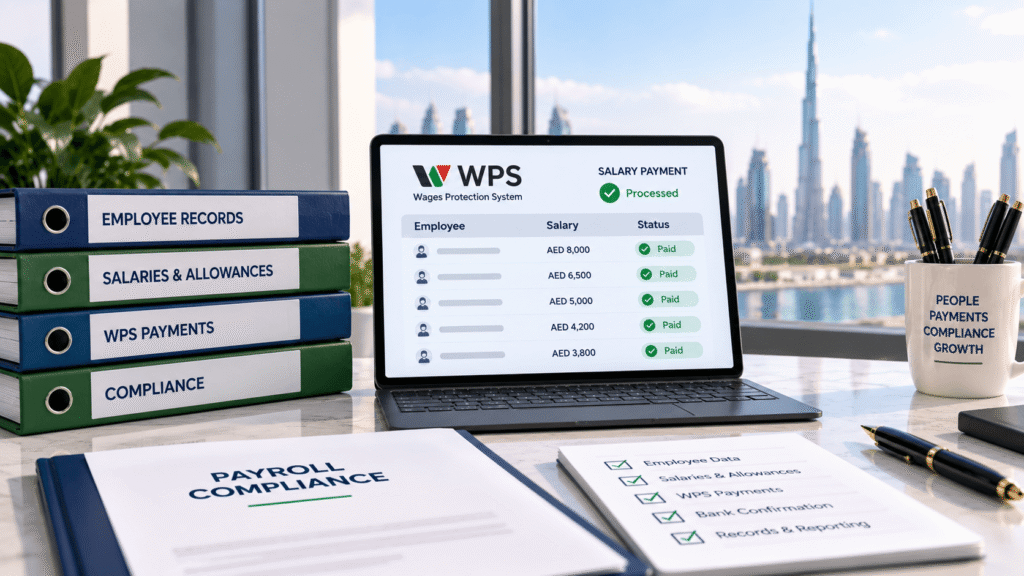
The Wage Protection System UAE (WPS) is an electronic system used to monitor the payment of employee wages. It enables salaries to be transferred electronically through approved banks, exchange houses and financial institutions, helping ensure employees receive their wages in accordance with their employment arrangements.
For MoHRE-registered establishments covered by the system, WPS is not simply a payroll convenience. Employers need to make sure salary payments and supporting payroll information are accurate and submitted through the required channels.
This means WPS payroll should be treated as part of the company’s monthly compliance process, alongside bookkeeping, bank reconciliation and other financial records.
The most important change for employers is the introduction of a unified wage payment deadline. Salaries for the previous Gregorian month are due on the first day of the following month. The UAE Government confirms that MoHRE-registered establishments must pay employees through WPS on the due date.
The new framework also uses an 85% compliance threshold for total wages transferred on time. This does not remove an employee’s right to receive their full contractual or legally due wages.
For employers, the practical message is simple: payroll should be completed early enough for the WPS payment to reach employees by the applicable due date.
What Should Employers Track for WPS Payroll?
A reliable WPS payroll process starts with accurate information. Employers should not wait until the salary file is ready to discover that employee records, salary figures or bank details do not match.
1. Employee Information
Maintain current employee information, including:
Employee identification details
Employment status
Contractual salary
Bank or salary account information
Start and end dates where relevant
Approved leave or unpaid leave
Changes to employment terms
Any changes affecting salary should be reflected in the payroll records before the WPS file is prepared.
2. Basic and Variable Salary Components
Payroll should clearly distinguish between fixed salary and variable components such as allowances, overtime, commissions or other approved payments.
This is important because the amount transferred through WPS should be supported by the employer’s payroll records. If the WPS salary file shows an amount that cannot be reconciled to the payroll calculation, the employer may face unnecessary queries or payment processing problems.
3. Deductions and Unpaid Leave
Employers should document salary deductions rather than simply reducing the amount transferred.
For example, if an employee’s salary is reduced because of an approved unpaid-leave period or another lawful deduction, the payroll records should clearly explain the calculation.
The current WPS framework also identifies unpaid leave and certain other circumstances among the categories that may be excluded from WPS compliance, subject to the applicable requirements and supporting documentation.
WPS Salary File: What Employers Need to Check
The WPS salary file, commonly referred to as the Salary Information File (SIF), contains structured payroll information used to process salary payments through the WPS.
Employers should review the file carefully before submission rather than assuming that payroll software has generated everything correctly.
Key checks include:
Employer details: Make sure the establishment information and relevant employer identification details match the registered records.
Employee details: Check that employees included in the file are correctly identified and correspond with the company’s current payroll records.
Bank details: Verify employee IBANs and the relevant bank or financial-institution information.
Salary amounts: Confirm that fixed and variable salary amounts agree with the approved payroll calculation.
Payment period: Make sure the salary period and payment information correspond to the correct payroll month.
Total amount: Reconcile the total value in the salary file with the company’s payroll register before submission.
A single incorrect employee record or mismatch can cause a salary file to be rejected or require correction, so a pre-submission review is an important WPS payroll control.
WPS Payroll Reconciliation: What Should Be Matched?
One of the most useful controls for UAE SMEs is a monthly WPS payroll reconciliation. The purpose is to compare the payroll calculation with the amount submitted through WPS and the amount actually processed by the bank.
A basic reconciliation can compare:
Record
What to Check
Payroll register
Total salaries and individual employee amounts
WPS salary file
Employee details and salary amounts
Bank payment record
Amount actually transferred
Employment records
Contractual salary and employee status
Leave records
Paid and unpaid leave affecting payroll
Accounting ledger
Payroll expense and related liabilities
If these records do not agree, the difference should be investigated before the payroll period is closed.
For example, if the payroll register shows AED 185,000 but the WPS file contains AED 181,500, the employer should identify the AED 3,500 difference before treating the payroll as complete.
When Should UAE Employers Pay WPS Salaries?
Under the current rules, salaries for the previous Gregorian month are due on the first day of the following month. This means employers need to build their payroll timetable around the new deadline rather than relying on the older payment practices that applied under the previous WPS framework.
For example, salary for September should be planned so that the required WPS payment reaches employees by 1 October.
This makes payroll preparation time particularly important. Businesses should allow sufficient time for:
Attendance and leave data to be finalised.
Payroll calculations to be reviewed.
Salary changes and deductions to be checked.
The WPS salary file to be generated.
The file to be reviewed and submitted.
The bank or approved payment channel to process the salaries.
Waiting until the deadline to start this process increases the risk of delays.
What Happens If WPS Salary Payments Are Delayed?
The current WPS framework uses progressive compliance measures when wages are not paid as required. MoHRE’s current guidance explains that electronic reminders can begin after the due date, with further measures applying if the non-compliance continues. These can include restrictions affecting the issuance of new work permits and other enforcement actions.
The exact consequence can depend on the circumstances, establishment category and duration of the non-compliance. Employers should therefore avoid relying on a general “grace period” and instead plan payroll so payments are completed by the required date.
WPS Payroll Records Employers Should Keep
Good WPS compliance depends on more than submitting the salary file. Businesses should retain records that explain how each payroll figure was calculated. Important records for WPS payroll can include:
Employment contracts and salary details
Monthly payroll registers
WPS salary files and submission records
Bank payment confirmations
Leave and attendance records
Approved salary adjustments
Overtime and allowance calculations
Records supporting lawful deductions
Employee joining and leaving records
Payroll-to-bank reconciliations
Correspondence relating to rejected or corrected salary files
Keeping these records together makes it easier to investigate discrepancies and respond to compliance queries.
WPS Checklist for UAE SMEs
A monthly WPS checklist for UAE SMEs can help reduce avoidable payroll errors. Before submitting salaries, employers should confirm:
Employee records are up to date.
New employees and leavers have been correctly reflected.
Contractual salaries agree with the payroll register.
Allowances, overtime and other variable payments are supported.
Leave and deductions have been properly documented.
Bank and IBAN details are correct.
The WPS salary file matches the payroll register.
Total payroll agrees with the WPS file.
The required payment date has been scheduled.
Bank processing time has been considered.
The final payment is reconciled with the bank record.
WPS records are retained with the supporting payroll documents.
For SMEs, this checklist can be incorporated into the monthly payroll closing process instead of being treated as a separate administrative task.
Common WPS Payroll Mistakes UAE Employers Should Avoid
Using Outdated WPS Deadlines: One of the biggest risks in 2026 is relying on information based on the previous WPS rules. The current framework applies from 1 June 2026 and introduces the first-of-the-month wage deadline.
Preparing the Salary File at the Last Minute: Even when payroll calculations are correct, bank processing or file errors can create delays. Preparing the file early provides time to correct problems.
Not Reconciling Payroll With WPS: A payroll register alone does not prove that the amount submitted through WPS is correct. The two should be compared before payment.
Ignoring Employee Data Changes: Changes to salary, bank details, leave or employment status should be reflected in the payroll records before the WPS file is generated.
Treating WPS as Separate From Accounting: WPS payroll affects payroll expenses, employee liabilities and bank transactions. Connecting payroll records with accounting records makes discrepancies easier to identify.
How Can Businesses Improve WPS Payroll Compliance?
A strong WPS process should follow a consistent monthly sequence:
Payroll preparation → review employee changes → calculate salaries → check deductions and allowances → generate WPS salary file → reconcile totals → submit through the approved channel → verify payment → reconcile with the bank and accounting records.
This creates a clear audit trail and reduces the risk of discovering a payroll problem after the payment deadline.
For growing SMEs, payroll software or professional payroll support can also reduce manual calculations and improve consistency. However, businesses should still review the final payroll output rather than relying entirely on automated processing.
Who Is Excluded From WPS Requirements?
WPS does not apply identically to every employee or establishment. The current rules contain specific exclusions.
The UAE Government’s guidance lists certain employee categories, including employees with wage-related labour complaints referred to the judiciary, workers reported as absent, certain workers whose freedom is restricted by a competent authority’s order, workers on approved unpaid leave, certain seafarers and specified foreign workers receiving wages outside the UAE. Certain establishments, including banks and financial institutions and some other categories, are also excluded under the applicable rules.
Businesses should therefore check the current rules rather than assuming that every employee or establishment is automatically treated in the same way.
How Ripple Accounting Supports WPS Payroll in the UAE
Managing WPS payroll involves more than transferring salaries. Ripple Accountants supports UAE businesses with payroll processing, WPS salary-file preparation, payroll record management, salary reconciliation and ongoing payroll compliance. Its wider accounting services can also support bookkeeping, bank reconciliation, financial reporting and other accounting requirements, helping businesses keep their payroll and financial records aligned.
WPS payroll is the process of paying employee wages through the UAE’s Wage Protection System. The system allows salary payments to be monitored through approved payment channels and supports wage-payment compliance for covered MoHRE-registered employers.
What is a WPS salary file?
A WPS salary file, commonly known as a Salary Information File (SIF), contains structured information needed to process employee salary payments through WPS. Employers should check employee details, bank information, salary amounts and totals before submission.
When are UAE salaries due under the current WPS rules?
Under the rules effective from 1 June 2026, salaries for the previous Gregorian month are due on the first day of the following month.
What should employers reconcile before submitting WPS payroll?
Employers should reconcile the payroll register with the WPS salary file and verify that the total salary amount, employee details, deductions and bank information are accurate. The final payment should also be checked against the bank record.
What records should SMEs keep for WPS payroll?
Businesses should retain payroll registers, WPS salary files, bank payment confirmations, employment and salary records, leave records, deduction support and payroll-to-bank reconciliation records.
What happens if a company delays WPS salary payments?
Delayed payments can trigger progressive compliance measures under the current WPS framework, including notifications and, depending on the circumstances and duration of non-compliance, restrictions and other enforcement actions.
Conclusion
WPS payroll UAE compliance is ultimately about accurate payroll data, timely salary payments and reliable supporting records. Since the WPS rules changed in June 2026, employers need to work with the new first-of-the-month payment deadline and avoid relying on older guidance. For UAE SMEs, a monthly WPS checklist, accurate salary file and payroll-to-bank reconciliation can make compliance much easier. Where payroll is complex or handled manually, professional payroll support can also help reduce errors and keep records organised.
Disclaimer: This article is provided for general informational purposes only and does not constitute legal, payroll, accounting or employment advice. WPS requirements, payment deadlines, exclusions and enforcement measures may change. Businesses should verify the latest requirements with the Ministry of Human Resources and Emiratisation (MoHRE) and obtain professional advice where necessary.
Environmental responsibilities have become an essential part of modern business operations. Companies across industries must consider not only their financial performance but…
Non-profit organizations play a vital role in supporting communities, advancing education, promoting healthcare, protecting the environment, and delivering humanitarian aid across the…
Businesses have traditionally relied on financial reports such as revenue, profit, cash flow, and expenses to evaluate performance. While these metrics remain…





0 Comments