The Role of ERP Systems in Accounting and Finance
Enterprise Resource Planning (ERP) systems have become essential tools for modern businesses that want to manage their accounting and finance operations more…
Read article
Are you sure your construction payroll shows not only who was paid, but also which site and project incurred the labor cost?
Construction companies in the UAE often manage employees across multiple projects, sites, and work locations. Workers may also move between projects, work overtime, or support more than one site during a payroll period. This makes WPS payroll construction UAE more complex than simply calculating monthly salaries. The UAE Wage Protection System (WPS) provides a mechanism for processing and monitoring wage payments. But WPS compliance is only one part of construction payroll management. The next step is connecting payroll information with the right site, project and labor cost records.
Read on to see how payroll records can be linked, and where professional payroll and accounting support from Ripple Accountants can help you!.

The Wage Protection System is an electronic wage-payment framework used to process employee salary payments through approved channels. The Central Bank explains that UAEWPS receives wage information from employers and facilitates its flow to contracted agents for payment to employees. It also receives payment and disbursement information for monitoring purposes.
For construction businesses, this creates an important distinction.
WPS payroll records show information relevant to wage processing and payment, while internal project payroll records can show where that labour cost belongs.
For example, a construction company may have 150 employees working across five active projects. The monthly payroll may show the total amount paid to employees, but management may also need to know:
A properly structured construction payroll process should answer these questions without treating project allocation as a substitute for WPS compliance.
Construction payroll can change frequently because labour requirements vary by project and construction phase.
A worker may spend one month at a residential development, move to a commercial site the following month and then support another project temporarily. Supervisors may also approve overtime when a project is approaching a deadline.
Without proper site and project records, the company may know how much it paid in total but have difficulty determining the actual labour cost of each project.
Unlike businesses where most employees work from one office, construction companies may have teams distributed across several locations.
For example, a company could have:
Each employee can have a different relationship with project costs.
The payroll process should therefore preserve enough information to distinguish employees, their payroll details and their internal site or project assignment.
Employee transfers are another important consideration. Suppose a worker spends 12 days on Project A and 10 days on Project B during the same month. Allocating the entire monthly payroll cost to Project A would distort the project’s labour cost.
Construction companies should maintain a documented method for handling these movements. Depending on the company’s accounting policy, allocation may be based on approved timesheets, recorded working hours, assignment dates or another consistent method.
The important point is that the method should be documented and applied consistently.
A construction payroll system should combine payroll information with relevant internal project information.
Maintain accurate employee records, including information needed for payroll processing and internal identification.
Depending on the company’s payroll system, this may include:
The exact information required for WPS processing should be maintained according to the applicable requirements and the company’s approved payroll process.
Construction companies should also track the components used to calculate each employee’s monthly payroll.
These may include:
The Central Bank’s WPS framework includes salary information and payment/disbursement information within the system’s processing and monitoring functions.
However, companies should avoid assuming that every internal management-accounting field is itself a WPS requirement.
For construction management purposes, record the employee’s assigned site. For example:
| Employee | Site | Project | Assignment |
| Worker A | Site 01 | Residential Tower | Full month |
| Worker B | Site 02 | Office Building | Full month |
| Worker C | Site 01 | Residential Tower | 15 days |
| Worker C | Site 03 | Villa Development | 15 days |
This type of record helps the finance and project teams understand how payroll costs should be allocated.
Each project should ideally have a unique internal code.
Instead of recording only:
Employee A — AED X payroll
the accounting records can provide a clearer picture:
Employee A — AED X payroll — Project 101 — Site 01
This makes project-level reporting easier and creates a stronger connection between payroll and management accounts.
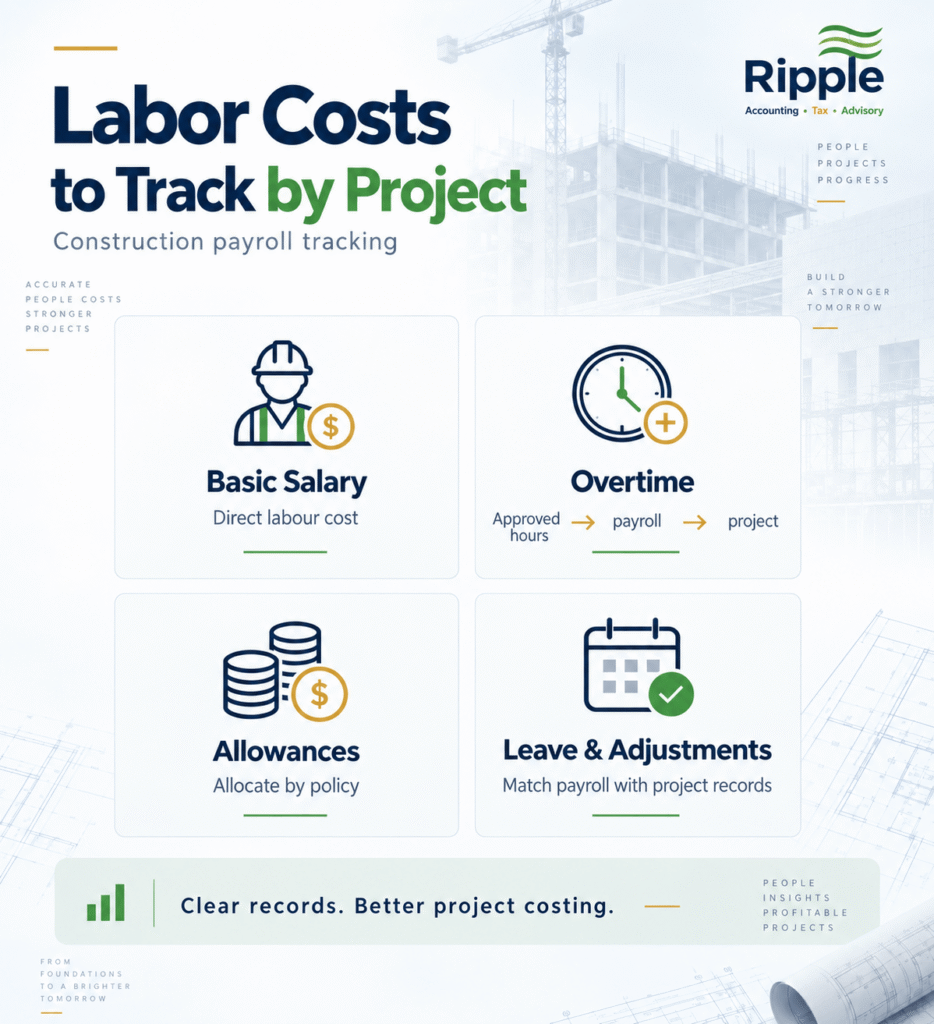
Salary is not always the only labor-related cost management needs to understand. Construction businesses may track several components separately.
Basic salary can form a significant portion of the direct labour cost associated with a project. Where employees work exclusively on one project, allocation may be relatively straightforward.
Overtime can become particularly important when construction deadlines require longer working hours. Companies should retain supporting records for approved overtime and connect those hours to the appropriate employee and, where relevant, project.
For example:
Employee → overtime hours → payroll calculation → project allocation
This creates a clearer audit trail than simply adding overtime to a total payroll figure.
Where applicable, companies may also need to track allowances and determine whether they form part of the project labour cost for internal reporting purposes. The accounting treatment should follow the company’s established policies rather than assuming that every payroll component should automatically be allocated in the same way.
Leave can affect the number of days or hours an employee works on a project during a particular month. Payroll teams should therefore ensure that approved leave information is reflected correctly in payroll calculations and that project allocation records do not contradict payroll data.

A useful way to understand construction payroll is to separate the process into three layers.
This layer focuses on processing employee wages through the applicable WPS arrangements. The Central Bank states that UAEWPS facilitates wage information flows, payment processing and monitoring of wage-payment flows.
This layer contains the company’s detailed payroll information, such as:
This layer connects payroll costs with:
Keeping these layers connected can help construction businesses identify discrepancies earlier.
It is also important to understand that project allocation is an internal accounting and management process; it should not be presented as an additional WPS requirement unless specifically required by the applicable rules.
A practical monthly review can include the following steps:
This creates a process that goes beyond simply asking whether employees were paid. It also helps management understand where the company’s labour costs were incurred.
A consistent allocation method is especially important when workers support multiple projects.
If a worker is assigned exclusively to one project for the entire payroll period, the relevant internal payroll cost may be allocated directly to that project according to the company’s accounting policy.
If an employee moves from one project to another, the company can use documented assignment dates or approved working records to determine the appropriate allocation.
For employees working across several projects, companies may use an approved allocation basis such as:
The chosen method should be reasonable, documented and applied consistently.
Payroll should not only be reviewed when an error is discovered.
Regular review can be useful:
A timely review gives the finance team an opportunity to investigate discrepancies while the supporting records are still available.
Managing payroll across multiple construction sites requires coordination between employee records, salary calculations, attendance information, project assignments and accounting records.
Outsourcing part of the payroll process can help businesses establish a more structured workflow for recurring payroll tasks. The objective should not simply be to calculate salaries, but to maintain reliable payroll records that can be reconciled with the company’s wider financial information.
Ripple Accountants can support UAE businesses with accounting, Payroll Services, bookkeeping, and related compliance requirements, helping businesses maintain more organized financial records as their operations grow.
For construction companies, a structured payroll process can help connect employee payroll information with internal site and project records, making it easier to review labor costs and identify discrepancies between payroll and accounting data.
Businesses looking for support with payroll and related accounting processes can contact Ripple Accountants!
WPS payroll refers to processing employee wage payments through the UAE Wage Protection System. For construction companies, internal payroll records can additionally be organized by site and project to help track labor costs. The WPS itself should not be confused with the company’s internal project-cost allocation system.
Construction companies may benefit from tracking payroll by project because employees can work across different sites and projects. Project-level records can help management understand labor costs and compare actual costs with project budgets.
Project codes are generally an internal management and accounting tool rather than something that should automatically be described as a WPS requirement. Companies should follow the applicable WPS requirements for salary processing while maintaining additional project information internally where needed.
Approved overtime should be recorded with the relevant employee and payroll period. Where overtime relates to a specific construction project, the company can also maintain supporting project records so the corresponding labour cost can be allocated consistently.
Payroll services can help businesses organise recurring payroll processes, employee records, payroll calculations and related reporting. Construction companies can also maintain internal site and project information so payroll costs can be connected with their accounting and project reporting processes.
WPS payroll for construction companies involves more than processing salaries on time. Construction businesses also need reliable internal records showing where employees worked, which projects incurred the labour cost and how overtime, leave and other payroll components were treated. A clear connection between employee → payroll → site → project → accounting records can make monthly reporting easier and help management understand project labour costs. Construction companies can build on this by maintaining consistent internal project-level payroll records and regularly reconciling them with their accounting information.
Disclaimer: This article provides general information about WPS payroll and project-level payroll tracking for UAE construction businesses. It is not legal, tax, accounting or employment advice. WPS requirements and other UAE employment regulations may change, and the appropriate treatment can depend on the company’s circumstances. Businesses should verify current requirements with the relevant UAE authorities or obtain professional advice before making compliance decisions.
Tell us a little about your business and our UAE tax experts will get back to you with clear, practical answers — no obligation.
 Bookkeeping
Enterprise Resource Planning (ERP) systems have become essential tools for modern businesses that want to manage their accounting and finance operations more…
Read article Audit
Audit
Effective financial management depends on more than accurate bookkeeping. Businesses also need strong internal controls to protect their assets, reduce risks, and…
Read article Bookkeeping
Inventory valuation is one of the most important aspects of accounting and inventory management. Every business that buys, manufactures, or sells products…
Read articlePage 40 of 45
Book a free consultation and get clear answers for your business.
0 Comments