Accounting for Trusts and Foundations in the UAE: Complete Guide
Trusts and foundations have become increasingly important tools for wealth preservation, succession planning, asset protection, and charitable activities in the UAE. As…
Read article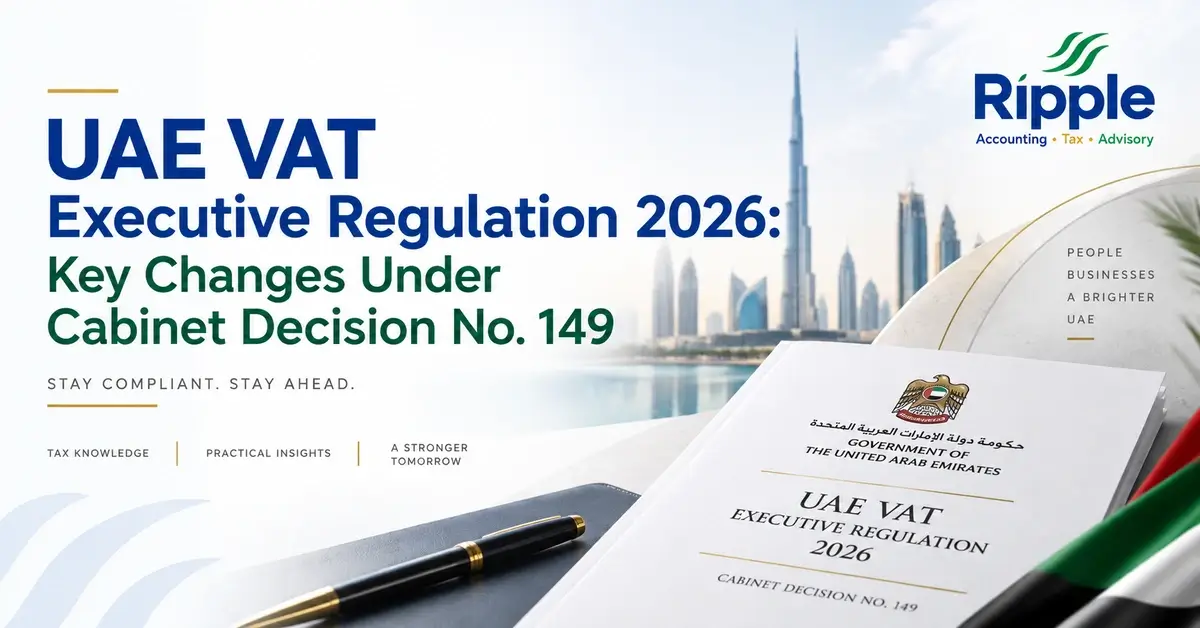
The UAE has introduced important amendments to its VAT framework through Cabinet Decision No. 149 of 2026, changing several provisions of the Executive Regulation of Federal Decree-Law No. 8 of 2017 on Value Added Tax. Most amendments take effect from 1 October 2026, while certain input tax apportionment changes have a later effective date. For UAE businesses, the changes affect areas ranging from composite supplies and employee benefits to cash payments, healthcare, capital assets and input tax recovery.
Read on to understand what changed, when the new rules apply and what your business should review.

It is important to distinguish between the VAT Law and its Executive Regulation. Federal Decree-Law No. 8 of 2017 remains the principal legislation governing VAT in the UAE. Cabinet Decision No. 149 of 2026 does not replace the VAT Law. Instead, it amends specific provisions of Cabinet Decision No. 52 of 2017, which contains the Executive Regulation supporting implementation of the VAT Law.
The decision was issued on 1 September 2026. According to Article 3 of Cabinet Decision No. 149, most amendments become effective from 1 October 2026. The amended input tax apportionment provisions in Article 55 have a separate implementation date: they apply from the first Tax Year commencing after 1 October 2027.
The Ministry of Finance stated that the amendments are intended to improve clarity, facilitate compliance, strengthen transparency and align the UAE VAT framework with evolving economic and legislative developments.
One of the significant changes appears in Article 4, dealing with supplies containing more than one component. A new Clause 6 provides that a taxable person cannot treat the components as separate supplies where the nature and economic substance of the transaction show that the components are interconnected and cannot reasonably be separated. In such circumstances, the transaction is treated as a single composite supply, with the VAT treatment determined by its principal component.
This matters because VAT outcomes can differ substantially depending on whether a transaction is regarded as one supply or several supplies. Businesses offering bundled products, service packages, subscriptions, hospitality arrangements, property-related packages or combined commercial services should therefore review how their contracts and invoices describe the components of a transaction.
The substance of the commercial arrangement may now be particularly important when determining the correct VAT treatment.
A new Clause 3 has been introduced into Article 54 – Special Cases of Input Tax. Under the amendment, input VAT may not be recovered on a supply exceeding an amount specified by the Minister where the consideration is paid, or intended to be paid, in cash, subject to controls set out in the relevant ministerial decision.
This provision is particularly important for businesses that routinely make substantial cash purchases.
However, businesses should avoid assuming a monetary limit that has not yet been prescribed. Cabinet Decision No. 149 itself does not specify the cash-payment threshold. Instead, it provides that the amount and applicable controls will be determined through a decision issued by the Minister.
Businesses should therefore monitor subsequent Ministry of Finance and Federal Tax Authority publications before applying a numerical threshold.
From a compliance perspective, finance teams may wish to review payment methods, procurement procedures, approval controls and supporting documentation for large transactions.
Article 53 deals with non-recoverable input tax, including goods and services provided to employees for their personal benefit.
The amended provision confirms an exception where employee goods or services are mandatory under applicable labour legislation in the UAE or in a financial or non-financial free zone. Importantly, employee accommodation is specifically addressed.
Accommodation provided by an employer is not automatically covered by this exception. The amended provision states that employer-provided accommodation is included only where providing that accommodation is mandatory pursuant to decisions or directives issued by the Ministry of Human Resources and Emiratisation.
The regulation also refers separately to goods or services provided under a contractual obligation or documented policy, subject to cases and conditions specified by the Federal Tax Authority.
Employers should therefore avoid assuming that VAT on all staff accommodation or employee benefits is recoverable simply because the cost relates to employees. The precise facts, legal requirement, documentation and purpose of the expense remain important.
The changes to Article 55 are among the most significant amendments for businesses that make a mixture of taxable and other supplies.
Under the amended methodology, the recoverable portion of residual input tax will generally be determined using the value of relevant supplies compared with the total value of supplies. Certain amounts, including supplies of capital assets and specified transactions involving concerned goods and concerned services, are excluded from the calculation.
The resulting percentage is rounded to the nearest whole number and then applied to the relevant residual input tax.
This represents an important change from the existing standard methodology, which is based on the proportion of recoverable input tax to the combined recoverable and non-recoverable input tax for the relevant period.
The Ministry of Finance explained that the revised approach is intended to better reflect the economic activities of taxable persons. Government entities and charities will continue to use a distinct methodology set out in the newly added Clause 19.
This is an important timing point. Although most provisions of Cabinet Decision No. 149 apply from 1 October 2026, the amendments to Clauses 6 and 7 of Article 55 and the newly introduced Clause 19 apply from the first Tax Year commencing after 1 October 2027.
Businesses making both taxable and exempt supplies therefore have additional time to assess the operational impact, but they should not leave system changes and modelling until the last moment.
Banks, financial businesses, property businesses and other organisations with material residual input tax may be particularly interested in modelling how the new method could affect their recoverable VAT position.
The amendment also changes Article 41, dealing with zero-rated healthcare services. The revised Clause 4 provides for zero-rating of the supply or import of medical products specified in a Cabinet decision. It also covers other goods supplied as part of providing zero-rated healthcare services where those goods are necessary for those healthcare services.
The Ministry of Finance explained that these amendments update the treatment of medical products in line with the UAE’s updated healthcare legislative framework. Healthcare providers, pharmacies, distributors and medical-product businesses should therefore review product classifications rather than assuming that every healthcare-related product qualifies automatically for zero-rating. The applicable Cabinet decisions and the specific nature of the product remain relevant.
The amendment to Article 57 clarifies the assets falling within the UAE VAT Capital Assets Scheme. A Capital Asset is defined for these purposes as a business asset costing AED 5 million or more, excluding VAT, on which VAT is payable and which has an estimated useful life of at least:
| Type of asset | Minimum estimated useful life |
| Building or part of a building | 10 years |
| Other Capital Assets | 5 years |
The regulation separately confirms that inventory held for resale is not treated as a Capital Asset for this purpose.
The Capital Assets Scheme can require VAT recovery adjustments over several years where the use of an asset changes. Accurate classification and maintenance of the Capital Asset register are therefore important for businesses making substantial property, machinery, infrastructure or other long-term investments.
The Ministry of Finance specifically described this amendment as a clarification designed to align the application of the Capital Assets Scheme with the VAT Law.
The amendments also affect Article 29, which governs the Profit Margin Scheme. For purposes of calculating the profit margin, the amended definition of the purchase price includes not only the amount paid for the relevant goods but also costs or fees incurred in purchasing them, provided input VAT on those costs or fees is not recoverable under the VAT Law.
This may be relevant to dealers in second-hand goods, antiques and collectors’ items using the Profit Margin Scheme.
Businesses applying the scheme should ensure that their accounting systems consistently identify which acquisition-related costs form part of the purchase price and whether VAT on those costs was recoverable.
Clause 2 of Article 52 has also been amended. For the relevant input tax recovery rules concerning exempt financial services, a person may be considered outside the State where their presence in the UAE is for less than 30 days and that presence is not effectively connected with the supply.
This provision is relatively technical, but it may be significant for financial services businesses dealing with overseas recipients whose representatives, employees or other personnel have a temporary presence in the UAE.
The factual connection between that UAE presence and the service being supplied should therefore be carefully assessed.
The decision also amends Article 60 relating to Tax Credit Notes. Under the amended provision, a Tax Credit Note must clearly display the words “Tax Credit Note.” Other existing information requirements under Article 60 continue to govern the contents of credit notes.
Businesses should use the amendment as an opportunity to check their ERP, accounting and invoicing templates to ensure tax credit notes meet the prescribed UAE VAT requirements.

Businesses should treat Cabinet Decision No. 149 as more than an accounting update. Depending on the organisation, the amendments may affect procurement, payment policies, employee benefits, contract drafting, VAT coding, ERP configuration and input tax recovery calculations.
A practical compliance review should consider whether bundled transactions have been classified correctly, whether significant purchases are being settled in cash, whether VAT recovered on employee-related costs is properly supported, whether Capital Assets are correctly tracked, and whether businesses with mixed supplies are prepared for the future apportionment methodology.
Businesses should also continue monitoring new Ministerial and FTA decisions, particularly regarding the cash-payment threshold, because Cabinet Decision No. 149 leaves that amount to a separate Ministerial decision.
The FTA’s VAT legislation page should be monitored for new decisions, clarifications and updated regulations.
Ripple Accountants supports UAE businesses with practical accounting, tax and compliance services. Its services include accounting and bookkeeping, financial reporting, budgeting and forecasting, account reconciliation, VAT registration and filing, Corporate Tax support, compliance reviews and audit support.
Ripple helps businesses maintain accurate financial records, meet tax and regulatory requirements, and improve financial visibility. Whether you need ongoing support with a specific accounting, Contact Ripple Accountants for a UAE VAT compliance review tailored to your transactions and business activities!
Most provisions become effective on 1 October 2026. However, the amended input tax apportionment provisions under Clauses 6 and 7 of Article 55 and the new Clause 19 apply from the first Tax Year commencing after 1 October 2027.
No. It amends certain provisions of the Executive Regulation of Federal Decree-Law No. 8 of 2017 on VAT. The VAT Law itself remains separate from its Executive Regulation.
Input VAT may be restricted where the value of a supply exceeds a threshold prescribed by the Minister and the consideration is paid or intended to be paid in cash. Cabinet Decision No. 149 itself does not state the monetary threshold.
Not automatically. The amended rule specifically states that employer-provided accommodation is not included in the relevant labour-law exception unless providing that accommodation is mandatory under decisions or directives issued by MOHRE. The circumstances of each expense should therefore be reviewed.
For the Capital Assets Scheme, a qualifying business asset must generally cost AED 5 million or more excluding VAT, with the prescribed minimum useful life and other applicable conditions.
No. The changes are particularly relevant where a taxable person incurs input VAT that relates partly to supplies giving a right to recovery and partly to other supplies or activities. Businesses whose input VAT is entirely attributable to taxable activities may have less exposure to the apportionment rules.
The UAE VAT Executive Regulation 2026 amendments represent a significant refinement of the country’s VAT framework rather than a wholesale replacement of existing VAT legislation. Cabinet Decision No. 149 introduces or clarifies rules on single composite supplies, cash payments, employee benefits, healthcare products, the Profit Margin Scheme, Capital Assets, Tax Credit Notes and input tax recovery. The revised input tax apportionment methodology is especially important because businesses have a longer implementation period and should use that time to evaluate the potential financial and systems impact. With most amendments effective from 1 October 2026, UAE businesses should review transactions and accounting policies early and monitor further Ministry of Finance and Federal Tax Authority guidance.
Disclaimer: This article is provided for general informational purposes only and does not constitute tax, accounting or legal advice. VAT treatment depends on the specific facts, contractual arrangements and circumstances of each transaction. The legislation and guidance may also be amended or supplemented after publication. Businesses should refer to the official legislation published by the UAE Ministry of Finance, Federal Tax Authority and Official Gazette and obtain professional advice before taking or refraining from any action.
Tell us a little about your business and our UAE tax experts will get back to you with clear, practical answers — no obligation.
 Bookkeeping
Trusts and foundations have become increasingly important tools for wealth preservation, succession planning, asset protection, and charitable activities in the UAE. As…
Read article Audit
Audit
Introduction Fraud can affect businesses of any size, leading to financial losses, damaged reputations, and compliance issues. A strong fraud prevention strategy…
Read article Compliance
Introduction Choosing the right accounting standards is essential for every business operating in the UAE. Financial statements prepared under the correct framework…
Read articlePage 35 of 45
Book a free consultation and get clear answers for your business.
0 Comments