The Cost of Poor Bookkeeping: Hidden Expenses for SMEs
Bookkeeping is one of the most important functions in any business, yet it is often overlooked by small and medium-sized enterprises (SMEs).…
Read article
Who in your business can see employee salaries, bank details, deductions and other payroll records and does everyone with access actually need to see them?
Payroll data privacy UAE is an important consideration for employers handling employee salaries, bank details, deductions and other payroll records. Businesses need to manage this information carefully while considering UAE data-protection requirements and employee confidentiality when collecting, storing, processing and sharing payroll data. The UAE Personal Data Protection Law provides a framework for protecting personal data and maintaining its confidentiality, while the UAE Labor Law requires workers to maintain the confidentiality of information and data they access through their work.
Let’s look at the practical payroll access controls UAE employers can use to protect sensitive employee information!

Payroll data privacy refers to the way an employer collects, uses, stores, shares and protects information connected with employee compensation and payroll administration. Depending on the business and payroll process, payroll records may contain:
Not every employee, manager or administrator needs access to all of this information. A sensible payroll-control system therefore combines data privacy with role-based access. Employees should generally have access only to the information required to perform their assigned responsibilities.
The UAE’s Federal Decree-Law No. 45 of 2021 Regarding the Protection of Personal Data establishes an integrated framework for personal-data protection. The UAE Government explains that the law covers the processing of personal data and establishes controls and obligations relating to the protection, confidentiality and privacy of personal data.
The official UAE Legislation platform provides the full text of Federal Decree by Law No. 45 of 2021 Concerning the Protection of Personal Data. The legislation came into force on 2 January 2022.
The UAE Labour Law is also relevant to employee confidentiality. Article 16 of Federal Decree-Law No. 33 of 2021 requires workers to maintain the confidentiality of information and data accessed through their work and not disclose work secrets.
Employers should assess the specific legal requirements applicable to their business, including whether another data-protection framework applies because of the company’s location, activities or sector.
Payroll systems commonly contain employee names, identification numbers and employment-related information. Access to these records should be limited to people who need the information for legitimate payroll, HR, accounting, compliance or management responsibilities.
For example, a payroll administrator may need access to employee records to process salaries, while a department manager may only need limited information relevant to approving attendance or overtime.
Salary information is particularly sensitive within an organisation. Payroll records may show:
Employers should avoid giving broad payroll-system access simply because someone works in HR, finance or administration. Instead, access should be linked to the person’s actual responsibilities.
Payroll processes may also involve employee bank-account or salary-payment information. Businesses should protect these details from unnecessary access and avoid distributing complete bank information through unsecured spreadsheets, messaging applications or uncontrolled email attachments. Where payroll information must be shared, employers should use approved business systems and limit the information included to what the recipient actually needs.
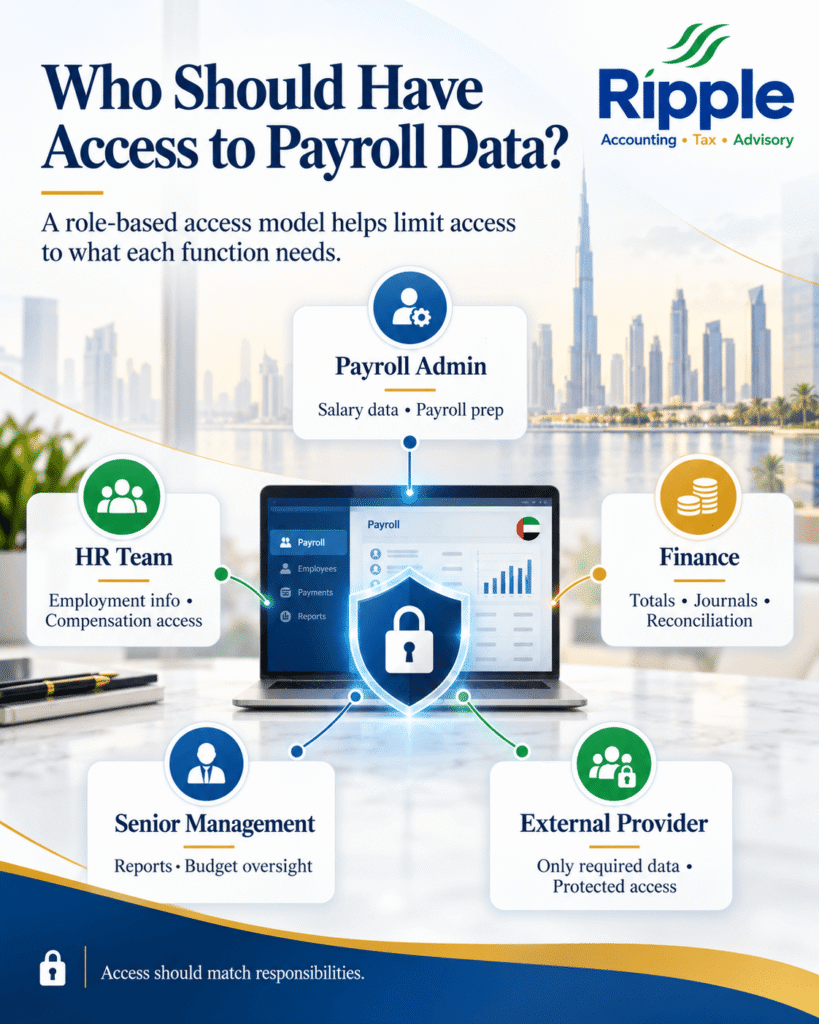
There is no single access structure that applies to every UAE employer. The appropriate model depends on the organisation’s size, payroll process and responsibilities.
However, a role-based access model can help.
Contracts, responsibilities, access rights and data-handling arrangements should be reviewed as part of the outsourcing process.
The first step is to define who needs access to payroll information. Instead of giving everyone the same permissions, create different access levels.
For example:
| Role | Possible Access |
| Payroll administrator | Employee payroll records and payroll processing |
| HR administrator | Relevant employment and compensation records |
| Accountant | Payroll totals, accounting records and reconciliation information |
| Manager | Limited team information needed for approvals |
| Senior management | Approved reports and management-level payroll information |
| IT administrator | System administration without unnecessary access to payroll content |
These are examples rather than mandatory UAE access categories. Each business should design access around its actual responsibilities.
Payroll systems should be protected with appropriate authentication controls. Businesses should consider:
A shared payroll password makes it difficult to determine who accessed or changed information. Individual accounts create a clearer accountability trail.
Access should not remain unchanged indefinitely. An employee who changes departments may no longer need the same payroll permissions. Similarly, temporary access given for a specific project should not become permanent without review. A business can conduct periodic access reviews by asking:
This can form part of a monthly, quarterly or other risk-based review process.
When an employee leaves the business, access to payroll systems, shared folders and payroll-related applications should be reviewed and removed as appropriate. This should be included in the company’s employee offboarding checklist. The same principle applies when an external payroll provider, consultant or temporary administrator no longer works on the account.
Where the payroll system supports it, employers should maintain logs showing relevant user activity. Access logs can help answer questions such as:
Logs can be particularly useful when investigating an unexpected payroll adjustment or suspected unauthorised access.
Many SMEs still use Excel or similar spreadsheets for payroll calculations. Spreadsheets can be useful, but they can also create privacy risks when multiple uncontrolled copies exist. Employers should avoid situations where payroll files are:
A central, controlled storage location can make it easier to manage permissions and identify the current payroll file.
Payroll information should not be sent to a large group simply because everyone is involved in the payroll process. Before sending a payroll report, check:
For example, a department manager may need to approve overtime amounts without needing access to the complete salary information of every employee.

A practical payroll privacy checklist can include the following:
Giving Everyone Full Payroll Access: A small business may give all finance or HR employees full access because it seems easier. However, broad access increases the number of people who can view sensitive information.
Their access and data-handling arrangements should therefore be considered when designing the company’s payroll privacy controls.
Payroll privacy is not only an IT issue. It connects with HR administration, payroll processing, accounting controls and financial reporting.
For example, a controlled payroll process can help a business maintain a clear trail from:
Employee record → Payroll calculation → Approval → Salary payment → Accounting entry → Payroll report
This makes it easier to identify who was responsible for each stage and where a correction may be required. For UAE SMEs, this approach can also reduce unnecessary circulation of sensitive payroll information while maintaining the records required for normal business operations.
Ripple Accounting, Tax & Advisory provides accounting and business support services to UAE businesses, including payroll services, accounting and bookkeeping, financial reporting, budgeting and forecasting, VAT and Corporate Tax support, audit support and compliance review.
For payroll-related requirements, Ripple can help businesses review payroll processes, supporting records, reconciliation procedures and administrative controls. Where payroll information feeds into the company’s financial records, accounting and reporting processes can also be reviewed to ensure that payroll data is properly reflected in the wider financial workflow.
If your business is reviewing who can access payroll records or wants a more structured payroll-control process, contact Ripple Accounting, Tax & Advisory for a tailored payroll and compliance review.
Payroll data privacy refers to protecting employee information used during payroll processing, including salary details, bank information, deductions, allowances, employment records and other personal information. The UAE Personal Data Protection Law establishes a framework for protecting personal data and maintaining its confidentiality.
Access should generally be limited to employees, administrators and service providers who need specific information to perform their authorized responsibilities. The exact access structure depends on the organization’s payroll process and internal responsibilities.
Payroll access controls are procedures and technical measures used to determine who can view, modify or administer payroll information. Examples include role-based permissions, individual accounts, strong authentication, access reviews and removal of unnecessary access.
Yes. Article 16 of Federal Decree-Law No. 33 of 2021 requires workers to maintain the confidentiality of information and data they access through their work and not disclose work secrets.
SMEs can start by identifying all payroll information they hold, listing who currently has access, removing unnecessary permissions, using individual accounts, securing payroll files, reviewing third-party access and establishing a regular access-review process.
Payroll data contains information that employees and businesses need to keep appropriately protected. UAE employers can reduce unnecessary exposure by limiting access according to job responsibilities, using individual accounts, reviewing permissions, protecting payroll files and maintaining appropriate records of system activity. A practical payroll privacy process should cover the entire information lifecycle—from collecting employee information and preparing payroll to approving payments, maintaining accounting records and removing access when responsibilities change.
Disclaimer: This article provides general information for UAE employers and is not legal, employment, cybersecurity or data-protection advice. Data-protection requirements can depend on the nature, location and activities of a business, and certain UAE free zones and sectors may have separate regulatory frameworks. Employers should review the legislation applicable to their circumstances and obtain professional advice where required. The official UAE Government and UAE Legislation platforms should be checked for current laws and amendments.
Tell us a little about your business and our UAE tax experts will get back to you with clear, practical answers — no obligation.
 Bookkeeping
Bookkeeping is one of the most important functions in any business, yet it is often overlooked by small and medium-sized enterprises (SMEs).…
Read article Compliance
Businesses today generate more financial and operational data than ever before. Every invoice, payment, approval, and customer transaction creates valuable information that…
Read article Compliance
Lease accounting has become one of the most important areas of financial reporting for businesses that rent offices, warehouses, vehicles, machinery, or…
Read articlePage 45 of 45
Book a free consultation and get clear answers for your business.
0 Comments