Statutory Audit vs Audit Support in the UAE: Understanding the Scope and Key Differences
Does your UAE business need a statutory audit or audit support? Knowing the difference between Statutory Audit vs Audit Support UAE services…
Read article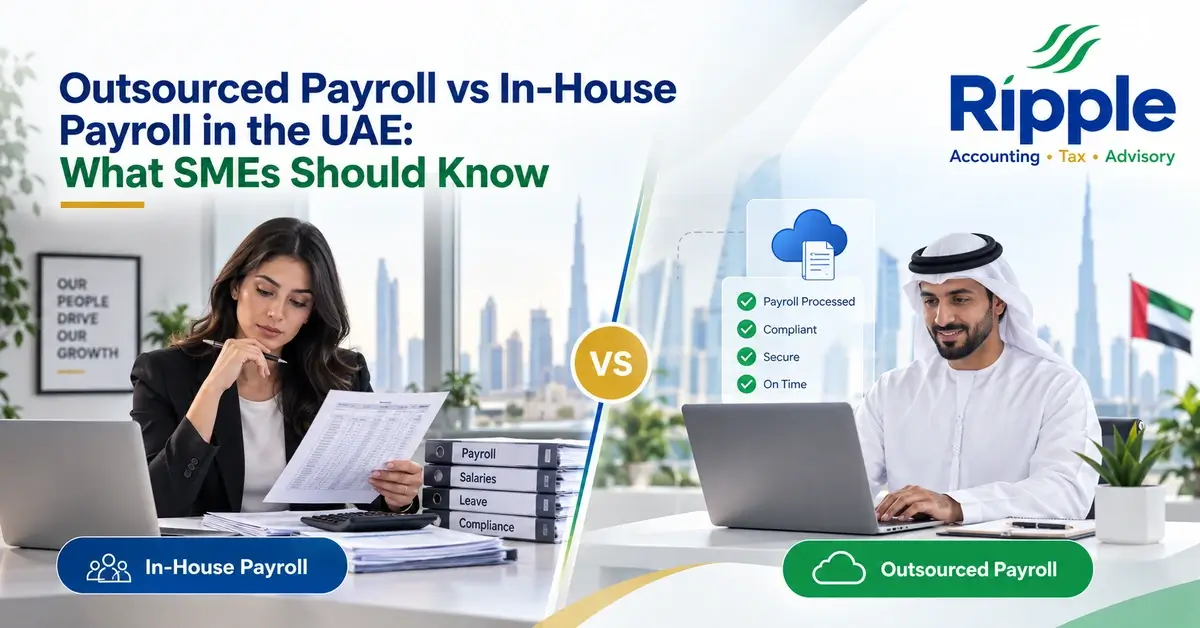
Could your UAE business manage payroll more efficiently in-house, or would outsourcing give your finance team more time and control?
For UAE SMEs, payroll is more than calculating monthly salaries. It can involve employee records, allowances, deductions, leave information, payroll reports, payment processing, and Wage Protection System (WPS) requirements. Businesses therefore need to decide whether payroll should be handled by an internal employee or an external payroll provider. The right choice between outsourced payroll vs in-house UAE options depends on factors such as employee numbers, internal expertise, payroll complexity, technology, cost, and the level of support required.
Before choosing an approach, it helps to compare how each model works, what it costs, and what responsibilities remain with the business.

In-house payroll means the company manages its payroll activities internally. A business may assign payroll responsibilities to an accountant, finance officer, HR employee or dedicated payroll specialist.
Depending on the organisation, the internal team may be responsible for:
The exact responsibilities depend on the company’s internal structure and the systems it uses.
For a small company with straightforward payroll, these tasks may be manageable alongside other accounting or HR responsibilities. As the workforce grows, however, payroll can become more time-consuming and require stronger controls.

Outsourced payroll means the business engages an external accounting or payroll service provider to manage some or all payroll-related activities.
The provider may handle activities such as:
The exact scope depends on the agreement between the business and the service provider.
Outsourcing does not mean the business gives up responsibility for its employees or employment obligations. Instead, it transfers agreed administrative and processing activities to a specialist provider while management retains oversight.
Outsourced payroll vs in-house Payroll decisions should be considered alongside the company’s wider compliance responsibilities.
The UAE Ministry of Human Resources and Emiratisation (MoHRE) states that establishments registered with the Ministry are required to pay employee wages on their due dates. The Wage Protection System enables wages to be paid electronically through authorised financial institutions.
The Ministry also explains that WPS is designed to monitor wage payments and help ensure workers receive their agreed wages on time.
This means payroll is not simply an internal administrative exercise. Businesses need processes that support accurate salary calculations, timely payments and appropriate records.
For current WPS requirements, businesses should refer to the applicable MoHRE rules and guidance rather than relying solely on an internal payroll checklist.
The two approaches can be compared across several practical areas.
| Factor | In-House Payroll | Outsourced Payroll |
| Payroll control | Managed directly by the business | Shared through agreed processes |
| Internal workload | Higher | Lower |
| Specialist support | Depends on internal staff | Available through provider |
| Employee data | Maintained internally | Shared with authorised provider |
| Technology | Business must provide/manage systems | Provider may provide payroll systems |
| Scalability | May require additional staff | Can often scale with workforce |
| Cost structure | Salaries, software and training | Service fees based on agreed scope |
| Continuity | Dependent on internal staff availability | Provider-based continuity |
| Management involvement | More internal administration | More oversight and review |
| Customisation | High internal control | Depends on provider’s systems |
Neither model is automatically suitable for every UAE SME. The decision should be based on the company’s actual payroll requirements.
Therefore, businesses should compare the total payroll administration cost, not simply the external provider’s monthly fee.
The exact workflow should be agreed in advance.
A proper comparison should therefore look at the full annual cost, not just the advertised monthly price.
Cost is often the deciding factor for SMEs, but payroll cost should be assessed more broadly.
A business should consider:
Businesses should consider:
For example, a company with a small workforce may find internal payroll manageable because its existing finance employee can process salaries alongside other accounting tasks.
Another company with multiple employees, frequent staff changes or a more complicated payroll structure may need to compare the cost of additional internal resources with an external payroll service.
Outsourcing may become worth evaluating when:
This does not mean every business should outsource. A company with a small workforce and experienced internal finance staff may prefer to retain payroll in-house.
Keeping payroll internally may be appropriate when:
The key question is whether payroll can be managed reliably without taking attention away from more important financial responsibilities.
Before making a decision, UAE SMEs can assess the following questions:
A growing workforce may require more administrative capacity.
Consider commissions, allowances, overtime, leave, deductions, employee changes and other variables.
If payroll depends entirely on one employee, consider what happens during absence or resignation.
Compare employee, software and administration costs against the complete outsourcing fee.
Some businesses need only payroll processing, while others may require payroll accounting, reporting and ongoing administrative support.
Review confidentiality, access controls and data-handling procedures before sharing employee information.
A clear process should establish who prepares, reviews and approves payroll.
Consider how the payroll process will work if the company doubles its workforce.
Managing payroll internally can become difficult when finance teams are also responsible for bookkeeping, reconciliations, tax compliance and financial reporting.
Ripple Accountants provides payroll services for UAE businesses, including salary calculations, employee payment records and monthly payroll reporting. Businesses can discuss their current payroll process with Ripple Accountants and assess whether selected payroll activities should remain in-house or be handled externally.
Want to compare the cost and workload of in-house and outsourced payroll for your UAE business? Contact Ripple Accountants for a tailored assessment.
You can also review Ripple’s Payroll Services to understand the available support.
There is no single option that is suitable for every business. The appropriate model depends on employee numbers, payroll complexity, internal expertise, cost, technology and the level of external support required.
It can be suitable for SMEs that want to reduce internal payroll administration or do not have dedicated payroll expertise. The business should compare the provider’s complete service cost with its internal payroll costs before deciding.
No. Outsourcing payroll processing does not automatically transfer the employer’s underlying responsibilities. Businesses should understand their obligations and maintain appropriate oversight of payroll and wage payments.
Businesses should review the provider’s scope of services, pricing, payroll processing procedures, reporting, data-security arrangements, responsibilities, deadlines and support for payroll changes or corrections.
Yes. Payroll information can form part of the wider accounting process. Salary expenses, employee-related costs and payroll liabilities should be appropriately reflected and reconciled within the company’s accounting records.
The decision between outsourced payroll vs in-house payroll in the UAE depends on the company’s workforce, internal resources, payroll complexity and total cost of administration. In-house payroll provides direct control and may work well for SMEs with straightforward payroll and capable finance staff. Outsourcing can reduce administrative workload and provide access to specialised payroll support, particularly as a business grows. Rather than choosing based only on the monthly price, businesses should compare the complete cost, responsibilities, controls, technology, scalability and support offered under each model.
Disclaimer: This article is provided for general informational and educational purposes only. It does not constitute legal, tax, accounting, employment or financial advice. UAE payroll and employment requirements may depend on the nature of the employer, employees and applicable regulations. Businesses should verify current requirements with the relevant UAE authorities and obtain professional advice based on their specific circumstances.
Tell us a little about your business and our UAE tax experts will get back to you with clear, practical answers — no obligation.
 Audit
Audit
Does your UAE business need a statutory audit or audit support? Knowing the difference between Statutory Audit vs Audit Support UAE services…
Read article Bookkeeping
Are your bank statements showing a different balance from your accounting records? For UAE businesses, even small differences can indicate missing transactions,…
Read article Corporate Tax
For UAE businesses, missing the UAE Corporate Tax return deadline can create unnecessary compliance risks, especially when financial records, tax adjustments and…
Read articlePage 10 of 45
Book a free consultation and get clear answers for your business.
0 Comments