Outsourced Accounting Fees UAE: What Determines the Monthly Cost?
M Maria August 28, 2026 11 min read
How much should a UAE SME actually pay for outsourced accounting, and why can two businesses receive completely different monthly quotes?
Accounting costs in the UAE can differ significantly between businesses. One provider may charge AED 1,000 per month, while another may quote AED 3,000 or more. The difference depends on factors such as transaction volume, VAT requirements, payroll, inventory, reporting needs, accounting software, and business complexity.
Understanding outsourced accounting fees UAE helps SMEs compare providers based on the services included rather than price alone. A low-cost package may exclude important services, while a higher-priced package could offer more comprehensive support and better value for a growing business.
How Much Does Outsourced Accounting Cost in the UAE?
There is no single fixed price for outsourced accounting in the UAE. Accounting firms usually determine their fees according to the volume and complexity of work required. As an indicative market benchmark, basic bookkeeping arrangements may start from around AED 500–1,500 per month, while more comprehensive SME accounting packages can range from approximately AED 1,500–5,000+ per month. Businesses with high transaction volumes, inventory, multiple entities, payroll, multiple currencies, or extensive reporting requirements may pay more.
These figures should be treated as indicative ranges rather than official UAE pricing. The final fee depends on the scope agreed between the business and accounting provider.
For example:
A small consultancy with one bank account and limited monthly transactions may need only basic bookkeeping and reconciliation.
A trading company may require inventory accounting, supplier reconciliation, VAT support and multiple bank reconciliations.
A growing company may also require payroll, management accounts, cash-flow reporting and Corporate Tax support.
Therefore, comparing accounting fees UAE businesses pay requires looking at what is included in the package, rather than comparing the monthly price alone.
What Does Outsourced Accounting Usually Include?
Outsourced accounting means hiring an external accounting professional or firm to perform some or all of the company’s accounting activities instead of employing a full-time internal accounting team.
Depending on the package, services may include:
Recording sales and purchase transactions
Bank reconciliation
Accounts payable and receivable
General ledger maintenance
VAT-related accounting support
Payroll accounting
WPS-related reconciliation
Monthly management accounts
Financial statements
Cash-flow reporting
Budgeting and forecasting
Corporate Tax accounting support
Year-end accounting assistance
A basic bookkeeping package will normally have a narrower scope than a complete outsourced accounting arrangement.
This distinction is important because outsourced accounting UAE providers may use different definitions for their packages. Always ask for a written breakdown of the services included.
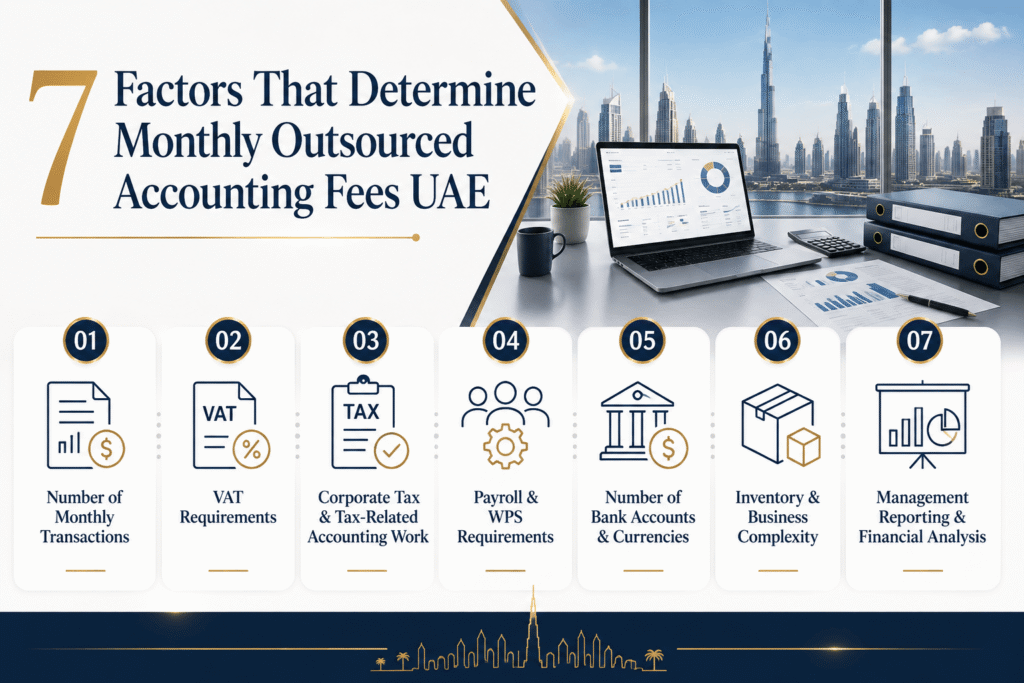
7 Factors That Determine Monthly Outsourced Accounting Fees UAE
1. Number of Monthly Transactions
Transaction volume is one of the most important factors affecting monthly bookkeeping cost UAE businesses incur.
A company processing 50 transactions a month requires considerably less bookkeeping work than a business processing 2,000 transactions.
Transactions may include:
Customer invoices
Supplier bills
Bank transactions
Credit-card transactions
Expense claims
Payment gateway transactions
Journal entries
Refunds and adjustments
For this reason, some providers offer different pricing tiers based on transaction volume.
Example: A small consulting company may issue 20 invoices and have 40 bank transactions each month. A retail business could process hundreds of sales and purchases every week. Even if both businesses are legally registered in the UAE, their accounting workload can be very different.
2. VAT Requirements
VAT can also affect accounting costs. Businesses registered for VAT need appropriate records and may require assistance with VAT calculations, reconciliations, and return preparation.
The UAE Federal Tax Authority states that mandatory VAT registration generally applies when taxable supplies and imports exceed the relevant AED 375,000 threshold, subject to the applicable rules.
Businesses may therefore need their accounting provider to handle:
VAT transaction classification
Input VAT reconciliation
Output VAT reconciliation
VAT control accounts
VAT return preparation
Supporting schedules
Record maintenance
If VAT filing is included in a package, the monthly fee may be higher than a basic bookkeeping-only arrangement.
Businesses should also remember that accounting records should be maintained properly throughout the year rather than reconstructed only when a VAT return becomes due.
3. Corporate Tax and Tax-Related Accounting Work
The introduction of UAE Corporate Tax has increased the importance of maintaining accurate accounting records. For businesses subject to UAE Corporate Tax, accounting data provides the foundation for determining taxable income and preparing the required tax information.
Depending on the engagement, an accounting provider may assist with:
Maintaining accounting records
Reviewing income and expenses
Preparing financial statements
Identifying accounting adjustments
Maintaining supporting schedules
Coordinating information required for Corporate Tax compliance
However, businesses should distinguish between accounting support and specialist tax advisory services. A low-cost bookkeeping package may not automatically include Corporate Tax return preparation or tax consulting.
This is another reason why comparing accounting services cost UAE businesses face should always involve checking the scope of work.
4. Payroll and WPS Requirements
Payroll adds another layer of accounting work. A business with employees may need monthly support for:
Salary calculations
Payroll journals
Employee deductions
Salary reconciliation
Leave and other payroll adjustments
End-of-service calculations
WPS-related records
For a business with five employees, payroll processing may be relatively straightforward. A company with 100 employees and variable salaries, allowances, and deductions will require considerably more work.
If payroll is not included in the quoted accounting fee, it may be charged separately.
Therefore, UAE businesses should ask:
“Does the monthly accounting fee include payroll and WPS reconciliation, or are these separate services?”
This simple question can prevent unexpected costs.
5. Number of Bank Accounts and Currencies
Bank reconciliation is a fundamental accounting task, but its workload depends on the number of accounts. A company operating one AED bank account is relatively simple to reconcile. A business with several UAE bank accounts, credit cards, and foreign-currency accounts requires more reconciliation work.
For example, an international trading company may have:
AED bank account
USD bank account
EUR bank account
Corporate credit card
Payment gateway accounts
Each account may require regular reconciliation.
Foreign-currency transactions can also create additional accounting considerations because exchange rates and foreign-exchange differences need to be appropriately recorded.
As a result, businesses should not assume that the fee for a one-bank-account company will apply to a multi-account business.
6. Inventory and Business Complexity
Not all businesses have the same accounting requirements. A professional services company may have relatively straightforward accounting because it primarily sells services.
A trading or e-commerce business may have much more complex records involving:
Inventory purchases
Stock movements
Cost of goods sold
Supplier balances
Customer returns
Discounts
Shipping costs
Payment gateway settlements
Inventory adjustments
The accounting provider may therefore charge more for businesses requiring inventory management and reconciliation. Similarly, construction, real estate, healthcare, hospitality and other specialized sectors may require additional accounting procedures.
The more complex the underlying business model, the more important it becomes to evaluate value and scope rather than simply looking for the cheapest bookkeeping fees UAE providers advertise.
7. Management Reporting and Financial Analysis
There is a major difference between bookkeeping and management accounting. Bookkeeping primarily focuses on recording and organizing financial transactions.
Management reporting goes further by helping business owners understand what those numbers mean. A more comprehensive accounting package may include:
Monthly profit and loss statement
Balance sheet
Cash-flow statement
Accounts receivable aging
Accounts payable aging
Budget vs actual analysis
KPI reporting
Gross-margin analysis
Management commentary
For example, a bookkeeping service may tell you that your business generated AED 500,000 in revenue.
A management reporting service can help you understand:
Which products generated the highest margins?
Why did operating expenses increase?
Which customers owe money?
How much cash is expected next month?
Is the business meeting its budget?
This additional analysis can increase outsourced accounting fees, but it can also provide substantially more business value.
Outsourced Accounting vs. Hiring an In-House Accountant
Cost is one of the main reasons SMEs consider outsourcing accounting. An in-house accountant can provide direct access to financial information, but the total employment cost may include:
Salary
Recruitment costs
Visa and employment-related costs
Leave and benefits
Software
Training
Office resources
Management time
Outsourcing can allow a business to access accounting expertise without maintaining a full internal accounting department.
However, outsourcing is not automatically cheaper in every situation. The right choice depends on transaction volume, business complexity, and the level of financial support required.
For many small and growing UAE businesses, outsourcing can provide a flexible way to obtain professional accounting support while keeping internal staffing requirements manageable.
What Should a Good Monthly Accounting Package Include?
Before agreeing to a monthly fee, ask the provider for a clear scope of work.
A useful accounting package may include:
Service
What to Check
Bookkeeping
Number of transactions included
Bank reconciliation
Number of accounts covered
VAT
Preparation and filing included?
Payroll
Number of employees covered
WPS
Reconciliation included?
Reporting
Monthly financial statements included?
Corporate Tax
Accounting support or tax filing?
Accounts receivable
Included or separate?
Accounts payable
Included or separate?
Year-end accounts
Included or additional fee?
This makes it easier to compare two quotations fairly.
For example, Provider A may quote AED 1,200 per month but include only bookkeeping. Provider B may quote AED 2,000 but include bookkeeping, VAT, payroll and monthly management accounts.
The second package may actually offer better value.
Watch Out for Hidden Accounting Costs
A low monthly quotation can sometimes exclude important services. Before signing an agreement, ask about:
Setup fees: Some providers charge an initial onboarding or accounting-system setup fee.
Historical bookkeeping: If your previous records are incomplete, cleaning up six or twelve months of transactions may be charged separately.
VAT filing: Confirm whether VAT return preparation is included in the monthly fee.
Corporate Tax support: Ask whether Corporate Tax-related accounting support is included or charged separately.
Year-end accounts: Some monthly packages cover bookkeeping but exclude year-end financial statements.
Additional transactions: Check what happens if your monthly transaction volume exceeds the agreed limit.
Payroll: Find out whether payroll and WPS-related support are included.
Understanding these potential additional charges makes it easier to calculate the true monthly bookkeeping cost UAE businesses should expect.
How to Compare Two UAE Accounting Quotes
Don’t compare quotations based only on the final AED figure.
Instead, create a simple comparison based on:
Price + Services Included + Transaction Limit + Reporting + Tax Support + Additional Charges
Provider B: AED 1,800/month Bookkeeping, bank reconciliation, VAT, payroll and monthly financial reports.
Provider B costs AED 800 more each month, but the business may avoid several separate charges.
The best accounting service is therefore not necessarily the cheapest one. It is the service that provides the right level of support for the company’s actual requirements.
When Should a UAE SME Outsource Accounting?
Outsourcing may make sense when:
The business does not need a full-time accountant.
The owner spends too much time handling financial records.
Accounting records are falling behind.
VAT compliance is becoming difficult to manage.
The company is growing rapidly.
Management needs regular financial reports.
There are multiple bank accounts.
Payroll is becoming more complex.
The business needs better cash-flow visibility.
A growing company may start with basic bookkeeping and gradually move toward a more comprehensive accounting package as its financial requirements increase.
How Ripple Accountant Can Help UAE Businesses
Ripple Accountant can support UAE businesses with outsourced accounting and bookkeeping requirements based on their business size, transaction volume, and reporting needs. The service can help businesses maintain organized accounting records, reconcile financial transactions, prepare regular financial reports, and support ongoing VAT and Corporate Tax-related accounting requirements.
1. How much does outsourced accounting cost in the UAE?
Indicative market pricing can range from approximately AED 500 to AED 5,000+ per month, depending on the business’s transaction volume, VAT requirements, payroll, reporting, inventory and overall complexity. Complex businesses may pay more.
2. Is outsourced accounting cheaper than hiring an accountant?
It can be, particularly for small businesses that do not need a full-time accounting employee. However, the comparison should consider the total cost of employment and the scope of outsourced services.
3. What affects bookkeeping fees in the UAE?
Transaction volume, number of bank accounts, VAT, payroll, inventory, currencies, reporting requirements and accounting-system complexity can all affect fees.
4. Does outsourced accounting include VAT?
Not necessarily. VAT services vary between providers. Always confirm whether VAT return preparation and filing are included in the quoted monthly fee.
5. Should SMEs outsource accounting?
For many SMEs, outsourcing can provide access to professional accounting support without maintaining a full internal accounting department. The decision depends on the company’s size, complexity, and financial reporting needs.
Conclusion
Outsourced accounting fees in the UAE are not determined by one standard monthly rate. The final cost depends on the amount of accounting work your business generates and the level of financial support you require. Transaction volume, VAT, Corporate Tax requirements, payroll, WPS, bank accounts, currencies, inventory, and management reporting can all increase the scope of an accounting engagement.
Disclaimer: This article provides general information about accounting reconciliation. Tax procedures and requirements may vary according to the taxpayer’s circumstances and applicable UAE legislation. Businesses should verify current requirements with the Federal Tax Authority or obtain advice from a qualified UAE tax professional before making tax-related decisions.
Auditing different types of businesses is essential because every industry operates with unique financial processes, regulations, and risks. A manufacturing company manages…
Corporate governance and accounting are closely connected because both help businesses operate with honesty, transparency, and accountability. A strong governance framework ensures…





0 Comments