Audit Trail: Maintaining a Paper Trail in the Digital Age
Businesses today generate more financial and operational data than ever before. Every invoice, payment, approval, and customer transaction creates valuable information that…
Read article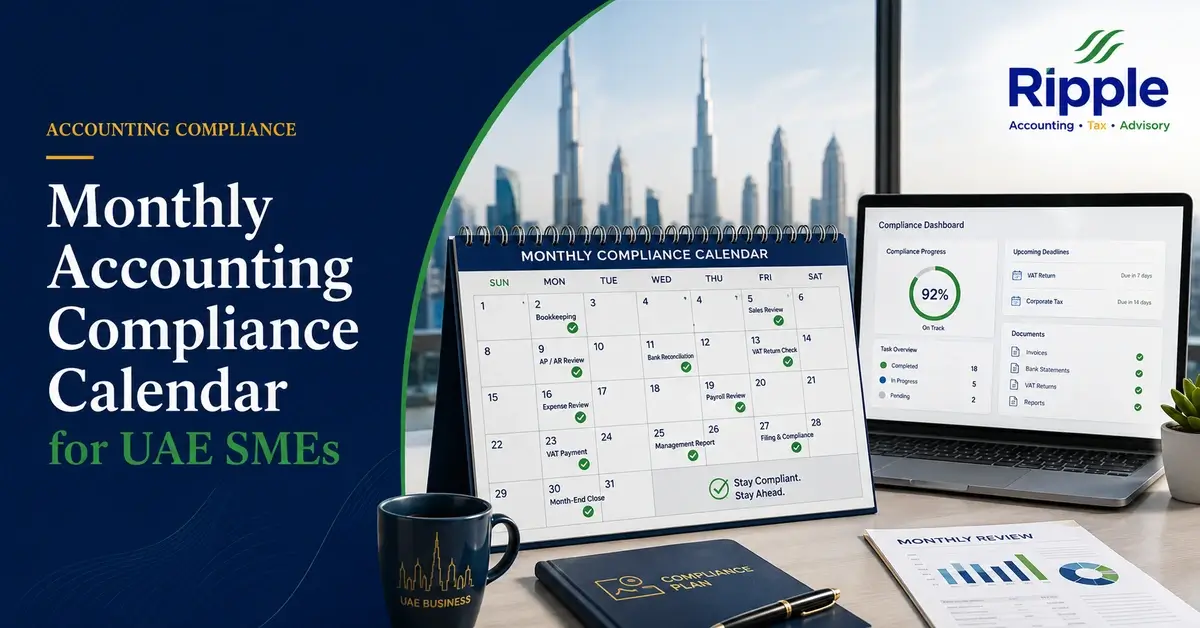
Are your UAE business’s accounting tasks truly under control each month?
Missed reconciliations, unrecorded invoices, or delayed VAT checks can quickly turn into bigger compliance and reporting problems. A monthly accounting calendar UAE for SMEs helps businesses stay organized by scheduling bookkeeping, reconciliations, tax reviews, payroll, receivables, payables, and financial reporting throughout the year. Instead of reacting to deadlines, SMEs can follow a clear monthly routine that keeps their accounts accurate, up to date, and ready for upcoming compliance requirements.

A monthly accounting calendar UAE is a structured schedule that identifies the accounting, bookkeeping, tax and financial-control activities a business should complete during each month. It can include routine tasks such as:
For SMEs, the purpose is not simply to “complete the books.” The objective is to ensure that financial information remains accurate, complete, supported and available when management or regulators need it.
A calendar also makes responsibilities clearer. The business owner, accountant, bookkeeper and finance manager can each know what needs to be completed and when.
Many small businesses do their bookkeeping only when a tax return or year-end deadline approaches. This creates a backlog and increases the risk of errors. A monthly process provides several advantages.
When transactions are recorded regularly, owners can see revenue, expenses, receivables, payables and cash flow more accurately.
This makes it easier to answer questions such as:
Tax compliance becomes considerably easier when accounting records are maintained throughout the year rather than reconstructed immediately before a deadline. For VAT-registered businesses, transaction records need to be reviewed regularly so that VAT treatment can be identified and supporting documents retained.
Regular reconciliations can identify duplicated transactions, missing entries, incorrect amounts and unexplained balances before they become difficult to investigate.
A business that closes its accounts every month has much less work to do at year-end.
Consistent records make it easier to connect transactions with invoices, receipts, contracts, bank statements and other supporting documentation.
A practical monthly bookkeeping checklist UAE businesses can use should cover the complete accounting cycle rather than focusing only on data entry.
Start by ensuring that all sales made during the month have been recorded correctly. Check:
Missing sales invoices can distort revenue, receivables and tax calculations. Businesses should also investigate gaps in invoice numbering where appropriate.
The finance team should collect supplier invoices, receipts and other supporting documents and record eligible business expenses. Review expenses for:
Avoid simply recording expenses under broad categories such as “miscellaneous” when a more accurate classification is available.
Proper categorisation improves both financial reporting and tax analysis.
Bank reconciliation should be one of the most important recurring tasks in the calendar. Compare the accounting records with the company’s bank statements and identify:
If a company has multiple bank accounts, each account should be reconciled separately.
Example:
Suppose the accounting system shows AED 150,000 in the bank, but the statement shows AED 143,500. The difference should not simply be carried forward. The accountant should investigate whether the difference relates to outstanding payments, bank charges, unrecorded transactions or accounting errors.
A monthly review of accounts receivable helps SMEs control cash flow. Prepare an ageing report showing amounts that are:
The finance team should identify customers requiring follow-up and communicate significant overdue balances to management.
This is particularly important for SMEs because strong reported revenue does not necessarily mean strong cash flow.
Supplier balances should also be reviewed monthly. Check:
A proper review can help management plan cash requirements and avoid unnecessary late-payment issues.
VAT should be integrated into the accounting process rather than treated as a separate activity performed only before filing. The Federal Tax Authority generally requires VAT returns and related payments within 28 days from the end of the relevant tax period, subject to the applicable rules and the business’s assigned tax period.
However, businesses should not assume that every UAE company has a monthly VAT filing period. The VAT tax period assigned to a business can differ.
Therefore, a good UAE tax compliance calendar should include the company’s actual VAT return period and deadline.
Before a VAT return is prepared, review:
Monthly bookkeeping makes this review much easier because the underlying transactions are already organised.
Corporate Tax is another important component of the compliance calendar.
For UAE businesses subject to Corporate Tax, accounting records should be maintained in a way that supports the calculation of taxable income and the preparation of the Corporate Tax return. The FTA states that Corporate Tax returns and the payment of Corporate Tax are generally due within nine months from the end of the relevant tax period, subject to the applicable legislation.
This does not mean Corporate Tax work should wait until the ninth month.
Instead, SMEs should monitor Corporate Tax throughout the year.
Monthly activities can include:
This approach reduces the risk of discovering major accounting issues immediately before the Corporate Tax filing deadline.
Payroll should also have a fixed place in the monthly accounting process. Depending on the business structure, the accounting team may need to record:
The accounting records should be reconciled with the relevant payroll documentation.
Where payroll-related payments involve separate systems or bank transfers, these should also be checked against the accounting ledger.
Once transactions have been recorded and reconciliations completed, the business should perform a monthly financial close.
A basic close can include:
The objective is to ensure the accounting system reflects the company’s financial position as accurately as possible.
A simple UAE SME compliance calendar can be organised as follows:
| Frequency | Key Activity |
| Weekly | Collect invoices and receipts |
| Weekly | Update sales and purchase records |
| Weekly | Monitor customer collections |
| Monthly | Complete bank reconciliations |
| Monthly | Review accounts receivable |
| Monthly | Review accounts payable |
| Monthly | Process payroll accounting |
| Monthly | Review VAT transactions |
| Monthly | Review general ledger |
| Monthly | Close accounts and prepare reports |
| Quarterly/As applicable | Prepare and file VAT return |
| Throughout the year | Monitor Corporate Tax position |
| Annually/As applicable | Prepare Corporate Tax return |
| Annually | Review financial records and supporting documentation |
The exact schedule should be adapted to the company’s VAT tax period, financial year, business activity and other applicable obligations.
Without a consistent accounting process, several problems can develop.
Creating a calendar is only the first step. SMEs need a process for actually using it.
Every task should have an owner. For example, the bookkeeper may handle transaction recording while the accountant reviews reconciliations and the business owner reviews management reports.
Don’t make the legal deadline your internal deadline. For example, if a VAT return is due on a particular date, set an earlier internal review date so there is time to correct errors.
Accounting software can automate recurring tasks, generate reports and help track outstanding invoices. However, automation does not replace review.
Invoices, receipts, contracts, bank statements and other records should be stored systematically and remain accessible.
UAE tax and regulatory requirements can change. The calendar should therefore be reviewed whenever the FTA or another relevant authority introduces new rules or requirements.
Maintaining a monthly accounting calendar can become difficult when business owners are already managing operations, customers and employees. Ripple Accountant can support UAE businesses with bookkeeping, accounting, reconciliations, financial reporting, VAT support and Corporate Tax-related accounting processes.
The goal is not simply to record transactions but to help businesses maintain organized financial records throughout the year. A structured monthly accounting process can give management better visibility while reducing the pressure associated with tax and year-end deadlines.
Contact Ripple Accountant today to discuss accounting issues of your UAE business.
Ideally, transactions should be recorded continuously or at least weekly, followed by a formal monthly close. Waiting until the end of the quarter or year increases the risk of errors and backlogs.
There is not necessarily a legal requirement to maintain a document specifically called a “monthly accounting calendar.” However, businesses have accounting, record-keeping and tax obligations, and a monthly calendar is a practical way to manage them.
No. VAT tax periods can differ depending on the business and the period assigned by the FTA. Businesses should follow their actual VAT filing requirements rather than assuming that all VAT returns are monthly.
Yes. Even though the Corporate Tax return is generally due within nine months after the end of the relevant tax period, monitoring accounting and tax-related information throughout the year makes the eventual filing process much easier.
There is no single task that is most important for every business, but bank reconciliation, complete transaction recording, receivables/payables review and tax-related checks are among the key recurring controls.
A monthly accounting calendar UAE SMEs can use is more than a list of deadlines. It is a financial-control system that helps businesses keep their books current, monitor cash flow, identify errors and prepare for VAT and Corporate Tax obligations. The most effective approach is to separate routine monthly accounting tasks from tax filing deadlines. Every month, businesses should focus on recording transactions, reconciling accounts, reviewing receivables and payables, checking VAT treatment, processing payroll and closing the books.
Disclaimer: This article is provided for general informational and educational purposes only. The information in this article should not be considered legal, tax, accounting, or financial advice. Businesses should review their specific circumstances and consult a qualified UAE accounting or tax professional and, where appropriate, the Federal Tax Authority before making tax, accounting or compliance decisions.
Tell us a little about your business and our UAE tax experts will get back to you with clear, practical answers — no obligation.
 Compliance
Businesses today generate more financial and operational data than ever before. Every invoice, payment, approval, and customer transaction creates valuable information that…
Read article Compliance
Lease accounting has become one of the most important areas of financial reporting for businesses that rent offices, warehouses, vehicles, machinery, or…
Read articlePage 45 of 45
Book a free consultation and get clear answers for your business.
0 Comments