DMTT Reporting Calendar UAE: Roles for Subsidiaries and Parent Companies
Who is responsible for Pillar Two reporting when a multinational group has several UAE entities? This question is becoming increasingly important as…
Read article
Do you receive monthly financial reports but still struggle to answer one simple question: “What actually needs my attention right now?”
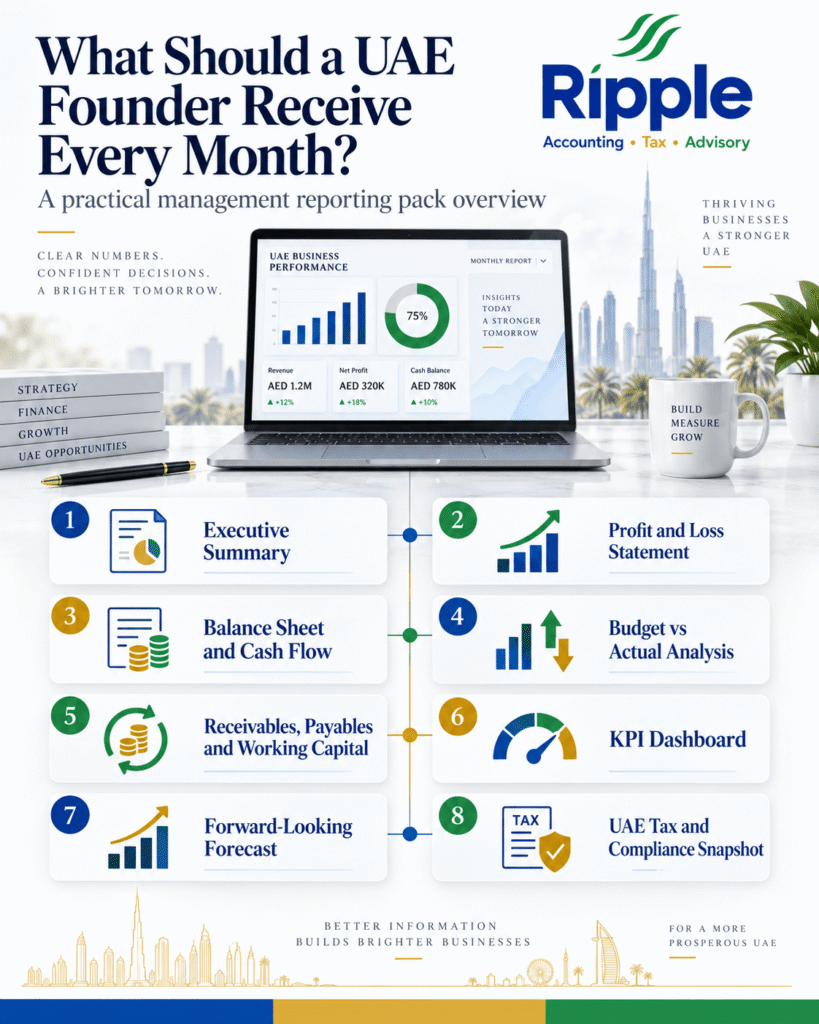
For many UAE founders, the problem is not a lack of numbers. It is receiving financial data without context, comparison or a clear next action. A well-designed management reporting pack brings financial statements, cash flow, KPIs, working-capital data, forecasts and commentary into one decision-focused view.
If your reports tell you what happened but not what to do next, here is what a founder-ready monthly pack should contain.

A management reporting pack is a recurring internal report designed to help owners and management understand performance and make better decisions.
A useful pack should answer four questions:
For a UAE founder, this may combine the profit and loss statement, balance sheet, cash-flow view, budget-versus-actual analysis, receivables and payables, selected KPIs, forecasts and management commentary.
The goal is not to create a longer report. It is to create a more useful one.
A monthly management reporting pack is generally an internal management tool rather than a standalone federal monthly filing requirement.
However, the underlying accounting information matters because UAE companies and taxable persons have record-keeping obligations.
Article 26 of Federal Decree-Law No. 32 of 2021 on Commercial Companies requires companies to keep accounting records that provide a clear picture of their transactions and financial position. Those accounting records must generally be retained for at least five years from the end of the relevant financial year.
For Corporate Tax, the Federal Tax Authority states that relevant records and documents should be retained for at least seven years following the end of the relevant Tax Period.
A management pack should therefore be viewed as a management layer built on reliable books and records. It does not replace a Corporate Tax Return, statutory financial statements or an audit where one is required.
The first page should answer:
What requires the founder’s attention?
Instead of repeating every number, it should highlight three to five major developments such as revenue below plan, margin pressure, cash constraints, overdue receivables, rising operating costs or a forecast shortfall.
Each issue should ideally include an explanation and a recommended action.
For example, “Receivables increased” is information. But “Receivables over 60 days increased because two major customers delayed payment; collection responsibility should be assigned this week” is management insight.
That is the difference between receiving accounts and receiving information that can actually support a decision.
A founder-ready profit and loss statement should normally show:
But a single month in isolation is rarely enough.
Where reliable information is available, compare the current month with the previous month, budget, year-to-date performance and a relevant prior period.
A founder should be able to identify whether a change represents a temporary fluctuation or a developing trend.
For example, declining profit may come from falling revenue, increasing direct costs, weaker pricing, changing sales mix or rising overheads. The P&L should help management identify where the movement is occurring.
The balance sheet helps founders understand what the business owns, what it owes and how its operations are being financed.
Important areas can include:
Cash flow then answers another critical question:
Is accounting profit actually turning into cash?
A profitable company can still face financial pressure if customers pay slowly, inventory absorbs cash, loans are being repaid or capital expenditure is high.
A useful monthly reporting pack should therefore highlight significant cash movements, upcoming obligations and, where appropriate, a rolling cash-flow forecast.
A KPI dashboard should not contain every metric that can be calculated. It should contain the measures connected to the company’s actual business model, priorities and management decisions.
For many businesses, headline measures could include revenue, gross margin, operating or net profit, cash balance, operating cash flow, receivables ageing, budget variance and forecast year-end performance.
The exact KPIs should vary between industries.
The objective is not to copy another company’s dashboard. It is to identify the metrics that explain the drivers of your own business.
A management reporting pack becomes much more useful when actual performance is compared with what management expected to happen.
For example:
Revenue is AED 250,000 below budget.
That information alone is not enough. Management should understand why.
Was the variance caused by fewer customers, lower prices, delayed projects, product mix, seasonality or simply timing?
The explanation matters because every cause may require a different response. The same principle applies to expenses.
Payroll above budget because the company intentionally hired ahead of an expansion has a very different meaning from payroll exceeding budget because staff costs are increasing without a corresponding increase in output or revenue.
Good variance reporting should therefore explain what changed, why it changed and what management should do next.
Working-capital reporting often explains why a business can report a profit while still experiencing cash pressure.
A useful monthly management pack may therefore monitor receivables ageing, materially overdue customers, upcoming supplier obligations, overdue payables, major customer or supplier concentrations and inventory days or slow-moving stock where relevant.
For founders, these reports make working capital practical.
Instead of only knowing that receivables equal AED 1 million, management can see how much is current, how much is overdue and which balances require collection action.
This information can directly influence cash planning, supplier payments and spending decisions.
Historic reports explain where the business has been. Founders also need to understand where current performance may take the company.
A forecast may include expected revenue, gross margin, operating costs, profit, cash flow, hiring, capital expenditure and funding requirements.
As the business becomes more sophisticated, this can develop into a rolling forecast that is updated every month using the latest actual results and management assumptions.
This becomes particularly useful before:
The founder can then evaluate a decision based not only on today’s bank balance but also on its expected effect over the coming months.
A monthly management pack should not become a substitute for tax compliance. However, it can help stop tax matters from becoming year-end surprises.
Depending on the business, the pack may include management estimates or status indicators relating to Corporate Tax exposure, VAT, upcoming filing deadlines, unresolved reconciliations and accounting adjustments that still require review.
The FTA states that Corporate Tax Returns and Corporate Tax payable are generally due within nine months after the end of the relevant Tax Period. Its September 2026 reminder confirms that taxable persons whose financial year ended on 31 December 2025 generally have until 30 September 2026 to file their Corporate Tax Return and pay the tax due.
That does not mean founders should wait until the filing deadline to understand potential tax exposure.
Regular monthly reporting can help management identify accounting issues earlier and plan the cash that may ultimately be required for tax obligations.
The quality of any management reporting pack depends on the reliability of the accounting records behind it.
For Corporate Tax purposes, Ministerial Decision No. 114 of 2023 provides that a Taxable Person applies International Financial Reporting Standards (IFRS), while a Taxable Person whose revenue does not exceed AED 50 million may apply IFRS for SMEs. Ministry of Finance guidance also explains the prescribed circumstances in which cash-basis accounting may be available to businesses with revenue below AED 3 million.
These requirements relate to the accounting basis underlying Corporate Tax financial information. They do not prescribe how an internal founder dashboard must look.
A business can therefore customize the format of its management pack while ensuring that the accounting information supporting it is prepared appropriately.
No.
An internal management reporting pack and an audit serve different purposes.
Ministerial Decision No. 84 of 2025 applies to relevant Tax Periods commencing on or after 1 January 2025. Among other provisions, it requires audited financial statements for a Taxable Person that is not a Tax Group and derives revenue exceeding AED 50 million during the relevant Tax Period, as well as for a Qualifying Free Zone Person. Tax Groups have specific audited special-purpose financial-statement requirements.
Businesses should therefore avoid simplifying the rule to “below AED 50 million means no audit.”
Free Zone status, Tax Group status, licensing requirements and other circumstances may affect the applicable position.
These functions are connected, but they are not identical.
As a company grows, it may therefore move from basic monthly accounts to a more detailed management reporting pack and eventually to ongoing CFO-level analysis.
Ask whether your reports arrive quickly enough to influence decisions. Check whether the underlying accounts are properly reconciled, whether you can see both profit and cash, whether performance is compared with budget or forecast, whether overdue receivables are visible, whether KPIs reflect your actual business model and whether management commentary explains why important numbers changed.
Most importantly, ask:
Does every major issue in the report lead to a decision or action?
If the numbers are technically accurate but management is still asking “So what?”, the reporting process probably needs to evolve.
At Ripple Accounting, Tax & Advisory management reporting can be structured to help business owners move from simply receiving financial statements to understanding what those numbers mean for their next decision.
Depending on the needs of the business, a reporting framework may include:
Is your monthly reporting helping you make decisions—or only telling you what already happened?
Contact Ripple Accounting, Tax & Advisory to review your existing management reporting pack and discuss a reporting framework tailored to your business model and growth stage.
A strong baseline normally includes an executive summary, P&L, balance sheet, cash-flow information, selected KPIs, working-capital analysis, budget-versus-actual reporting, forecasts and management commentary. The exact content should reflect the business and the decisions management needs to make.
The official federal sources reviewed do not establish a general requirement for every UAE business to submit an internal management reporting pack every month. Businesses do, however, have applicable accounting-record, tax-record, financial-statement and, in certain circumstances, audit obligations.
Monthly reporting is practical for many businesses because it provides regular visibility without waiting until year-end. Smaller or less complex businesses may sometimes use quarterly reporting, while rapidly growing businesses may review selected cash and operational measures more frequently.
KPIs are management tools rather than a general statutory monthly-reporting requirement. The most useful KPIs are those connected to the business model, strategy and decisions management needs to make.
Management reporting is primarily prepared for internal decision-making and can include KPIs, forecasts, budgets and management commentary. Statutory or tax financial information is prepared to meet applicable accounting, legal, tax or audit requirements. Both may use the same underlying accounting data, but their purposes are different.
A useful management reporting pack should do more than confirm what happened last month. For a UAE founder, it should connect financial statements with cash, working capital, KPIs, comparisons, forecasts and clear management actions. The best management pack is not the one with the most pages or the most impressive dashboard. It is the one that helps management identify problems earlier, understand what is driving performance and make better decisions using reliable financial information. As the company grows, its reporting should grow with it—from basic financial statements to structured management insight and, where appropriate, CFO-level forecasting and strategic support.
Disclaimer: This article is for general informational purposes only and does not constitute accounting, Corporate Tax, VAT, audit, legal or financial advice. UAE requirements may vary depending on the entity, business activities, revenue, Mainland or Free Zone status, Qualifying Free Zone Person status, Tax Group status, licensing authority and other circumstances. UAE legislation and official guidance may also be amended. Businesses should review the latest Federal Tax Authority, Ministry of Finance and UAE legislation guidance and obtain professional advice based on their specific circumstances.
Tell us a little about your business and our UAE tax experts will get back to you with clear, practical answers — no obligation.
 Corporate Tax
Who is responsible for Pillar Two reporting when a multinational group has several UAE entities? This question is becoming increasingly important as…
Read article Corporate Tax
When is your UAE Corporate Tax return due? The deadline is not the same for every business. It generally depends on the…
Read article Bookkeeping
Are your UAE business’s accounting tasks truly under control each month? Missed reconciliations, unrecorded invoices, or delayed VAT checks can quickly turn…
Read articlePage 16 of 45
Book a free consultation and get clear answers for your business.
0 Comments