Lease Modifications Under IFRS 16: Remeasurement and Accounting Entries in the UAE
What happens when a UAE business changes the terms of an existing lease? Under IFRS 16 lease modification requirements, changes such as…
Read article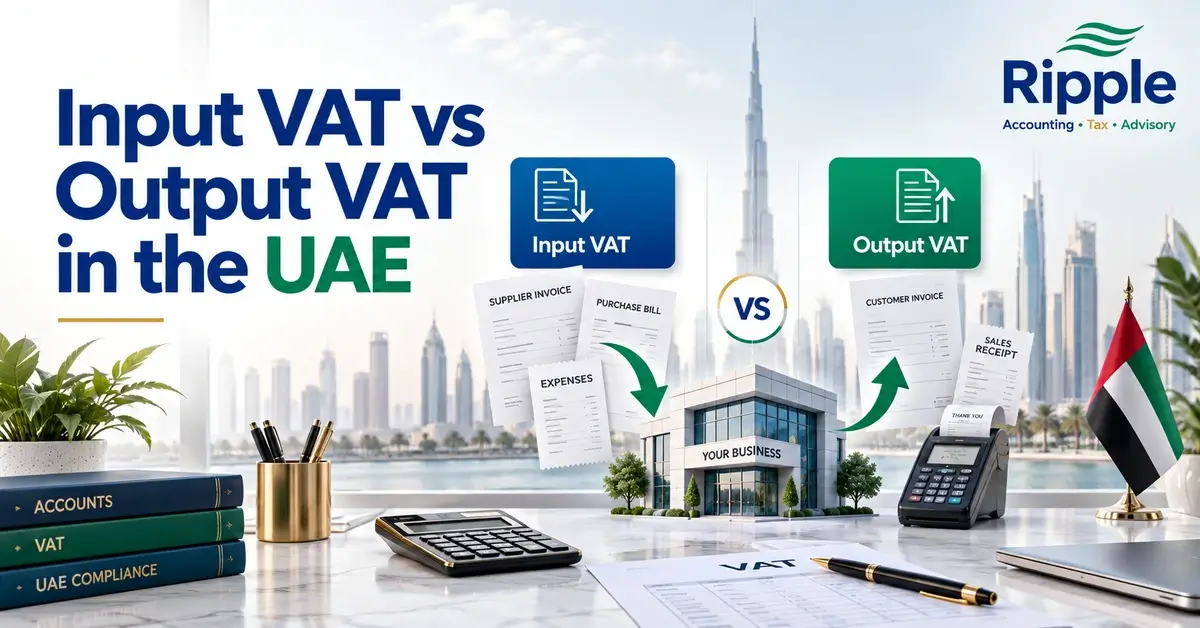
Do you know the difference between the VAT your business charges customers and the VAT it pays on business expenses?
Understanding input VAT vs output VAT UAE businesses deal with is essential for preparing accurate VAT returns. Output VAT generally relates to VAT charged or accounted for on taxable supplies, while input VAT relates to VAT incurred on eligible business purchases and expenses. The difference between the two helps determine whether a business has VAT to pay to the Federal Tax Authority (FTA) or is in a position where input tax exceeds output tax.
Read on to understand how input and output VAT work, when input VAT may be recoverable, and how businesses can reconcile both figures before preparing a UAE VAT return.

Output VAT is the VAT a VAT-registered business charges or accounts for on its taxable supplies.
For example, suppose a UAE business provides a taxable service for AED 10,000 and charges VAT at 5%.
The calculation would be:
The AED 500 is output VAT.
The FTA’s VAT Return User Guide explains that output tax is VAT a taxable person calculates and charges on supplies of goods and services after VAT registration. It also notes that output tax can arise in certain deemed-supply and reverse-charge situations.
Output VAT therefore generally comes from the business’s taxable sales and other transactions where the business is required to account for VAT.
Depending on the business and its transactions, output VAT may arise from:
The exact VAT treatment depends on the nature of the transaction and the applicable UAE VAT rules.

Input VAT is VAT incurred by a business on goods and services it purchases or incurs for its business activities.
For example, a company purchases office equipment for AED 5,000 plus AED 250 VAT.
The AED 250 paid as VAT is input VAT.
However, input VAT should not automatically be treated as recoverable simply because VAT appears on a supplier invoice.
The FTA’s Input Tax Apportionment Guide explains that VAT incurred on goods and services can generally be recovered through the VAT return when the applicable conditions are satisfied. It also explains that recovery depends on how the goods or services are used.
Depending on the nature and use of the expense, input VAT may arise on:
The fact that a business paid VAT does not by itself establish that the full amount can be recovered.
The simplest way to understand the distinction is:
| Input VAT | Output VAT |
| VAT incurred on eligible business purchases | VAT charged or accounted for on taxable supplies |
| Generally relates to purchases and expenses | Generally relates to sales and other taxable transactions |
| May be recoverable subject to applicable conditions | Generally becomes part of the VAT liability |
| Recorded through purchase and expense transactions | Recorded through sales and other output transactions |
| Contributes to determining the net VAT position | Contributes to determining the net VAT position |
The two figures are brought together when a business prepares its VAT return.
A VAT return essentially brings together the VAT a business is required to account for and the eligible input tax it can recover.
In simplified terms:
Output VAT − Recoverable Input VAT = Net VAT Position
For example:
Output VAT: AED 25,000
Recoverable Input VAT: AED 15,000
Net VAT payable: AED 10,000
This is a simplified illustration. The actual VAT return can include different categories, adjustments and transactions that need separate treatment.
The FTA’s VAT return filing guidance identifies sections for VAT on sales and other outputs, VAT on expenses and other inputs, and the resulting net VAT due.
A business may have a period where recoverable input VAT is higher than its output VAT.
For example:
Output VAT: AED 12,000
Recoverable Input VAT: AED 18,000
The difference is:
AED 6,000
This creates a net refundable position, subject to the applicable rules and the business’s circumstances.
The FTA provides a VAT refund service for registered taxable persons and states that refund applications require relevant information and supporting documents, including output and input tax reports and tax invoices/supporting documents for the relevant refund request.
A business should therefore distinguish between input VAT incurred and input VAT that is actually recoverable.
Input VAT recovery is subject to conditions.
The FTA’s Input Tax Apportionment Guide states that a registrant is entitled to recover input tax incurred on goods and services to the extent those goods or services are used, or intended to be used, for specified activities that allow recovery. It also explains that input VAT on expenses used solely for non-business purposes or wholly exempt supplies is not recoverable.
This means businesses should ask more than:
“Did we pay VAT?”
They should also ask:
“Was the expense used for a purpose that allows input VAT recovery, and do we have the required supporting records?”
Where a business expense is used wholly for activities that allow input VAT recovery, the applicable input VAT may generally be recoverable, subject to the relevant requirements.
Where an expense relates solely to exempt supplies or another purpose that does not allow recovery, the input VAT may not be recoverable.
Some expenses may relate partly to activities that allow input VAT recovery and partly to activities that do not.
In these circumstances, the business may need to determine the recoverable portion.
The FTA’s guidance explains that where goods or services are used partly for recoverable purposes and partly for other purposes, the business must determine the portion of input tax that can be recovered.
A business should maintain a clear connection between the expense, VAT amount and supporting documentation.
A review can include:
The FTA’s current public clarification on tax invoices and input tax recovery provides specific guidance on tax invoices and input tax recovery.
This is particularly important where a business has a large number of supplier invoices or uses automated accounting systems.
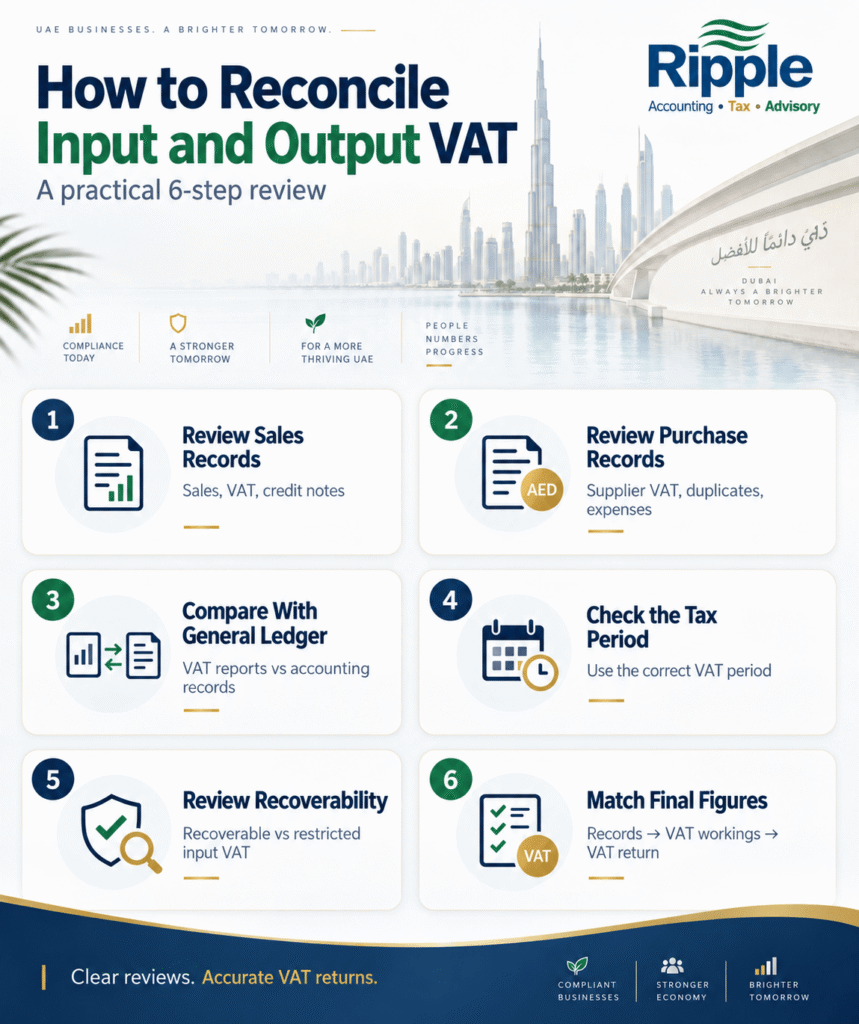
A regular reconciliation can help businesses identify differences before submitting a VAT return.
Start with the sales ledger for the relevant VAT period.
Check:
Check the purchase ledger and expense accounts.
Look for:
The VAT control accounts and VAT reports should be compared with the accounting records.
A difference does not necessarily mean there is an error, but it should be explainable.
Make sure transactions have been considered in the appropriate VAT period based on the applicable VAT rules.
This is particularly important for invoices, credit notes, imports and adjustments recorded around the end of a tax period.
Do not treat all VAT on purchases as automatically recoverable.
Review whether each significant or unusual expense meets the relevant recovery requirements.
Before submitting, compare the final VAT workings with the figures entered into the VAT return.
This creates a final control between:
Accounting records → VAT workings → VAT return
Before preparing the VAT return, businesses can use the following checklist:
The FTA states that VAT-registered businesses are required to file their VAT return and make related VAT payments within 28 days from the end of the relevant tax period.
A documented review before that deadline can reduce the risk of discovering discrepancies at the last minute.
Understanding input VAT vs output VAT UAE businesses deal with is only useful when the underlying accounting records are accurate and properly reconciled.
Ripple Accountants can support UAE businesses with VAT registration and filing-related accounting requirements, including organising VAT records, reviewing input and output VAT figures and reconciling relevant accounting information before VAT return preparation.
If your business needs help reviewing input VAT, output VAT or the records supporting its VAT return, contact Ripple Accountants to discuss your requirements.
Input VAT is VAT incurred by a business on eligible purchases and expenses, while output VAT is VAT charged or accounted for on taxable supplies and certain other transactions. The two figures contribute to determining the business’s net VAT position.
No. Input VAT recovery is subject to applicable conditions. The FTA explains that recovery generally depends on the use of the goods or services and whether they relate to activities that allow input tax recovery.
In a simplified calculation, a business subtracts recoverable input VAT from output VAT:
Output VAT − Recoverable Input VAT = Net VAT payable or refundable position.
The actual VAT return can contain additional categories and adjustments.
If eligible recoverable input VAT exceeds output VAT for a tax period, the business may have a net refundable position, subject to the applicable requirements. The FTA provides a process through EmaraTax for eligible VAT refund requests.
A business can compare its sales and purchase records with VAT reports, review credit notes and adjustments, check input VAT recovery, reconcile VAT control accounts and compare the final figures with the VAT return before submission.
Understanding input VAT vs output VAT UAE businesses report is fundamental to preparing an accurate VAT return. Output VAT generally relates to VAT charged or accounted for on taxable supplies, while input VAT relates to VAT incurred on business purchases and expenses. However, input VAT is not automatically recoverable simply because VAT has been paid. The applicable recovery conditions and supporting records need to be considered. A regular reconciliation between sales, purchases, VAT reports, accounting records and the VAT return can help businesses identify differences before filing.
Disclaimer: This article is provided for general informational purposes and does not constitute tax, legal or accounting advice. UAE VAT legislation, FTA guidance and administrative procedures may change. The VAT treatment of a particular transaction depends on its specific facts and the applicable legislation and guidance. Businesses should review the latest FTA requirements and obtain professional advice where appropriate before preparing or submitting a VAT return.
Tell us a little about your business and our UAE tax experts will get back to you with clear, practical answers — no obligation.
 Compliance
What happens when a UAE business changes the terms of an existing lease? Under IFRS 16 lease modification requirements, changes such as…
Read article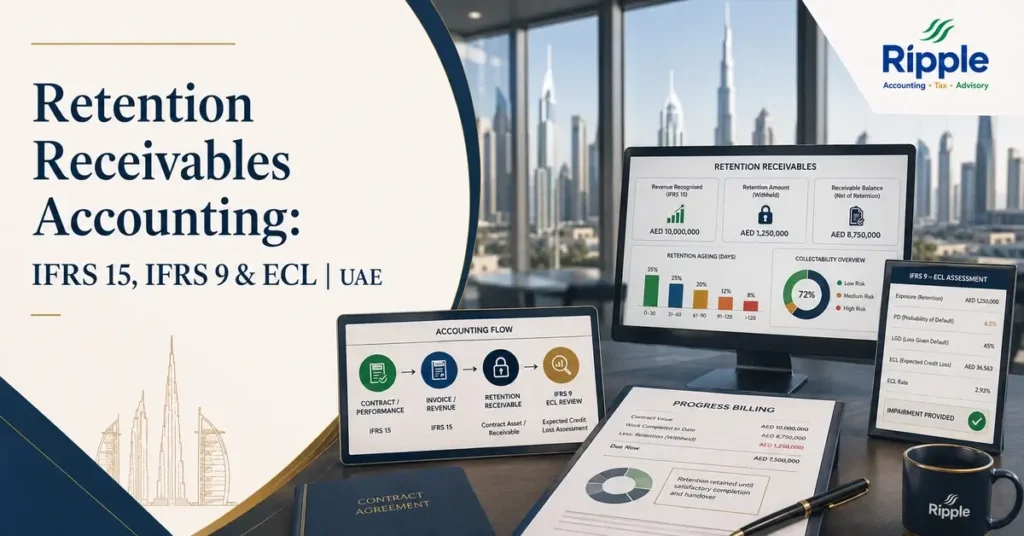 Compliance
A construction company may complete work and earn revenue, yet still have part of its payment withheld by the customer as retention.…
Read article Corporate Tax
How much of your UAE company’s trade receivables is actually expected to be collected? IFRS 9 requires businesses applying full IFRS to…
Read articlePage 15 of 45
Book a free consultation and get clear answers for your business.
0 Comments