Corporate Tax Registration vs Filing in the UAE
Are you confused about whether registering for UAE Corporate Tax means that your company has already completed its tax filing obligation? Corporate…
Read article
How much of your UAE company’s trade receivables is actually expected to be collected?
IFRS 9 requires businesses applying full IFRS to recognize expected credit losses rather than waiting until a customer formally defaults. For trade receivables, the simplified approach and provision matrix can make this process practical, particularly where a business has many customer balances. UAE businesses should combine reliable ageing data, historical collection experience, and forward-looking information to produce a reasonable ECL estimate.
Let’s look at how a UAE business can build, calculate and document a practical IFRS 9 ECL model.

Expected Credit Loss (ECL) is a forward-looking estimate of the credit losses an entity expects to incur on financial assets within the scope of IFRS 9.
The underlying concept is based on the expected cash shortfall between the contractual cash flows due to the business and the cash flows it expects to receive. IFRS 9 requires ECL measurement to reflect an unbiased, probability-weighted assessment, the time value of money and reasonable and supportable information available at the reporting date.
This means a company should not wait until an invoice becomes irrecoverable before recognising the potential loss.
For example, if a UAE company has AED 2 million of customer receivables but its historical experience and current information indicate that some balances may not be collected, the financial statements should reflect the expected credit loss.
Trade receivables can represent a significant part of working capital for UAE businesses, particularly in industries such as:
A business may report strong revenue and still face a cash-flow problem if customers delay or fail to pay.
An ECL allowance helps financial statements reflect the expected collectability of receivables instead of presenting every outstanding invoice as if it will definitely be collected.
For UAE Corporate Tax purposes, the accounting framework is also relevant. Ministerial Decision No. 114 of 2023 states that a Taxable Person applies IFRS for Corporate Tax purposes. A Taxable Person with revenue not exceeding AED 50 million may apply IFRS for SMEs, subject to the applicable rules.
This distinction matters because businesses using IFRS for SMEs should not automatically assume that the full IFRS 9 ECL requirements apply in exactly the same way.
One of the most useful features of IFRS 9 for ordinary trade receivables is the simplified approach. For qualifying trade receivables, IFRS 9 permits an entity to recognise lifetime expected credit losses rather than applying the general three-stage impairment model. A provision matrix is specifically identified as a practical expedient for calculating ECL on trade receivables.
This can make the process considerably easier for businesses with a large number of relatively similar customer balances. Instead of building a separate probability-of-default model for every invoice, the company can:
A provision matrix is a structured table that applies different expected loss rates to receivables according to characteristics such as ageing or customer risk. For example:
| Receivable ageing | Illustrative ECL rate |
| Current | 1% |
| 1–30 days overdue | 2% |
| 31–90 days overdue | 5% |
| 91–180 days overdue | 15% |
| More than 180 days overdue | 40% |
These percentages are illustrative only. IFRS 9 does not prescribe a universal loss rate for UAE companies.
The IFRS 9 application guidance specifically gives a provision matrix as an example of a practical expedient and explains that rates may be based on the number of days a receivable is past due. It also notes that different customer segments may need different groupings where their historical loss patterns differ significantly.
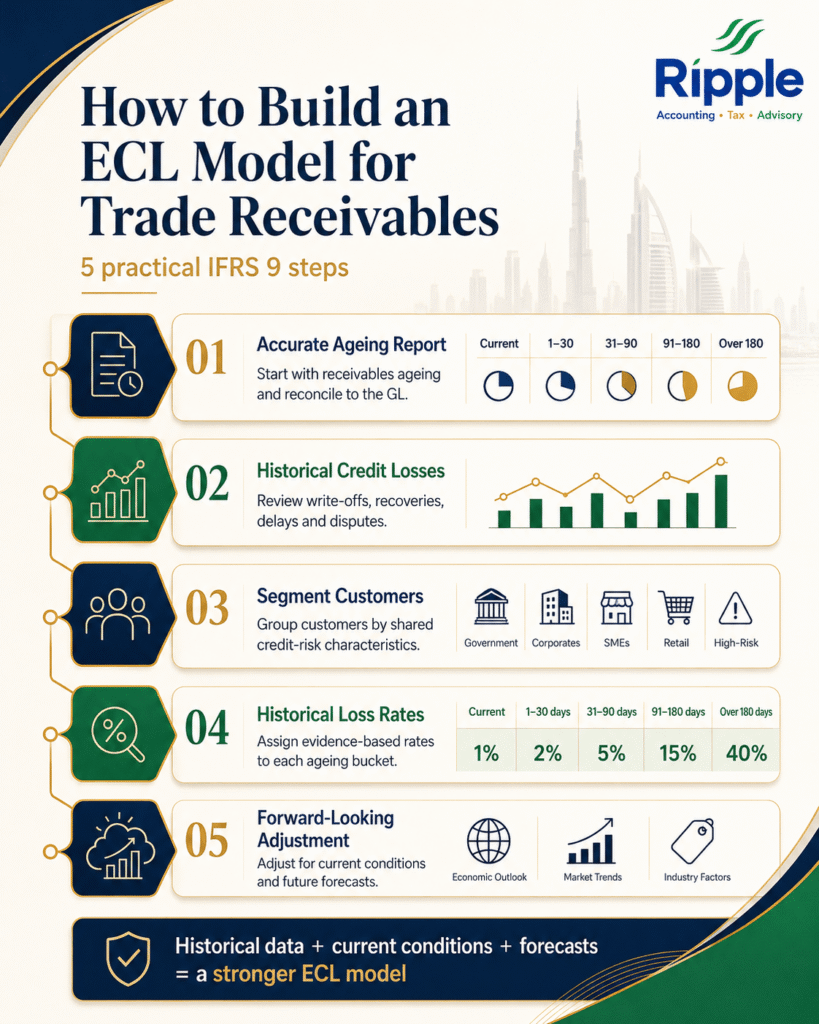
Start with the accounts receivable ageing report at the reporting date. For example:
| Ageing category | Receivables |
| Current | AED 2,000,000 |
| 1–30 days | AED 500,000 |
| 31–90 days | AED 200,000 |
| 91–180 days | AED 100,000 |
| Over 180 days | AED 50,000 |
| Total | AED 2,850,000 |
Before calculating ECL, reconcile this report to the general ledger. If the ageing report does not agree with the accounting records, the ECL calculation may be based on unreliable information.
Next, examine how customers have actually behaved in previous periods.
Useful information includes:
Historical loss experience provides the starting point for the provision matrix.
However, historical data should not automatically be carried forward without considering whether current circumstances are different.
Not all customers necessarily carry the same credit risk.
For example, a UAE business may have:
IFRS 9 allows appropriate grouping based on shared credit-risk characteristics. Relevant characteristics can include geographical region, product type, customer rating, collateral, trade credit insurance and customer type.
If different customer groups demonstrate significantly different loss patterns, separate loss rates may provide a more representative result.
Suppose a company’s historical analysis produces these illustrative rates:
| Ageing | Balance | Historical ECL rate |
| Current | AED 2,000,000 | 1% |
| 1–30 days | AED 500,000 | 2% |
| 31–90 days | AED 200,000 | 5% |
| 91–180 days | AED 100,000 | 15% |
| Over 180 days | AED 50,000 | 40% |
The historical loss rates should be supported by the company’s actual data rather than selected simply because they appear reasonable.
This is one of the most important parts of IFRS 9. Historical experience is a useful starting point, but the model should also consider current conditions and reasonable and supportable forecasts.
IFRS 9 identifies information about past events, current conditions and forecasts of future economic conditions as relevant to ECL measurement. Historical information may need to be adjusted to reflect current and expected conditions.
For a UAE business, management may consider evidence such as:
The adjustment should be evidence-based rather than simply adding an arbitrary percentage.
Assume the following receivables and illustrative loss rates:
| Ageing | Receivable | ECL rate | Expected loss |
| Current | AED 2,000,000 | 1% | AED 20,000 |
| 1–30 days | AED 500,000 | 2% | AED 10,000 |
| 31–90 days | AED 200,000 | 5% | AED 10,000 |
| 91–180 days | AED 100,000 | 15% | AED 15,000 |
| Over 180 days | AED 50,000 | 40% | AED 20,000 |
| Total | AED 2,850,000 | AED 75,000 |
The illustrative ECL allowance is therefore AED 75,000. The calculation can be summarised as:
ECL = Receivable balance × Expected loss rate
However, this formula is only the final calculation. The important accounting work happens before it: establishing appropriate segmentation, historical rates, and forward-looking adjustments.
Not necessarily. Imagine a business has two customer groups.
Applying exactly the same ECL rate to both groups may fail to reflect their different credit-risk characteristics.
IFRS 9’s provision-matrix guidance recognises this issue by allowing appropriate groupings where historical experience shows materially different loss patterns between customer segments.
The objective is not to make the model unnecessarily complicated. It is to ensure that the loss allowance reasonably reflects the characteristics of the receivables portfolio.
A provision matrix works well for groups of similar receivables, but management should also consider customer-specific circumstances.
For example, suppose a customer owes AED 500,000 and has entered serious financial difficulty. The general ageing matrix might produce a 5% ECL rate, resulting in an allowance of AED 25,000.
But if available evidence indicates that only AED 300,000 is expected to be recovered, the expected shortfall may be much higher than the portfolio rate suggests. Indicators requiring closer review may include:
The provision matrix should therefore be part of a broader credit-risk assessment rather than an automatic substitute for management judgement.
The ECL estimate should be reassessed at each reporting date. A business should periodically review:
A business experiencing rapid changes in customer behaviour may need more detailed monitoring than a company with stable, predictable receivables.
IFRS 9 is deliberately forward-looking, so an ECL model should evolve when the evidence changes. The IASB’s post-implementation review found that the impairment requirements have generally resulted in more timely recognition of credit losses.
A well-supported ECL calculation should have a clear audit trail. Useful documentation can include:
This documentation helps demonstrate how management moved from the receivables balance to the final ECL allowance.
The UAE connection is important because the Ministry of Finance has established the accounting standards applicable for Corporate Tax purposes. Under Ministerial Decision No. 114 of 2023, Taxable Persons apply IFRS, while Taxable Persons with revenue not exceeding AED 50 million may apply IFRS for SMEs.
Businesses should therefore first establish which accounting standard applies to them before assuming that the full IFRS 9 ECL requirements apply.
The FTA’s official Corporate Tax Guide | Accounting Standards also explains the interaction between UAE Corporate Tax requirements, IFRS, IFRS for SMEs and the cash basis of accounting.
This is particularly useful for UAE businesses trying to understand how their financial reporting framework interacts with Corporate Tax compliance.
Banks and other licensed financial institutions require a separate discussion. The CBUAE has specific requirements concerning classification, provisioning, and ECL. Its current Rulebook requires licensed financial institutions to maintain a proactive, forward-looking, and documented provisioning process supported by appropriate policies, systems, data, and analytical tools.
The CBUAE framework also addresses ECL estimation, including probability of default, loss given default, risk profiles, data quality and back-testing.
Therefore, the simple provision-matrix approach discussed in this article should not be treated as a complete ECL framework for banks or regulated financial institutions.
A reliable ECL calculation depends heavily on the quality of the underlying accounting data. If the receivables ageing is incomplete, customer balances are unreconciled, or historical collection information is not properly maintained, the resulting ECL model may be difficult to support. Ripple Accountant can help UAE businesses organise the accounting information required for an ECL assessment, including receivables ageing, ledger reconciliations, collection analysis, financial reporting and supporting schedules. A structured process can help management understand how the expected credit loss allowance was calculated and provide better documentation for financial statement review.
Contact Ripple Accountant to discuss your requirements and build an accounting process suited to your business.
IFRS 9 Expected Credit Loss is a forward-looking impairment approach that estimates expected credit losses using relevant historical, current and forecast information.
Yes. IFRS 9 specifically identifies a provision matrix as a practical expedient for calculating ECL on trade receivables.
For qualifying trade receivables subject to the simplified approach, lifetime expected credit losses are recognised. The precise application depends on the nature and terms of the receivable.
No. The loss rate should be developed using relevant historical experience and adjusted for current conditions and reasonable and supportable forecasts.
Not necessarily. UAE Corporate Tax rules specify IFRS as the applicable accounting standard, while qualifying businesses with revenue not exceeding AED 50 million may apply IFRS for SMEs. Businesses should establish their applicable accounting framework before determining the relevant impairment requirements.
A simple trade-receivables provision matrix should not be treated as a complete model for banks. UAE licensed financial institutions are subject to specific CBUAE provisioning and credit-risk requirements.
A practical IFRS 9 expected credit loss model for trade receivables should combine accurate receivables data, historical collection experience, appropriate customer segmentation, and forward-looking information. For many UAE businesses, the provision matrix provides an efficient way to estimate lifetime ECL without individually modelling every invoice. The key is not choosing a convenient percentage. The business needs to be able to explain why the loss rate is appropriate, what evidence supports it, and how current conditions have been considered.
Disclaimer: This article is provided for general informational purposes only and does not constitute accounting, audit, tax or legal advice. UAE businesses should confirm the accounting framework applicable to them and refer to the latest IFRS requirements, UAE Ministry of Finance and FTA guidance and, where applicable, CBUAE regulations. Professional advice should be obtained before making entity-specific accounting or tax decisions.
Tell us a little about your business and our UAE tax experts will get back to you with clear, practical answers — no obligation.
 Corporate Tax
Are you confused about whether registering for UAE Corporate Tax means that your company has already completed its tax filing obligation? Corporate…
Read article VAT
VAT
Are you a UAE-based consultancy or agency selling services overseas while managing a remote team across different countries? Cross-border business can create…
Read article Compliance
Do you receive monthly financial reports but still struggle to answer one simple question: “What actually needs my attention right now?” For…
Read articlePage 2 of 45
Book a free consultation and get clear answers for your business.
0 Comments