Audit Trail: Maintaining a Paper Trail in the Digital Age
Businesses today generate more financial and operational data than ever before. Every invoice, payment, approval, and customer transaction creates valuable information that…
Read article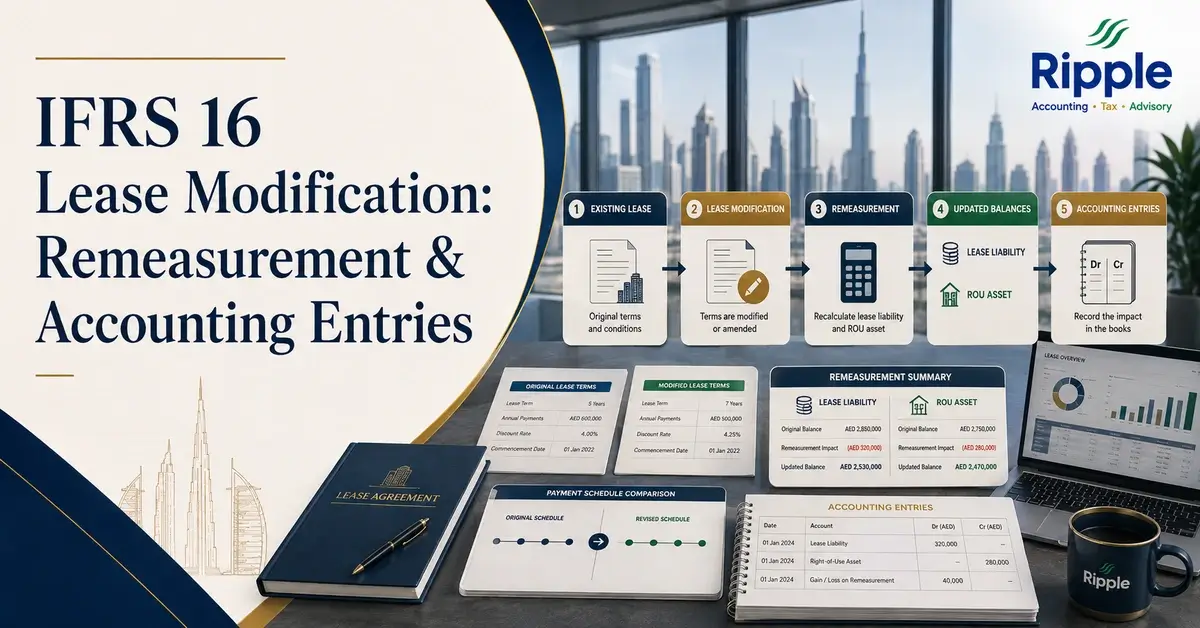
What happens when a UAE business changes the terms of an existing lease?
Under IFRS 16 lease modification requirements, changes such as rent revisions, lease extensions, additional space, or early termination can require the lease liability and right-of-use (ROU) asset to be remeasured. The accounting depends on the nature of the modification and whether it qualifies as a separate lease. For UAE businesses, applying the correct treatment helps maintain reliable financial statements and supports accurate Corporate Tax reporting.
So, when should a lease be measured, which discount rate should be used, and what journal entries are required? Let’s break it down step by step.

A lease modification occurs when the original contractual terms and conditions of a lease are changed. Common examples include:
For a UAE business, an office lease could initially cover 2,000 square feet for five years. Two years later, the company may negotiate an additional 1,000 square feet or decide to surrender part of the premises. Such changes can trigger the IFRS 16 lease modification requirements.
The key accounting question is whether the modification should be treated as a separate lease or whether the existing lease must be remeasured.
Under IFRS 16, a lessee accounts for a modification as a separate lease when both of the following conditions are met:
Example: Additional Office Space
A Dubai company leases 1,000 square metres of office space. Later, it agrees with the landlord to add another 300 square metres. The additional rent reflects the stand-alone market price for that additional space.
If the IFRS 16 conditions are satisfied, the additional space may be accounted for as a separate lease.
In this situation, the existing lease is not remeasured for the modification. Instead, the additional lease is accounted for separately.
If the modification does not meet both conditions for separate-lease treatment, the lessee accounts for it as a modification of the existing lease.
At the effective date of the modification, IFRS 16 requires the lessee to:
This is where IFRS 16 remeasurement becomes particularly important.
For a non-separate lease modification, the lessee generally remeasures the lease liability by discounting the revised lease payments using a revised discount rate. The revised discount rate is generally:
This means a UAE company should not automatically continue using the original discount rate when a modification requires remeasurement.
Simple Remeasurement Example
Assume a UAE company has a lease with:
The company calculates the present value of the revised lease payments using the applicable revised discount rate.
Assume the resulting revised lease liability is AED 507,500.
The increase is:
AED 507,500 − AED 500,000 = AED 7,500
The company would generally increase the lease liability by AED 7,500 and make a corresponding increase to the ROU asset, assuming this is a modification other than one that decreases the scope of the lease.
A simplified entry would be:
| Account | Debit (AED) | Credit (AED) |
| Right-of-use asset | 7,500 | — |
| Lease liability | — | 7,500 |
This increases both the ROU asset and lease liability.
The exact calculation should be based on the revised contractual cash flows and the applicable discount rate rather than simply recording the difference between total future payments.
A different treatment applies when a modification reduces the scope of the lease. For example, a UAE company may lease 5,000 square feet of office space but later agree to surrender 2,000 square feet before the original lease ends.
IFRS 16 requires the lessee to reduce the carrying amount of the ROU asset to reflect the partial or full termination. Any resulting gain or loss from the partial or full termination is recognised in profit or loss.
Example: Partial Lease Termination
Assume:
The company removes the relevant portions:
ROU asset reduction: AED 240,000
Lease liability reduction: AED 232,000
The difference creates a gain of:
AED 240,000 − AED 232,000 = AED 8,000
A simplified entry could be:
| Account | Debit (AED) | Credit (AED) |
| Lease liability | 232,000 | — |
| Gain on lease modification | — | 8,000 |
| Right-of-use asset | — | 224,000 |
The actual entry will depend on the precise carrying amounts and allocation methodology.
For modifications that do not decrease the scope of the lease, IFRS 16 generally requires a corresponding adjustment to the ROU asset for the remeasurement of the lease liability.
For example, suppose a UAE company negotiates a longer lease term without adding a separate underlying asset.
If the revised lease payments result in a higher present value, the company would generally:
If the revised measurement reduces the liability, the ROU asset is generally reduced, subject to the specific IFRS 16 requirements.
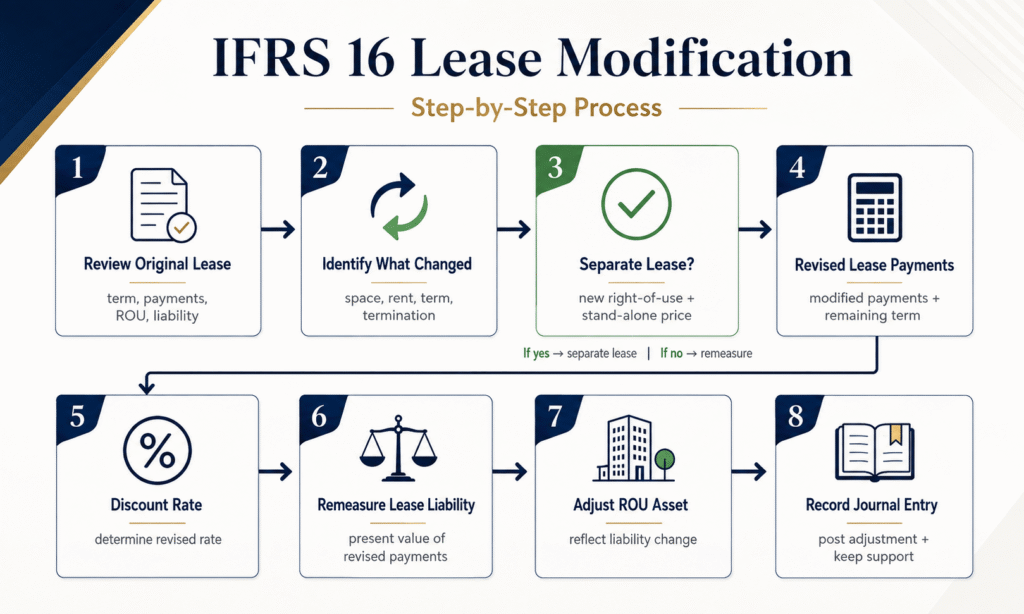
UAE accountants can use the following process when reviewing a modification.
Obtain the original lease agreement and identify:
Determine whether the modification involves:
Check whether the modification:
If both conditions are satisfied, separate-lease accounting may apply.
Determine the lease payments applicable to the modified arrangement and the remaining lease term.
For a non-separate modification requiring remeasurement, determine the revised discount rate in accordance with IFRS 16.
Calculate the present value of the revised lease payments.
Adjust the ROU asset for the corresponding change in the lease liability, subject to the specific requirements for decreases in scope.
Record the required adjustment and maintain documentation supporting the calculation.
A strong audit trail is particularly important when lease modifications involve significant amounts. Businesses should retain:
The FTA accounting standards guide states that accounting standards govern how particular transactions and events are reported and directs taxpayers to the relevant standard setter for transaction-specific accounting requirements.
Maintaining this documentation helps the finance team explain the accounting treatment to auditors and support the figures reported in the financial statements.
Lease modifications can become difficult when a business manages multiple properties, branches, warehouses, vehicles or equipment leases. Identifying the correct treatment, calculating the revised lease liability and recording the corresponding ROU adjustment requires careful accounting review.
Ripple Accounting can support UAE businesses with accounting and bookkeeping, financial reporting, Corporate Tax support, audit support, and related compliance requirements. Ripple’s UAE-focused team helps businesses maintain organized accounting records and reliable financial reporting.
Contact Ripple to review the accounting treatment and help ensure the relevant records and calculations are properly maintained.
A lease modification is a change to the scope or consideration of a lease that was not part of the original terms and conditions. Examples include adding or removing leased space, extending the lease or changing contractual payments.
A modification is treated as a separate lease when it adds the right to use one or more underlying assets and the additional consideration is commensurate with the stand-alone price for the increase in scope, including appropriate adjustments where applicable.
3. Does every lease modification require remeasurement?
No. A modification that qualifies as a separate lease is accounted for separately. Other modifications may require remeasurement of the lease liability and an adjustment to the ROU asset.
For a non-separate modification requiring remeasurement, IFRS 16 generally requires a revised discount rate based on the interest rate implicit in the lease for the remainder of the lease term, if readily determinable, or the incremental borrowing rate at the modification date when the implicit rate cannot readily be determined.
A decrease in lease scope generally requires the lessee to reduce the ROU asset and lease liability for the terminated portion and recognise any resulting gain or loss in profit or loss.
Yes, accounting standards are relevant to the preparation of financial statements used in the UAE Corporate Tax framework. UAE Ministerial Decision No. 114 of 2023 specifies the applicable accounting standards and methods for Corporate Tax purposes.
IFRS 16 lease modification accounting requires UAE businesses to look beyond the simple change in rent or lease terms. Changes such as lease extensions, additional premises, rent revisions, reductions in leased space and early termination can have different accounting consequences. Maintaining an updated lease register, recalculating the liability correctly and documenting the judgement behind the accounting treatment can help UAE businesses produce accurate financial statements and maintain appropriate Corporate Tax records.
Disclaimer: This article is provided for general educational and informational purposes only and does not constitute accounting, tax, audit, legal or financial advice. IFRS 16 treatment depends on the specific contractual terms, facts and circumstances of each lease. UAE businesses should consult a qualified accountant, auditor or tax professional before applying a lease-modification treatment to their financial statements or Corporate Tax calculations. Businesses should also verify the latest UAE legislation, FTA guidance, Ministry of Finance decisions and applicable IFRS requirements before making compliance decisions.
Tell us a little about your business and our UAE tax experts will get back to you with clear, practical answers — no obligation.
 Compliance
Businesses today generate more financial and operational data than ever before. Every invoice, payment, approval, and customer transaction creates valuable information that…
Read article Compliance
Lease accounting has become one of the most important areas of financial reporting for businesses that rent offices, warehouses, vehicles, machinery, or…
Read articlePage 45 of 45
Book a free consultation and get clear answers for your business.
0 Comments