UAE Compliance Review After Changing Business Activity
Have you recently added a new activity to your UAE trade licence? Before you start generating revenue from it, it is worth…
Read article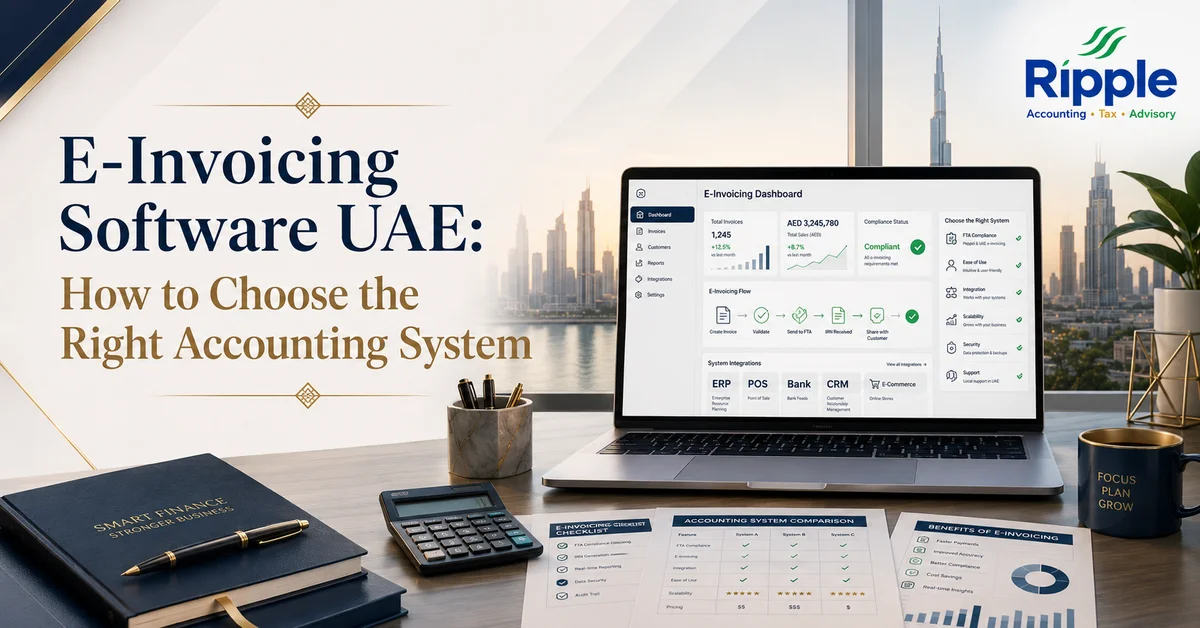
Is your accounting software ready for UAE e-invoicing?
The UAE’s e-invoicing system is changing how businesses create and exchange invoices. An e-Invoice is structured electronic invoice data, not a PDF, scanned document, or email. Voluntary implementation began on 1 July 2026, with mandatory implementation phased in from 2027. Businesses with annual revenue of AED 50 million or more must implement e-invoicing from 1 January 2027, while businesses below AED 50 million have a 1 July 2027 implementation date. This makes choosing the right e-invoicing software UAE solution essential.
UAE e-invoicing is more than sending an invoice electronically. It changes how invoice information is created, checked, exchanged and recorded. Under the UAE framework, an eInvoice is structured electronic data that can be automatically processed by business systems. A PDF, scanned invoice, or invoice sent by email does not become an eInvoice simply because it is digital.
For businesses, this means their accounting software UAE solution needs to do more than create a printable invoice. It should capture the required information and connect with the UAE e-invoicing system through an Accredited Service Provider (ASP).
The easiest way to understand the difference is to look at how the information is handled:
| PDF/Traditional Invoice | UAE eInvoice |
| Usually created as a document or PDF | Created as structured electronic data |
| Often sent by email | Exchanged electronically between systems |
| May require manual data entry | Designed for automated processing |
| Customer may download and enter information manually | Information can flow directly into the buyer’s system |
| A PDF itself is not an eInvoice under the UAE framework | Meets the required electronic invoicing format |
For example, a traditional process may look like:
Accounting software → PDF invoice → Email → Customer → Manual data entry
With e-invoicing, the process is designed to be more automated:
Accounting/ERP system → Accredited Service Provider (ASP) → Peppol network → Buyer’s ASP → Buyer’s system
This is why businesses should not simply ask, “Can this software create an invoice?” The more important question is:
Can this software create the required structured invoice data and connect it to the UAE e-invoicing ecosystem?

Think of your accounting software as the starting point of the process. When a sale takes place, the system already holds information such as the customer, products or services, prices and VAT. Instead of simply turning that information into a PDF, an e-invoicing-ready system can prepare the required structured data for electronic exchange.
The simplified flow is:
Sales transaction → Accounting/ERP system → E-invoice creation → Accredited Service Provider → Peppol network → Buyer/Buyer’s system → Reporting and accounting records
1. Sale takes place: A business sells goods or services to a customer.
2. Accounting or ERP system creates the invoice data: The system collects the relevant transaction, customer, and tax information.
3. The invoice is sent to an ASP: The Accredited Service Provider acts as the connection between the business’s system and the UAE e-invoicing network.
4. The invoice is exchanged through the Peppol network: Peppol is the framework and network that enables compatible systems to exchange electronic business documents.
5. The buyer receives the invoice electronically: The buyer’s system can receive and process the structured invoice data rather than manually entering information from a PDF.
The UAE’s e-invoicing model is based on the Peppol four-corner model, where the supplier and buyer use their respective service providers to exchange electronic invoices. The Ministry of Finance introduced the UAE’s four-corner model as part of the national e-invoicing framework.
These terms can sound technical, but their roles are relatively simple:
| Term | Simple explanation | Why it matters |
| PINT-AE | The UAE-specific invoice specification is based on the Peppol International Invoice model | Defines how required invoice information should be structured |
| Peppol | A framework and network that allows compatible systems to exchange electronic documents | Enables businesses using different systems to communicate electronically |
| ASP | An Accredited Service Provider approved under the UAE e-invoicing framework | Connects businesses to the e-invoicing ecosystem and facilitates electronic invoice exchange |
The PINT-AE specification is particularly important because it provides the structure for UAE e-invoices. Your software provider should therefore be able to explain how its solution supports PINT-AE rather than simply claiming that it offers “digital invoicing.”
Businesses should also check whether their chosen service provider is included in the UAE Ministry of Finance’s official list of Accredited Service Providers.
Not necessarily. UAE e-invoicing does not automatically mean that every business needs to replace its existing accounting platform. In many cases, an existing system may remain suitable if it can be configured or integrated with the required e-invoicing infrastructure.
The first step should therefore be a readiness assessment, not an immediate software purchase.
Your current accounting software may continue to work if it:
If these capabilities are available, you may need an integration or configuration project rather than a complete replacement.
An upgrade or replacement deserves consideration when your existing system:
The decision should be based on your entire finance process rather than e-invoicing alone.
Suppose your accounting system works well for bookkeeping, VAT, and reporting but cannot communicate with an ASP. Adding an integration layer could be more economical than replacing the entire platform. However, if the system already causes problems with bookkeeping, reporting, reconciliation, and automation, e-invoicing may simply highlight the need for a broader technology upgrade.
The best accounting software UAE solution is therefore not necessarily the newest or most expensive one. It is the system that meets your compliance, operational, and future growth requirements.
When comparing UAE e-invoicing software, evaluate the entire financial workflow rather than just the invoice screen.
The provider should clearly explain how its software supports the UAE e-invoicing framework.
Ask:
Avoid relying on vague claims such as “e-invoice ready.”
PINT-AE is an important technical requirement within the UAE framework. Ask whether PINT-AE support is:
Your vendor should be able to explain exactly how the system will handle the required invoice format.
Peppol capability is another key consideration. Ask whether the accounting platform connects directly to the Peppol environment or relies on an ASP or another integration layer.
The Ministry of Finance’s accreditation requirements include active Peppol certification and successful OpenPeppol conformance testing for service providers.
Your accounting software should work smoothly with the ASP selected by your business. Check:
Always verify the provider’s status against the Ministry of Finance’s current official list.
API functionality becomes especially important when your business uses multiple systems. For example:
E-commerce platform → ERP → Accounting software → ASP
Good e-invoicing ERP integration UAE can reduce duplicate data entry and improve consistency between sales, accounting, and tax records.
Your system should correctly support your existing VAT and accounting workflows. Look for appropriate handling of:
E-invoicing should become part of your accounting process rather than a separate manual exercise.
Automated validation can identify missing or incorrect information before an invoice moves through the system. Useful checks can include:
This can reduce avoidable errors and manual corrections.
Your system should maintain a reliable history of invoice activity. Depending on the solution, this may include:
A good audit trail improves visibility and helps finance teams investigate discrepancies.
Choose software that provides useful reporting rather than simply transmitting invoices. Consider whether it can help you monitor:
Finally, consider whether the platform can grow with your company. Evaluate:
A low-cost system that must be replaced soon may cost more in the long run than a scalable solution selected properly from the beginning.
Should you purchase ERP software simply because UAE e-invoicing is coming?
No.
The right choice depends on the complexity of your business.
Accounting software may be sufficient for businesses with:
For many SMEs, a capable cloud accounting platform combined with appropriate e-invoicing integration may be more practical than implementing a full ERP.
An ERP may be more suitable for businesses with:
An ERP can connect finance with inventory, procurement, sales and other business processes.
E-invoicing should be one consideration within a larger technology strategy. If your current accounting software already works well and can be integrated with the e-invoicing ecosystem, replacing it solely because of e-invoicing could create unnecessary costs, migration risks, and employee disruption.
Before searching for new e-invoicing software UAE, assess what you already have.
Ask your software provider:
Check whether your system captures complete and accurate:
Poor-quality data can create implementation problems even when the software itself is capable.
Assess:
Map your existing workflow. For example:
Sales order → Manual invoice → PDF → Email → Spreadsheet → Accounting entry → Reconciliation
Then identify where automation could reduce duplicate work.
Create a simple comparison between Current system capabilities and UAE e-invoicing requirements. This will help you determine whether you need configuration, integration, process redesign, staff training, or a new system.
A software demonstration is not enough. Ask the provider specific questions before signing a contract.
Ask about:
The UAE’s ASP accreditation requirements themselves include information-security, business-continuity and technical requirements, making security an important part of your vendor assessment.
Request the complete cost structure, including:
There is no universal price for e-invoicing software in the UAE. Costs depend on the business size, accounting platform, transaction volume, integration requirements, and selected service provider.
Your total investment may include:
A smaller business with simple transactions may need an accounting platform and suitable e-invoicing connectivity. A larger company may need an ERP, multiple integrations, advanced workflows, and customized reporting. Therefore, comparing software based only on monthly subscription price can be misleading.
Use this formula:
Total Cost of Ownership = Software + ASP + Integration + Implementation + Migration + Training + Support
A solution with a higher upfront cost may still deliver better value if it reduces manual work, prevents errors, and avoids another system replacement later.
Before selecting your solution, check whether it meets the following requirements:
| Requirement | Check |
| UAE e-invoicing compatibility | Yes / No |
| PINT-AE support | Yes / No |
| Peppol capability | Yes / No |
| ASP integration | Yes / No |
| API availability | Yes / No |
| UAE VAT configuration | Yes / No |
| Automated validation | Yes / No |
| Credit-note functionality | Yes / No |
| Audit trail | Yes / No |
| Reporting | Yes / No |
| Data security | Yes / No |
| Scalability | Yes / No |
| Vendor support | Yes / No |
| Migration assistance | Yes / No |
Do not select a system simply because it ticks the compliance box. It should also fit your employees, processes, budget and future growth.
A structured selection process can reduce implementation risk.
Document what your accounting platform already handles and identify its limitations.
Compare your current processes against UAE e-invoicing requirements, including data, integration, and reporting.
Only compare software that meets your core technical and accounting requirements.
Before committing, test realistic transactions. Include standard invoices, credit notes, corrections, customer data, and accounting entries.
Plan for:
Starting early allows your business to solve technical problems before mandatory implementation.
E-invoicing is a technology change, but it also affects bookkeeping, tax records, invoicing processes, and financial controls. That is why businesses may benefit from reviewing their accounting processes before implementation.
Ripple Accountant supports UAE businesses with accounting, bookkeeping, VAT, corporate tax, financial reporting, and compliance services. Its services include organized accounting records, invoice and expense management, financial reporting, and tax compliance support.
This does not mean every business needs to replace its accounting software. A proper assessment can help determine whether the existing system needs configuration, integration, or a broader upgrade.
Ready to Prepare Your Business for UAE E-Invoicing? Don’t wait until your implementation deadline is approaching.
Contact the Ripple Accountant team to discuss your current accounting setup, identify potential gaps, and plan the next steps for a smoother transition.
There is no single best solution for every UAE business. The right option depends on transaction volume, business complexity, existing accounting software, ERP requirements, integration capabilities, and budget. Look for UAE compatibility, PINT-AE support, Peppol connectivity, ASP integration, security, and scalability.
Potentially, yes. You may not need to replace your system if it can capture the required information and connect with the UAE e-invoicing ecosystem. Check your vendor’s roadmap and integration capabilities before making a replacement decision.
No. A business does not need a full ERP simply because of e-invoicing. For many SMEs, suitable accounting software with the necessary integration capabilities may be sufficient.
PINT-AE is the UAE-specific implementation of the Peppol International Invoice specifications. It defines the technical structure for electronic invoices and credit notes while incorporating UAE-specific requirements.
Yes. The UAE framework uses the OpenPeppol standard and its interoperability framework. Accredited service providers are required to meet relevant Peppol requirements as part of accreditation.
Choosing accounting software for UAE e-invoicing readiness is not simply about finding a platform that can generate electronic invoices. It is about making sure your accounting system, data, integrations, and financial processes can work together under the UAE’s new e-invoicing framework.
Disclaimer: This article is intended for general educational and informational purposes only. It does not constitute legal, tax, accounting, audit, or regulatory advice. UAE requirements can vary depending on the business structure, activity, location, tax status, and applicable regulatory framework. Businesses should obtain professional advice based on their specific circumstances.
Tell us a little about your business and our UAE tax experts will get back to you with clear, practical answers — no obligation.
 Compliance
Have you recently added a new activity to your UAE trade licence? Before you start generating revenue from it, it is worth…
Read article Audit
Audit
Does your UAE business need a statutory audit or audit support? Knowing the difference between Statutory Audit vs Audit Support UAE services…
Read article Bookkeeping
Are your bank statements showing a different balance from your accounting records? For UAE businesses, even small differences can indicate missing transactions,…
Read articlePage 10 of 45
Book a free consultation and get clear answers for your business.
0 Comments