UAE VAT Registration Threshold: Mandatory or Voluntary?
When does VAT registration become mandatory for a UAE business, and when is it simply an option? For UAE businesses, the answer…
Read article
Does your business know why its profit is different from the cash actually available in the bank?
A cash-flow statement helps answer that question by showing how cash and cash equivalents moved during a reporting period. Under IAS 7, cash flows are classified into operating, investing and financing activities, with operating cash flows presented using either the direct or indirect method.
For UAE businesses, understanding direct vs indirect cash flow is important because the two methods present operating cash flow differently. The direct method shows major cash receipts and payments, while the indirect method starts with profit and adjusts it for non-cash items and changes in working capital.
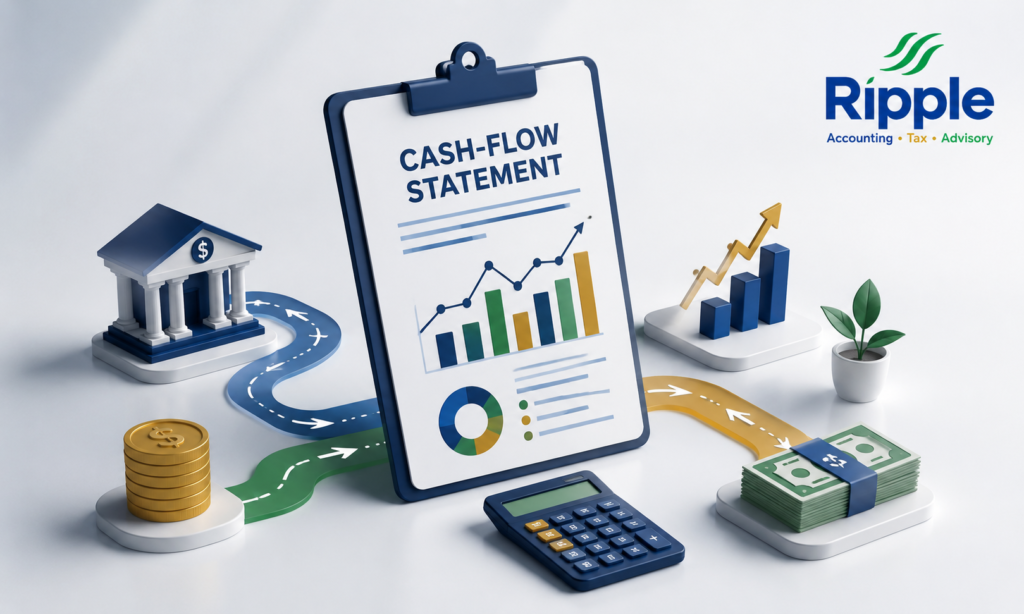
A cash-flow statement shows how cash moved into and out of a business during a specific period. It complements the income statement and balance sheet because profit alone does not tell you whether the business actually collected enough cash to pay its bills.
For example, imagine a UAE company makes an AED 100,000 credit sale in December. The sale increases revenue and may increase profit, but if the customer does not pay until January, the business has not yet received that AED 100,000 in cash.
This is why:
Profit does not always equal cash.
A company can report a profit and still experience a cash shortage because customers are paying slowly, inventory has increased, or significant loan or asset payments have been made.
The income statement generally follows accrual accounting, meaning revenue and expenses can be recognized before cash is received or paid. Cash flow reporting focuses on the actual movement of cash.
For example:
Understanding these differences is essential when preparing a cash flow statement UAE businesses can use for financial reporting and decision-making.
IAS 7 divides cash flows into three main categories.
| Section | What it shows | Examples |
| Operating activities | Cash generated or used by normal business operations | Customer receipts, supplier payments, employee payments |
| Investing activities | Cash related to long-term assets and investments | Buying equipment, selling property or investments |
| Financing activities | Cash related to funding the business | Loans received, loan repayments, share capital |
The direct vs indirect choice mainly concerns the presentation of operating cash flows. Investing and financing activities are reported separately under the cash-flow statement framework.
The direct method shows the actual cash received and paid from day-to-day business operations. For example:
In simple terms, the direct method answers: “How much cash actually came into and went out of the business?”
A simplified estimated calculation could look like this:
Cash received from customers
AED 800,000
Less: Cash paid to suppliers
AED 450,000
Less: Cash paid to employees
AED 180,000
Less: Other operating cash payments
AED 70,000
Net cash from operating activities = AED 100,000
The actual statement can contain additional categories depending on the nature of the business and applicable reporting requirements.
Simple UAE Business Example
Consider a Dubai-based trading company. During the year:
The business generated:
AED 2,000,000 − AED 1,100,000 − AED 400,000 − AED 200,000 = AED 300,000
So, its operating activities generated AED 300,000 of cash.
This format can be particularly easy for business owners to understand because it shows where the operating cash actually came from and where it went.
The direct method can provide several benefits:
IAS 7 specifically notes that the direct method can provide information useful for estimating future cash flows that is not available in the same way through the indirect method.
The main challenge is data. A business needs sufficiently detailed information about actual cash receipts and payments. If its accounting records are primarily designed around accrual accounting, additional work may be required to convert the information into the required cash categories.
For businesses with large transaction volumes, multiple bank accounts or complex operations, preparing this information can therefore require more effort.
The indirect method cash flow statement takes a different route. Instead of starting with cash received and paid, it starts with an accounting profit figure and then adjusts that figure to determine operating cash flow.
In simple terms:
Profit → Adjustments → Operating cash flow
IAS 7 explains that the indirect method adjusts profit or loss for items such as non-cash transactions, accruals and deferrals, changes in operating receivables and payables, and items whose cash effects belong to investing or financing activities.
A simplified example might look like this:
| Adjustment | AED |
| Net profit | 250,000 |
| Add: Depreciation | 40,000 |
| Less: Increase in receivables | (70,000) |
| Add: Increase in payables | 30,000 |
| Net operating cash flow | 250,000 |
The purpose is not simply to add and subtract random figures. Each adjustment explains why accounting profit is different from the cash generated by operating activities.
Depreciation reduces accounting profit because the cost of an asset is allocated over its useful life. However, depreciation itself does not represent a current-period cash payment. Therefore, when starting from profit under the indirect method, depreciation is added back as a non-cash expense.
Working capital is another major reason profit and cash can differ. Suppose a UAE consulting company records AED 500,000 of sales during the year, but AED 150,000 remains unpaid by customers at year-end. The business may recognize the revenue and profit, but it has not collected all the related cash.
Similarly, if the company delays paying suppliers, its cash position may temporarily be higher even though the related expenses have already been recognized. The indirect method captures these movements through working-capital adjustments.
The indirect method:
The main weakness is that it is less intuitive for someone who simply wants to know:
“How much cash did customers pay us?”
It does not present operating cash receipts and payments as directly as the direct method. Instead, the reader must understand the adjustments between profit and cash.
The following comparison makes the cash flow direct vs indirect decision easier to understand:
| Factor | Direct Method | Indirect Method |
| Starting point | Actual cash receipts and payments | Profit or loss |
| Main focus | Shows where operating cash came from and went | Explains the difference between profit and operating cash |
| Cash visibility | High | Moderate |
| Preparation | Can require detailed cash information | Often easier using existing accounting records |
| Working capital | Not the main focus | Clearly highlights working-capital changes |
| Connection with profit | Less direct | Strong |
| Ease for business owners | Generally easier to understand | Requires more accounting knowledge |
| Forecasting usefulness | Strong visibility into cash categories | Useful for understanding cash conversion |
| Best suited for | Businesses wanting detailed cash visibility | Businesses wanting reconciliation between profit and cash |
Yes, when prepared correctly.
The difference is primarily in how operating cash flow is presented and calculated, not in the underlying amount of cash generated. IAS 7 permits either approach for operating activities.
For example, if a business generates AED 500,000 of net cash from operating activities, both methods should ultimately arrive at that AED 500,000 figure, even though one starts with cash receipts and payments while the other starts with profit and adjustments.
There is no universal answer that makes one method best for every business. The appropriate choice depends on the business’s reporting framework, accounting systems, available data, and the needs of management and other financial statement users.
The direct method may be attractive when your business:
For example, a growing UAE SME experiencing collection problems may benefit from seeing exactly how much cash is being collected from customers rather than only seeing an indirect reconciliation from profit.
The indirect method may be more practical when:
For many businesses, this can make preparation more efficient because the required information can be derived from existing accounting records.
UAE SMEs should not choose a method simply because another company uses it.
Instead, consider:
For entities applying the IFRS for SMEs Accounting Standard, the IFRS Foundation also permits operating cash flows to be presented using either the indirect or direct method.
IAS 7 is the key international accounting standard governing the statement of cash flows. It requires cash flows to be classified into operating, investing, and financing activities and permits operating cash flows to be presented using either the direct or indirect method.
The direct method discloses major classes of gross cash receipts and gross cash payments. For example:
IAS 7 encourages the direct method because it can provide information useful for estimating future cash flows.
Under the indirect method, profit or loss is adjusted for:
This creates a bridge between accounting profit and operating cash flow.
For UAE businesses preparing financial statements under IFRS or the IFRS for SMEs framework, understanding the applicable requirements is important for consistent financial reporting.
However, businesses should not assume that one method is universally required for every UAE entity. The appropriate reporting requirements can depend on the applicable accounting framework and the nature of the entity.
Even a correctly selected method can produce misleading information if the underlying accounting records are incomplete.
1. Confusing Profit With Cash: A profitable business can still have insufficient cash. Credit sales, delayed customer payments, and inventory purchases can all create a difference.
2. Ignoring Working-Capital Changes: Receivables, payables and inventory can significantly affect operating cash flow. Ignoring them can make cash performance appear stronger or weaker than it really is.
3. Treating Depreciation as a Cash Expense: Depreciation reduces accounting profit but is a non-cash expense. It therefore requires appropriate treatment under the indirect method.
4. Mixing Operating, Investing and Financing Activities: Buying equipment is different from paying suppliers. Similarly, receiving a business loan is different from collecting customer revenue. Each cash movement needs to be classified appropriately.
5. Using Incomplete Accounting Records: If bank accounts are not reconciled or transactions are missing, the cash-flow statement may not accurately reflect the business’s position.
6. Failing to Reconcile the Closing Cash Balance: The ending cash reported in the cash-flow statement should be consistent with the relevant cash and cash-equivalent balances in the financial records.
Choosing between the direct and indirect method is only one part of effective cash flow reporting UAE businesses need.
If customer collections are significantly below expectations, management can investigate before the issue becomes a serious liquidity problem.
Preparing a useful cash-flow statement requires more than putting numbers into a template. Businesses need accurate bookkeeping, properly classified transactions, and reliable financial records.
Ripple Accountant can support UAE businesses with accounting and financial reporting needs, including cash-flow reporting and related financial management processes.
For UAE SMEs, this can turn the cash-flow statement from a year-end reporting requirement into a practical management tool.
Need Help With Cash-Flow Reporting? Contact the Ripple Accountant team for support with cash-flow statements, financial reporting, and cash-flow forecasting.
The direct method presents major operating cash receipts and payments. The indirect method starts with profit or loss and adjusts it for non-cash items, working-capital changes and other relevant items to calculate operating cash flow.
Neither is universally better. The direct method provides clearer visibility into actual cash receipts and payments, while the indirect method makes it easier to understand the relationship between profit and cash.
Yes. When correctly prepared, both methods should arrive at the same net cash flow from operating activities. They simply present and calculate the operating section differently.
The indirect method can often be easier when a business already has reliable accrual-based accounting records. The direct method may require more detailed information about actual cash receipts and payments.
Yes. IAS 7 permits entities to report operating cash flows using either the direct or indirect method. The standard also encourages the direct method.
The indirect method is widely used in practice, particularly where businesses already maintain accrual-based financial statements. However, IAS 7 permits both methods. The IFRS Foundation’s analysis has also shown substantially more entities in its sample using the indirect method.
The choice between the direct and indirect cash flow statement is ultimately a choice about how you want to explain operating cash flow. For UAE businesses, the right approach should be based on the applicable accounting framework, reporting requirements, management needs, and quality of accounting records, not simply on which method appears easier.
Disclaimer: This article is intended for general educational and informational purposes only. It does not constitute legal, tax, accounting, audit, or regulatory advice. UAE requirements can vary depending on the business structure, activity, location, tax status, and applicable regulatory framework. Businesses should obtain professional advice based on their specific circumstances.
Tell us a little about your business and our UAE tax experts will get back to you with clear, practical answers — no obligation.
 VAT
VAT
When does VAT registration become mandatory for a UAE business, and when is it simply an option? For UAE businesses, the answer…
Read article Compliance
Are your employees being paid on time, and does your payroll data match what is being submitted through the Wage Protection System…
Read article Compliance
Have you recently added a new activity to your UAE trade licence? Before you start generating revenue from it, it is worth…
Read articlePage 9 of 45
Book a free consultation and get clear answers for your business.
0 Comments