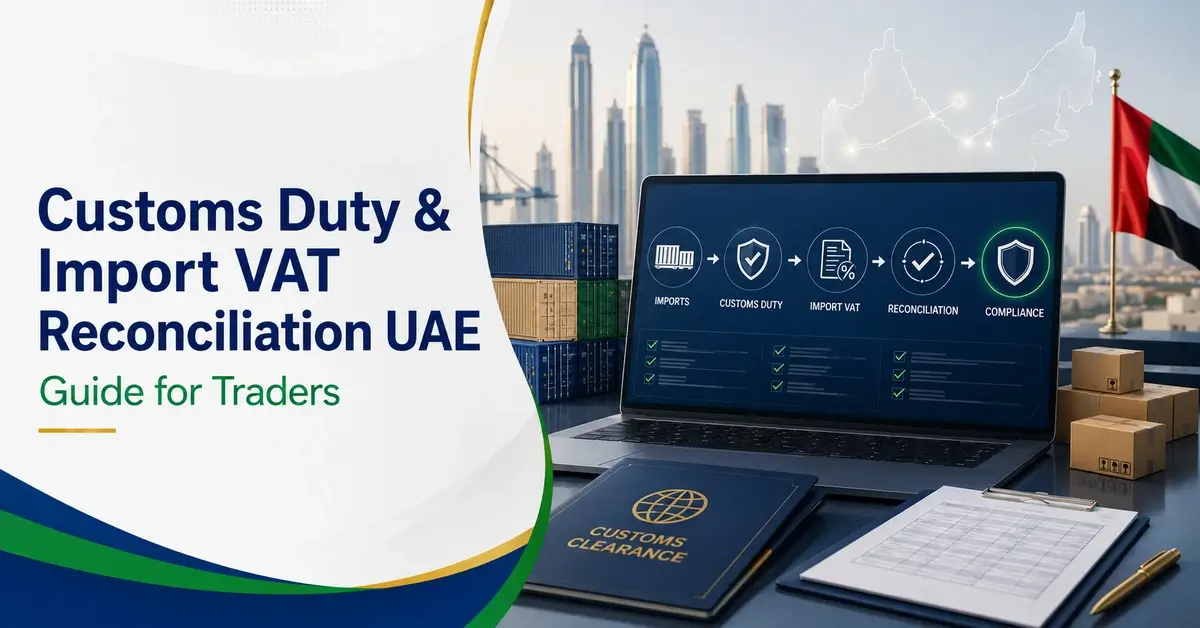
Customs Duty & Import VAT Reconciliation UAE: Guide for Traders
M Maria September 4, 2026 12 min read
Are your customs duty and import VAT records accurate?
For high-volume UAE traders, managing multiple shipments can make reconciliation challenging. Customs duty and import VAT reconciliation UAE helps businesses match customs declarations, import VAT, and accounting records, identify discrepancies, and maintain accurate documentation.
So, how can businesses manage this process effectively? Let’s explore.
What Is Customs Duty and Import VAT Reconciliation UAE?
Customs duty and import VAT reconciliation is the process of comparing import-related transactions recorded across different systems and documents. For a typical UAE importer, the relevant information may exist in:
Customs declarations
Commercial invoices
Packing lists
Bills of lading or airway bills
Certificates of origin
Customs duty records
Import VAT records
Freight and insurance documents
Supplier accounts payable records
Inventory records
General ledger accounts
VAT return data
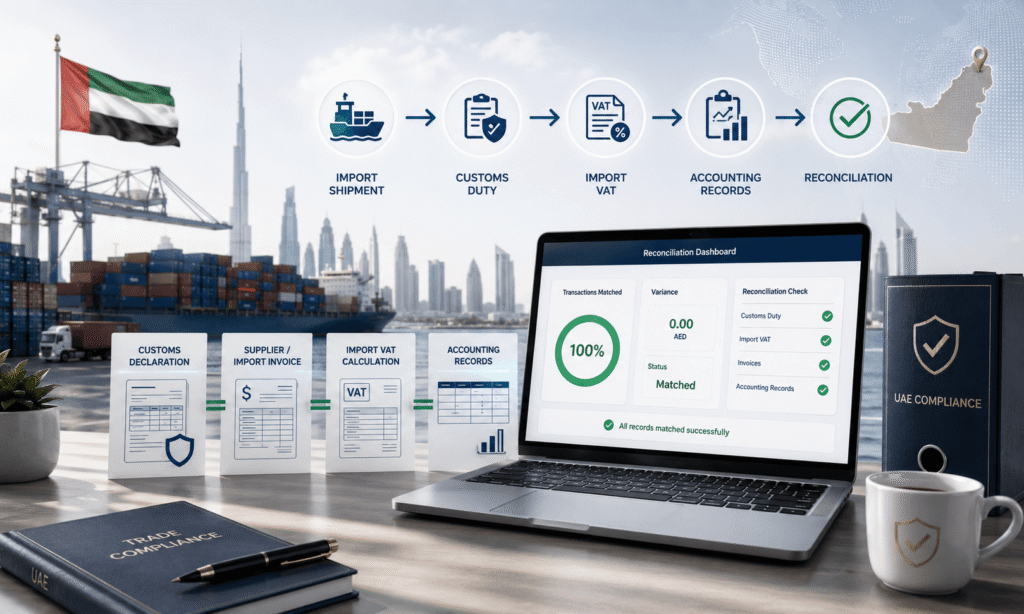
The objective is to establish a clear connection between the physical import, customs declaration, tax treatment and accounting entry.
For high-volume traders, manual comparison becomes increasingly difficult because hundreds of declarations may relate to multiple suppliers, currencies, products and shipments.
A structured reconciliation process can therefore help identify missing declarations, duplicated entries, incorrect customs values, VAT differences and accounting errors before they affect financial statements or VAT returns.
Why Import Reconciliation Matters for UAE Traders
Import reconciliation is not simply an accounting exercise. It can affect several areas of a trading business.
1. Accurate VAT reporting
Registered businesses must correctly account for imports for VAT purposes. The FTA VAT Import Declaration User Guide explains different scenarios for VAT-registered importers and the process for declaring imports.
The FTA also explains that imports can be relevant when determining VAT registration obligations where the imported goods would be taxable if supplied within the UAE.
If accounting records do not agree with customs and VAT records, the business may need to investigate and correct the difference.
2. Correct inventory costing
Customs duties, freight, insurance and other import-related costs can affect the cost attributed to imported inventory depending on the applicable accounting treatment. If these costs are omitted, duplicated or allocated incorrectly, management may receive an inaccurate view of gross margins.
For high-volume traders, even a small per-shipment error can become material when multiplied across hundreds of transactions.
3. Better cash-flow visibility
Importers often pay significant amounts before goods are sold.
Reconciling customs duties and import VAT allows finance teams to understand how much cash is being committed to imports and whether tax-related balances have been properly recorded.
4. Audit and FTA readiness
A well-organised reconciliation creates an evidence trail linking the accounting ledger to underlying import documentation. Dubai Customs states that an importer or representative must declare the value of imported goods as part of the customs declaration and provide the supporting invoice.
Maintaining these documents in an organised manner makes it easier to investigate discrepancies and respond to information requests.
How Import VAT and Customs Duty Connect
One of the most important concepts for UAE traders is understanding the relationship between customs duty and import VAT.
Customs duty and VAT are separate charges, but the customs-related amounts can affect the calculation of import VAT.
The FTA VAT Returns User Guide explains that the value of an import includes the customs value, insurance, freight, customs fees and applicable excise tax. It also states that import VAT is imposed on top of customs duties.
A simplified illustration is:
Customs value + relevant costs + customs duty = VAT import value
The applicable VAT rate is then applied to the relevant taxable import value.
However, businesses should not treat this formula as a substitute for checking the actual tax treatment of each transaction. Certain goods, import arrangements, designated-zone transactions and other circumstances can have different VAT consequences.
For this reason, the reconciliation should begin with the actual customs declaration and the applicable FTA treatment rather than relying only on an accounting system calculation.
What Should Be Reconciled?
A robust reconciliation should compare several fields rather than only the total customs duty.
Customs declaration vs accounting records
Compare:
Declaration number
Import date
Supplier
Importer
Currency
Customs value
Customs duty
Other customs charges
Import VAT
Total amount
Accounting reference
Customs declaration vs supplier invoice
Check whether:
Supplier name matches
Invoice number matches
Product quantities are consistent
Currency is correctly recorded
Declared values are supported
Relevant shipping costs have been considered
Any discounts or adjustments are appropriately documented
Dubai Customs lists an invoice, packing list, certificate of origin, and relevant permits among the documents required for its customs declaration service, depending on the transaction.
Import VAT vs VAT records
The finance team should compare the import information appearing in customs/FTA records against the VAT accounting records and VAT return.
The FTA VAT Returns User Guide specifically explains that businesses can compare imports appearing in the VAT return with their customs and, where applicable, excise tax import declarations and make adjustments where necessary.
A Practical Customs Duty Reconciliation Process
High-volume traders can establish a monthly or periodic reconciliation workflow.
Step 1: Extract the customs data
Obtain the relevant customs declaration information for the reconciliation period. Depending on the emirate and customs authority, this may come from the applicable customs platform or records maintained by the customs broker.
For example, Dubai Customs provides a customs declaration service covering import, export, transit, transfer and temporary admission regimes.
Step 2: Extract the accounting data
Export the corresponding import-related transactions from the accounting system. Useful fields include:
Supplier
Invoice number
Purchase order
Goods receipt
Customs declaration number
Inventory account
Customs duty account
Import VAT account
Freight account
Date
Amount
Currency
Step 3: Match transactions
Use a unique reference wherever possible. A customs declaration number is particularly useful because it can connect customs documentation with the corresponding accounting transaction.
For high-volume businesses, automated matching can use combinations such as:
Declaration number + supplier + invoice number + import date
Step 4: Investigate unmatched transactions
Create an exception report containing:
Customs entries with no accounting entry
Accounting entries with no customs declaration
Differences in customs value
Differences in customs duty
Differences in import VAT
Duplicate declarations
Duplicate accounting entries
Incorrect dates
Missing supporting documents
Step 5: Review the differences
Not every difference automatically means an error. For example, timing differences can occur when goods are cleared through customs near the end of an accounting period, but the accounting entry is posted later. Other differences may arise from:
Currency conversion
Freight allocation
Customs adjustments
Credit notes
Returned goods
Partial shipments
Import-for-re-export arrangements
Different accounting cut-off dates
Each exception should therefore be investigated and documented.
Step 6: Post necessary corrections
After identifying a genuine accounting or VAT error, the finance team should determine the appropriate correction and ensure that the supporting documentation is retained. Where a VAT return requires an adjustment, the business should follow the applicable FTA rules and guidance rather than simply changing the accounting ledger.
Example: Import VAT Reconciliation
Imagine a UAE trading company imports goods with a customs value of AED 500,000.
The business also incurs relevant freight, insurance and customs-related costs. Customs duty is calculated according to the applicable customs rules.
The finance team records the supplier invoice in the accounting system but fails to capture the customs duty correctly. As a result:
Inventory cost may be understated.
The customs duty expense or inventory component may be incorrect.
The import VAT calculation may not agree with the customs information.
The VAT reconciliation may show an unexplained difference.
Management reports may show an inaccurate gross margin.
A reconciliation would identify the difference by comparing the customs declaration, supporting documents, VAT records and accounting entries.
The important lesson is that import VAT reconciliation should not be performed in isolation from customs and accounting records.
Common Import Reconciliation Problems in High-Volume Trading
Missing customs declarations: A customs entry may exist but have no corresponding accounting transaction.
Duplicate entries: The same import may be entered twice, particularly when information is received from both a customs broker and an internal purchasing team.
Incorrect customs value: The customs value in the accounting system may differ from the value declared to Customs. Dubai Customs confirms that the value of imported goods must be declared and supported by an invoice.
Incorrect import VAT: The VAT amount recorded in the accounting system may not agree with the relevant import records.
Timing differences: A shipment cleared at the end of one month may be posted in the accounting system in the following month.
Currency differences: Supplier invoices may be denominated in USD, EUR, GBP or another currency while customs and accounting records are converted into AED.
Unallocated freight and insurance: Import-related freight and insurance may be recorded separately without being appropriately connected to the relevant shipment or inventory transaction.
Poor broker documentation: When customs brokers handle large numbers of shipments, businesses may receive incomplete or inconsistently formatted documentation.
How High-Volume Traders Can Improve Reconciliation
Maintain a central import register
Create a master import register containing at least:
Field
Purpose
Customs declaration number
Primary matching reference
Import date
Period and cut-off control
Supplier
Vendor verification
Invoice number
Document matching
Customs value
Customs reconciliation
Customs duty
Duty reconciliation
Import VAT
VAT reconciliation
Freight
Import-cost analysis
Insurance
Import-cost analysis
Accounting reference
Ledger matching
VAT return period
Tax reporting control
Reconciliation status
Exception tracking
Use exception-based review
Finance teams should avoid manually reviewing every field every month if technology can perform the initial matching. Instead, the system can identify transactions that do not match and direct the finance team towards exceptions.
Reconcile regularly
For a business handling a small number of imports, monthly reconciliation may be sufficient. For high-volume traders, weekly or even more frequent monitoring can reduce the number of unresolved transactions accumulating at month-end.
Keep supporting documents together
A reconciliation should be supported by an organised document trail. Dubai Customs’ customs declaration service identifies documents such as invoices, packing lists, certificates of origin and permits among the required documentation, depending on the transaction.
Businesses should establish a consistent naming and filing structure so that a declaration can quickly be traced back to the relevant commercial documents.
When Should a Business Perform Import Reconciliation?
A high-volume trader should consider reconciliation at several levels.
During the month: Monitor unusual or high-value import transactions and unresolved customs entries.
At month-end: Reconcile customs declarations with accounting records to identify cut-off and posting issues.
Before VAT return preparation: Compare import records with VAT accounting and the relevant information available for VAT reporting.
Before an audit or FTA review: Perform a deeper review of outstanding differences and supporting documentation.
After system or broker changes: A new ERP, accounting system, customs broker or warehouse process can introduce mapping and data-transfer errors. A focused reconciliation after the change can identify problems early.
How Ripple Helps UAE Trading Businesses
High-volume import reconciliation can become difficult when customs data, supplier invoices, inventory records and VAT information are maintained across different systems.
Ripple Accounting supports UAE businesses with accounting, bookkeeping, VAT compliance, financial reporting and tax-related services. For trading businesses, Ripple can help establish cleaner accounting records, reconcile transactions and organize financial information so that import-related data can be reviewed more efficiently.
If your business handles a large number of imports, Contact Ripple for a consultation to discuss your accounting and VAT compliance needs.
Email: info@uaetaxcompliance.ae
Phone: +971 52 356 5409
WhatsApp: +971 4 250 0833
Frequently Asked Questions
What is customs duty reconciliation in the UAE?
Customs duty reconciliation is the process of comparing customs declarations and duty amounts against accounting records and supporting import documents to identify discrepancies.
Is import VAT the same as customs duty?
No. Customs duty and VAT are separate charges. However, customs duty can form part of the value used to calculate import VAT. The FTA VAT Returns User Guide explains that import VAT is imposed on the import value, which includes customs-related components, and that import VAT is imposed on top of customs duties.
What documents should importers keep for reconciliation?
Depending on the transaction, businesses may need commercial invoices, packing lists, certificates of origin, permits, customs declarations, and related shipping and accounting documentation. Dubai Customs specifically identifies several of these documents for its customs declaration service.
How often should high-volume traders reconcile imports?
There is no single frequency that suits every business. High-volume traders should generally consider more frequent monitoring because discrepancies can accumulate quickly. Monthly reconciliation, supplemented by more frequent exception monitoring, is a practical approach for many businesses.
What happens if customs and accounting records do not match?
The difference should be investigated to determine whether it is a timing difference, currency issue, missing document, incorrect posting, duplicate transaction, or another legitimate adjustment. Genuine errors should be corrected using the appropriate accounting and VAT procedures.
Can an accounting firm help with import reconciliation?
Yes. An accounting provider can help businesses organise accounting records, reconcile transactions, investigate discrepancies, and prepare supporting information for VAT and audit-related processes.
Conclusion
For high-volume UAE traders, customs duty and import VAT reconciliation is an important financial control rather than simply an administrative task. When customs declarations, supplier invoices, import VAT, customs duty, inventory records and accounting entries are reconciled regularly, businesses can identify errors earlier and maintain more reliable financial and VAT records. The key is to establish a consistent process: capture the customs data, match it with accounting records, investigate exceptions, document the differences, and correct genuine errors promptly.
Disclaimer: This article is provided for general informational purposes only and does not constitute tax, accounting, legal, or professional advice. Regulations and requirements may change, and their application can vary depending on individual business circumstances. Readers should refer to the latest information from the relevant UAE authorities and seek professional advice where appropriate.
Environmental responsibilities have become an essential part of modern business operations. Companies across industries must consider not only their financial performance but…
Non-profit organizations play a vital role in supporting communities, advancing education, promoting healthcare, protecting the environment, and delivering humanitarian aid across the…
Businesses have traditionally relied on financial reports such as revenue, profit, cash flow, and expenses to evaluate performance. While these metrics remain…





0 Comments