How to Handle Errors in Bookkeeping: Correction Methods
Bookkeeping errors can happen in businesses of every size. Whether you manage your accounts manually or use accounting software, even a small…
Read article
Are you confused about whether registering for UAE Corporate Tax means that your company has already completed its tax filing obligation?
Corporate Tax registration and Corporate Tax filing are two separate compliance steps in the UAE. Registration establishes a business’s Corporate Tax account with the Federal Tax Authority (FTA), while filing involves submitting the Corporate Tax Return for a specific Tax Period and paying any Corporate Tax due.
For new companies and Free Zone entities, understanding this difference is important for avoiding missed deadlines and incomplete compliance. This guide explains the difference between Corporate Tax registration vs filing UAE businesses need to understand, including deadlines, EmaraTax procedures, records and common mistakes.
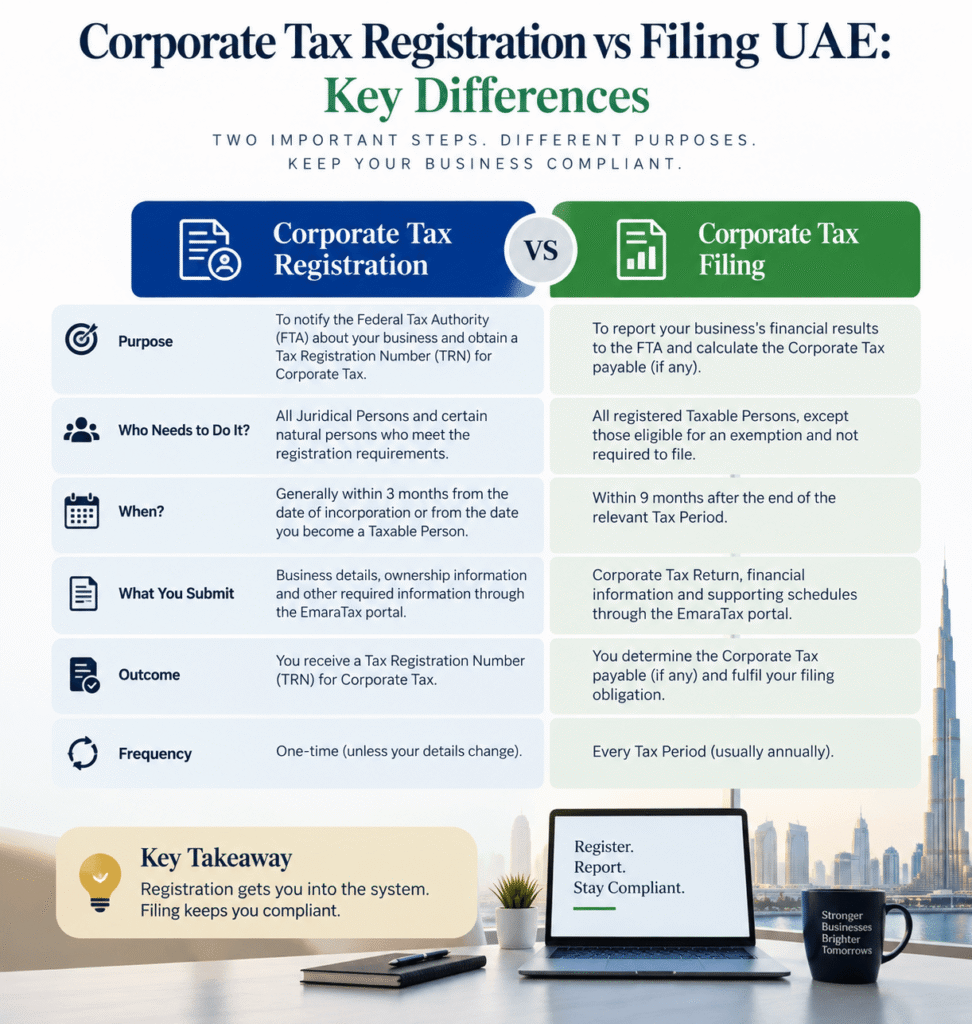
Corporate Tax registration and filing serve different purposes. Corporate Tax registration is the process through which a person required to register provides information to the FTA and obtains a Corporate Tax Registration Number.
Corporate Tax filing, on the other hand, is the submission of a Corporate Tax Return for a particular Tax Period. The return reports relevant financial and tax information and determines the Corporate Tax payable, if any.
The UAE Ministry of Finance explains that taxable persons are required to register for Corporate Tax and that Corporate Tax Returns are generally filed within nine months from the end of the relevant Tax Period.
Therefore:
Registration gives the business its Corporate Tax registration status; filing reports the business’s tax position for a specific Tax Period. Completing one does not mean the other has automatically been completed.

Corporate Tax registration is the first major administrative step for persons that fall within the UAE Corporate Tax registration requirements.
The FTA’s Corporate Tax Registration service enables persons subject to Corporate Tax to submit a registration application and obtain a Corporate Tax Registration Number. The service is available through the EmaraTax platform.
The registration requirements depend on the type and status of the person.
The FTA states that all taxable persons must register and obtain a Corporate Tax Registration Number. Certain Exempt Persons may also be required to register where the FTA requests them to do so.
For natural persons conducting a business or business activity in the UAE, the FTA states that registration is required where annual revenue exceeds the relevant threshold under the Corporate Tax Law.
For companies and other juridical persons, the applicable registration timeline depends on factors such as when the entity was incorporated, established or recognised and its specific circumstances.
Corporate Tax registration is completed electronically through EmaraTax.
The FTA’s current service process includes:
The FTA lists documents that may include the company’s incorporation documents, commercial registration certificate, valid trade licence and identification documents for relevant owners and authorised signatories.

Corporate Tax filing is the process of submitting a Corporate Tax Return to the FTA for a particular Tax Period.
Unlike registration, which establishes the taxpayer’s Corporate Tax account, filing reports the business’s tax position for the relevant period.
The UAE Corporate Tax regime operates on a self-assessment basis. The Ministry of Finance explains that taxable income is calculated by the taxable person and the resulting Corporate Tax liability is reported through the Corporate Tax Return.
A return can therefore involve reviewing accounting income, making the relevant Corporate Tax adjustments, determining taxable income and calculating the resulting tax liability.
The general filing deadline is within nine months from the end of the relevant Tax Period. The same general nine-month period applies to payment of Corporate Tax due for that Tax Period.
For example, if a company’s Tax Period ends on 31 December 2025, its Corporate Tax Return and payment of Corporate Tax due would generally be due by 30 September 2026.
The FTA specifically reminded taxpayers in September 2026 that taxpayers with a 31 December 2025 year-end were required to file and pay by 30 September 2026.
No.
This is one of the most important distinctions for new companies.
The deadline to register for Corporate Tax is determined by the applicable registration rules and the taxpayer’s circumstances.
The deadline to file is generally determined by the end of the relevant Tax Period.
For example, a newly incorporated company may have to register within its applicable registration deadline, but its first Corporate Tax Return will generally be filed after the end of its first Tax Period.
Businesses should therefore track these as two separate compliance dates.
Preparing a Corporate Tax Return requires more information than simply having a Corporate Tax Registration Number.
Businesses should generally have their accounting and tax records organised before filing.
Depending on the business, this may include:
The exact information required depends on the taxpayer’s circumstances and the applicable Corporate Tax rules.
The FTA has emphasised that taxable persons must retain records and documentation supporting information provided in their Tax Returns.
| Area | Corporate Tax Registration | Corporate Tax Filing |
| Purpose | Registers the taxpayer with the FTA | Reports the tax position for a Tax Period |
| Result | Corporate Tax Registration Number | Submitted Corporate Tax Return |
| Timing | Depends on applicable registration rules | Generally within 9 months after the Tax Period |
| Platform | EmaraTax | EmaraTax |
| Financial information | Basic business and registration information | Detailed accounting and tax information |
| Tax calculation | Not the main purpose | Determines taxable income and Corporate Tax payable |
| Payment | Registration itself is not a tax payment | Any Corporate Tax due is generally paid with the return |
| Recurring obligation | Registration remains relevant while applicable | Return generally required for each relevant Tax Period |
The distinction is important because a company can be successfully registered but still have an outstanding filing obligation.
Free Zone businesses should not assume that Free Zone status removes their Corporate Tax registration obligation.
The Ministry of Finance specifically states that Free Zone Persons are included among persons required to register for Corporate Tax.
However, registration and the eventual calculation of Corporate Tax are separate matters.
A Free Zone business may need to assess whether it qualifies for the Qualifying Free Zone Person regime and whether particular income meets the conditions for the applicable tax treatment.
Therefore, Free Zone businesses should distinguish between:
Free Zone status by itself should not be treated as a reason to ignore Corporate Tax registration or filing requirements.
Registration does not end the business’s Corporate Tax responsibilities.
Once registered, the business needs to continue monitoring its Corporate Tax obligations.
These can include:
The business should maintain financial records that support its Corporate Tax position.
Accounting information should be reviewed and reconciled before the filing deadline.
The return should be submitted through the applicable FTA process within the statutory deadline.
Where Corporate Tax is payable, the amount should be settled within the applicable deadline.
Businesses should retain records supporting the information included in their Corporate Tax Return.
The FTA has stated that taxable persons and certain exempt persons must retain relevant records and documents for at least seven years following the end of the relevant Tax Period.
A new company can use a simple compliance process to avoid confusing registration with filing.
Determine whether the company falls within the Corporate Tax registration requirements.
Check the applicable registration timeline based on the company’s legal form, incorporation date and circumstances.
Submit the required information and supporting documents to the FTA through EmaraTax.
Identify the company’s relevant Tax Period and financial year.
Keep the accounting records needed to support the eventual Corporate Tax calculation.
Before the filing deadline, review the financial statements, accounting records and relevant Corporate Tax adjustments.
File the return through EmaraTax within the applicable deadline and pay any Corporate Tax due.
Late registration can result in an administrative penalty.
The FTA’s current Corporate Tax Registration service states that an administrative penalty of AED 10,000 applies for late Corporate Tax registration.
However, the FTA also has a specific initiative concerning the waiver of the late registration penalty where qualifying conditions are satisfied.
Under the initiative, eligible persons may have the late registration penalty waived if they submit their first Tax Return, or Annual Declaration where applicable, within seven months from the end of their first Tax Period or first Financial Year.
This seven-month condition relates specifically to the penalty-waiver initiative. It should not be confused with the general Corporate Tax Return deadline of nine months.
Businesses should check the current FTA requirements before relying on the waiver.
Late filing can result in administrative penalties. The FTA has stated that late submission of a Tax Return or late payment of Corporate Tax can trigger penalties, including AED 500 per month or part of a month during the first 12 months, increasing to AED 1,000 per month or part of a month from the thirteenth month onward, under the applicable penalty rules.
This makes it important for businesses to prepare their accounting and tax information well before the filing deadline rather than waiting until the final weeks.
New UAE companies can use the following checklist as a starting point:
This checklist should be adapted to the company’s legal structure, activities and specific Corporate Tax position.
Understanding Corporate Tax registration vs filing UAE requirements is only the first step. Businesses also need to ensure that their accounting records, Tax Period, registration information and Corporate Tax calculations are aligned before filing.
Ripple Accounting, Tax & Advisory can support UAE businesses with Corporate Tax compliance, including registration-related requirements, preparation of accounting information, Corporate Tax return support and related compliance reviews.
If you have recently established a UAE company, operate a Free Zone entity or are unsure whether your registration and filing obligations are up to date, contact Ripple Accounting, Tax & Advisory for a tailored compliance review and practical support based on your business circumstances.
No. Corporate Tax registration establishes the taxpayer’s registration with the FTA and results in a Corporate Tax Registration Number. Filing involves submitting a Corporate Tax Return for a specific Tax Period.
A Corporate Tax Return is generally due within nine months from the end of the relevant Tax Period. The same general deadline applies to payment of Corporate Tax due.
Free Zone Persons are included among persons required to register for Corporate Tax. However, their eventual Corporate Tax treatment depends on their circumstances and whether they meet the conditions for any applicable Free Zone regime.
Yes. Registration and filing are separate obligations. A company can have a Corporate Tax Registration Number while still needing to submit its Corporate Tax Return for a completed Tax Period.
Yes. The FTA currently states that an AED 10,000 administrative penalty applies for late Corporate Tax registration. An FTA waiver initiative may apply to eligible taxpayers who satisfy its specific conditions, including the seven-month first-return requirement.
Corporate Tax registration and filing are connected but separate UAE tax obligations. Registration establishes the business’s Corporate Tax status with the FTA, while filing reports the company’s tax position for a specific Tax Period. Businesses should track the applicable registration deadline separately from the Corporate Tax Return deadline, maintain reliable accounting records and prepare supporting documents before filing. For most taxable persons, the Corporate Tax Return is generally due within nine months from the end of the relevant Tax Period. Keeping these obligations separate in your compliance calendar can help prevent missed deadlines and avoidable penalties.
Disclaimer: This article provides general information about Corporate Tax registration and filing requirements in the UAE. Tax rules, deadlines, penalties and administrative procedures may change, and the requirements applicable to a business depend on its legal structure, activities, Tax Period and individual circumstances. This content should not be treated as tax or legal advice. Businesses should review the latest FTA and Ministry of Finance guidance and obtain professional advice where required.
Tell us a little about your business and our UAE tax experts will get back to you with clear, practical answers — no obligation.
 Bookkeeping
Bookkeeping errors can happen in businesses of every size. Whether you manage your accounts manually or use accounting software, even a small…
Read article Bookkeeping
Managing payroll is one of the most important responsibilities for any business. Employees expect to receive accurate salaries on time, while businesses…
Read article Audit
Audit
Investing in a company involves more than reviewing its profits or growth projections. Investors need reliable financial information to understand whether a…
Read articlePage 41 of 44
Book a free consultation and get clear answers for your business.
0 Comments