Corporate Tax Registration vs Filing in the UAE
Are you confused about whether registering for UAE Corporate Tax means that your company has already completed its tax filing obligation? Corporate…
Read article
Are your sales increasing while your gross margin is getting weaker?
For UAE trading businesses, margin leakage can come from purchasing errors, inventory movements, landed costs, returns and incorrect cost allocations. Strong COGS controls UAE help ensure every product sold carries an accurate and properly supported cost. This improves gross-margin reporting, inventory valuation and financial decision-making while supporting reliable accounting records for UAE Corporate Tax calculations.
So, how can UAE trading businesses strengthen COGS and prevent avoidable margin leakage? Let’s explore the key controls.

Cost of Goods Sold represents the cost associated with products that a business has sold during a particular period. For a trading company, COGS generally connects three key components:
Opening inventory + Purchases and directly attributable costs − Closing inventory = COGS
For example, suppose a UAE distributor starts the month with AED 500,000 of inventory, purchases AED 1 million during the month and finishes with AED 600,000 of inventory.
Its basic COGS calculation would be:
AED 500,000 + AED 1,000,000 − AED 600,000 = AED 900,000
If sales for the same period are AED 1.3 million, the gross profit would be AED 400,000 and the gross margin would be approximately 30.8%.
However, the calculation is only useful when the underlying purchasing, inventory and costing data is accurate.
The Federal Tax Authority’s Determination of Taxable Income guide also provides examples where cost of goods sold is presented as an expenditure in determining accounting income.
Margin leakage occurs when a business loses expected profit through costs, pricing issues, operational errors or transactions that are not properly controlled. In a trading business, some common causes include:
For example, a company may believe that a product costs AED 100 because that is the supplier invoice price. But after freight, insurance and other directly attributable import costs, the actual landed cost may be AED 108.
If the product is sold for AED 120, the business may believe it is earning a 20% gross margin based on its purchase price. The actual margin is lower once the complete product cost is considered. This is why COGS controls should not be treated as a purely bookkeeping exercise.
Trading companies can have hundreds or thousands of SKUs, multiple suppliers, frequent imports and constantly changing purchase prices. Without appropriate controls, management may receive a gross-margin report that looks precise but is based on incomplete costing data.
Strong COGS controls can help businesses:
The UAE Ministry of Finance explains that accounting income is generally the starting point for determining taxable income, followed by the adjustments required under the Corporate Tax rules. This makes reliable accounting data particularly important for businesses preparing their financial statements and Corporate Tax computations.
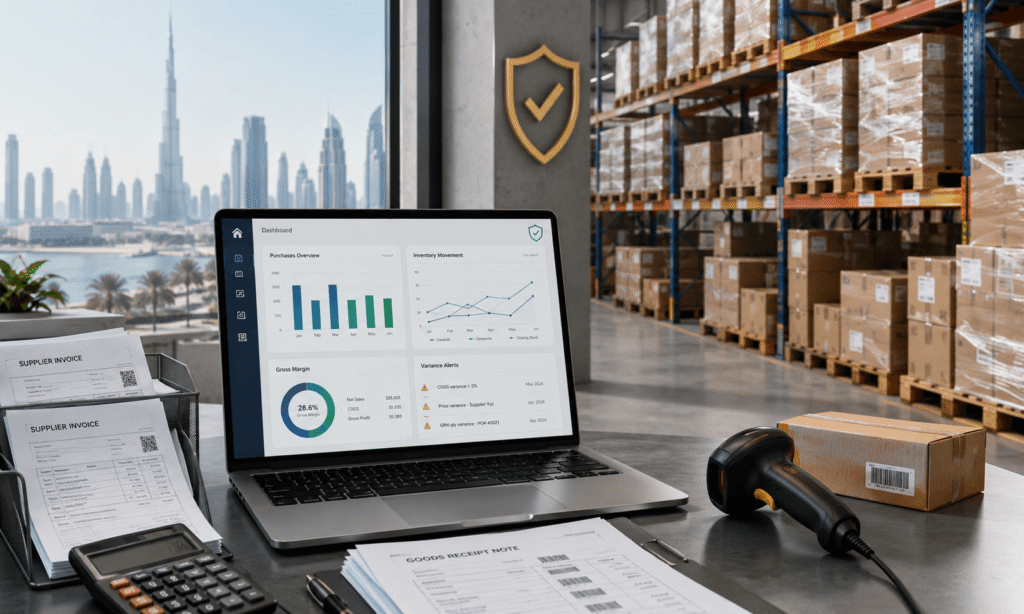
One of the first controls should be a three-way matching process. The accounting team should compare:
Purchase Order → Goods Received Note → Supplier Invoice
The objective is to confirm that:
For example, if a company orders 1,000 units at AED 50 each but receives only 950 units, an invoice for 1,000 units should not automatically be posted without investigation. Small differences repeated across multiple suppliers can materially affect inventory and COGS.
For UAE importers, purchase price alone may not represent the complete cost of bringing goods into inventory. Depending on the transaction and applicable accounting treatment, businesses may need to consider costs associated with importing and bringing inventory to its required location and condition.
Potential components can include:
If these costs are excluded or incorrectly expensed, product-level margins can become distorted.
Example
A business imports goods with a supplier invoice value of AED 200,000. It also incurs:
If the relevant costs are appropriately attributable to inventory, the accounting team needs to ensure they are captured consistently within the company’s costing methodology.
A product that appears profitable based only on the supplier invoice may therefore have a substantially different true margin.
One of the most important COGS controls UAE businesses can implement is a monthly inventory-to-GL reconciliation. The inventory subledger should be compared with the relevant general-ledger accounts.
Investigate differences caused by:
The reconciliation should not simply identify a difference. It should document why the difference exists and how it was resolved.
System inventory should be tested against physical inventory. A business can perform:
Suppose the system shows 5,000 units of a product, while a physical count finds only 4,900 units. The 100-unit difference needs investigation.
Possible causes include:
Ignoring such differences can cause both inventory and COGS to become unreliable.
The Federal Tax Authority provides guidance on understanding taxpayer obligations and maintaining relevant tax information and records.
Returns can create significant COGS errors if they are not processed correctly. For a customer return, the business should determine whether:
A returned product should not automatically be treated as normal inventory. Similarly, supplier returns should be properly removed from inventory and reflected in the relevant supplier and inventory records.
A monthly return report can help identify unusual patterns by supplier, product or sales channel.
Supplier prices frequently change. A business that purchases the same SKU at AED 40, AED 43 and AED 48 during different months should monitor those movements.
A purchase-price variance report can show:
| SKU | Previous Cost | Current Cost | Variance |
| Product A | AED 40 | AED 42 | +AED 2 |
| Product B | AED 75 | AED 73 | -AED 2 |
| Product C | AED 100 | AED 115 | +AED 15 |
Large variances should trigger investigation. The business may need to determine whether the change resulted from:
This information is particularly useful for pricing decisions.
Company-wide gross margin can hide serious problems. Suppose a trading company reports a 25% overall gross margin. That does not necessarily mean every product line is profitable. One product may generate a 40% margin while another produces only 5%.
Therefore, management should periodically review:
Sales price − product cost = gross profit
and
Gross profit ÷ sales price × 100 = gross margin percentage
Product-level reporting can help identify:
A monthly COGS variance report can identify problems before they become significant.
Management can compare:
For example, if sales remain relatively stable but COGS suddenly increases from 70% to 82% of revenue, management should investigate. The increase may be genuine, but it could also indicate:
Incorrect master data can create COGS problems without being immediately obvious. Each SKU should have clearly defined information such as:
Duplicate SKUs are particularly dangerous. If the same product exists under multiple codes, inventory may become fragmented and management may receive misleading margin information. Master-data changes should therefore be controlled and reviewed.
Month-end cut-off is another important area. The accounting team should confirm that purchases and sales are recorded in the correct accounting period.
For example, goods received before month-end but invoiced later may need appropriate accounting treatment under the company’s accounting policies.
Similarly, goods dispatched before year-end should not be left in inventory if the relevant sale has been recognised.
Incorrect cut-off can distort both:
for the reporting period.
COGS controls are primarily an accounting and management control, but accurate accounting records can also support tax compliance. The UAE Corporate Tax framework generally starts the taxable-income calculation from accounting income, followed by specified tax adjustments.
The FTA’s Determination of Taxable Income guide demonstrates COGS as an expenditure item and separately illustrates adjustments relating to unrealised inventory losses. This is an important reminder that accounting treatment and Corporate Tax treatment should not automatically be assumed to be identical in every situation.
Businesses should therefore maintain supporting records that allow COGS and inventory figures to be traced back to underlying transactions.
A strong COGS control environment should create an audit trail from the financial statements back to individual transactions. Depending on the business, this may include:
The FTA has also issued FTA Decision No. 4 of 2026, covering rules and requirements for maintaining information contained in accounting records and commercial books. The decision was published by the FTA on 20 August 2026.
Businesses should review the official decision and applicable tax legislation to understand the requirements relevant to their circumstances.
Before closing each month, a UAE trading company can use the following checklist:
This checklist can turn COGS review from a year-end exercise into a continuous management control.
Accurate COGS requires more than entering supplier invoices into accounting software. Businesses need connected controls across purchasing, inventory, imports, sales and financial reporting. ,Ripple Accountant can help UAE trading businesses strengthen their accounting processes, reconcile inventory and COGS, improve financial reporting, and identify areas where margin leakage may be occurring. From bookkeeping and account reconciliations to VAT and Corporate Tax support, a structured accounting process can give management better visibility over product costs and profitability.
If your UAE trading business is experiencing unexplained margin reductions, inventory differences or inconsistent COGS figures, contact Ripple Accountant to review your accounting and control processes.
COGS controls are accounting and operational procedures used to ensure that the cost assigned to goods sold is complete, accurate and properly supported. They can include purchase matching, inventory reconciliation, stock counts, landed-cost reviews, and margin analysis.
COGS directly affects gross profit and gross-margin reporting. Incorrect COGS can make products appear more or less profitable than they actually are and can lead to unreliable management reports.
The appropriate treatment depends on the nature of the cost and the applicable accounting framework and company accounting policy. Trading businesses should assess costs associated with bringing inventory to its required location and condition rather than automatically treating every import-related charge as a period expense.
A monthly reconciliation is generally a strong control for businesses with regular inventory movements. Higher-volume businesses may also benefit from weekly exception reporting or cycle counts for important SKUs.
Not necessarily. Accounting income generally provides the starting point for determining taxable income, but Corporate Tax rules may require adjustments. The FTA’s official guidance should be reviewed for the specific transaction and circumstances.
For UAE trading businesses, margin leakage can remain hidden when COGS is treated simply as an accounting number rather than a controlled business process. Strong COGS controls UAE practices connect purchasing, landed costs, inventory, sales returns, stock counts and financial reporting so that management can see the real profitability of its products. Regular inventory-to-GL reconciliations, purchase-price variance reviews, physical stock counts, product-level margin analysis, and month-end cut-off checks can help identify errors before they become costly.
Disclaimer: This article is provided for general informational purposes only and does not constitute tax, accounting, legal, or other professional advice. UAE Corporate Tax and accounting requirements can depend on the nature of the business, accounting standards, transactions and individual circumstances. Businesses should review the applicable UAE legislation, Federal Tax Authority guidance, and Ministry of Finance publications and obtain professional advice where required. For the latest requirements, always refer to the official UAE government sources.
Tell us a little about your business and our UAE tax experts will get back to you with clear, practical answers — no obligation.
 Corporate Tax
Are you confused about whether registering for UAE Corporate Tax means that your company has already completed its tax filing obligation? Corporate…
Read article VAT
VAT
Are you a UAE-based consultancy or agency selling services overseas while managing a remote team across different countries? Cross-border business can create…
Read article Compliance
Do you receive monthly financial reports but still struggle to answer one simple question: “What actually needs my attention right now?” For…
Read articlePage 2 of 45
Book a free consultation and get clear answers for your business.
0 Comments