UAE Corporate Tax Penalties: Registration, Filing and Payment
Have you missed a UAE Corporate Tax deadline and are unsure which penalty may apply to your business? UAE Corporate Tax compliance…
Read article
Is your UAE business profitable on paper but still struggling to maintain enough cash for salaries, suppliers, tax payments or expansion?
This is where a cash flow statement UAE SMEs can provide a clearer picture. Unlike the income statement, which measures income and expenses, a cash flow statement shows how cash actually moved into and out of the business during a reporting period. For UAE SMEs, understanding cash flows is particularly important because a profitable business can still experience cash shortages if customers pay late, inventory absorbs working capital or large amounts are invested in equipment. This guide explains what a cash flow statement is, how it works, and the difference between the direct and indirect methods, with practical examples for UAE businesses.

A cash flow statement is a financial statement that reports the movement of cash and cash equivalents during a specific accounting period. It helps answer three basic questions:
A cash flow statement normally divides cash movements into three categories:
Together, these sections explain the change in the company’s cash position between the beginning and end of the reporting period.
For example, a UAE trading company may report a profit of AED 500,000 but have only AED 100,000 available in its bank accounts. The difference could be caused by unpaid customer invoices, inventory purchases, loan repayments or investment in equipment. The cash flow statement helps management identify those movements.
Cash flow management is one of the most important financial disciplines for small and medium-sized businesses. A business needs sufficient liquidity to pay:
A cash flow statement also helps business owners distinguish between profitability and liquidity.
Suppose a UAE consultancy invoices a customer AED 200,000 in December but receives payment in February. The revenue may be recognised according to the applicable accounting framework, but the business does not have the AED 200,000 in cash during December.
Similarly, purchasing inventory for AED 150,000 may reduce cash immediately even though the entire cost may not appear as an expense in the income statement until the inventory is sold.
This is why SMEs should not rely on the income statement alone when assessing financial health.
For UAE Corporate Tax purposes, financial statements must generally be prepared using accounting standards accepted in the UAE.
The Federal Tax Authority states that IFRS is the most frequently used accounting standard in the UAE. Eligible businesses may also use IFRS for SMEs for Corporate Tax purposes where the relevant conditions are met.
Ministerial Decision No. 114 of 2023 also expressly includes a cash flow statement among the components of a complete set of financial statements.
The FTA explains that businesses using IFRS or IFRS for SMEs need to prepare financial statements for determining accounting income and subsequently taxable income, subject to the applicable UAE Corporate Tax rules.
For UAE Corporate Tax purposes, the FTA’s accounting standards guidance states that a taxable person may use IFRS for SMEs if revenue does not exceed AED 50 million in a Tax Period, subject to the applicable rules.
Businesses above the relevant threshold are required to use IFRS for Corporate Tax purposes. This makes it important for SME owners and finance teams to establish which accounting framework applies before preparing financial statements.
Important: The term “SME” in a commercial sense does not automatically mean that every business can use IFRS for SMEs. The applicable accounting and tax requirements should be assessed based on the business’s circumstances and current UAE rules.
Before comparing the direct and indirect methods, it is important to understand the three main sections of the statement.
Operating activities relate to the company’s core business operations.
Examples include:
For example, a UAE restaurant’s operating cash flow may include cash received from customers and payments for food ingredients, employee wages, rent and other operating costs.
Strong operating cash flow generally indicates that the core business is generating sufficient cash to support its operations.
Investing activities generally relate to the purchase and sale of long-term assets and investments.
Examples include:
For example, if a UAE manufacturing business purchases machinery for AED 300,000, the payment would generally be reflected as an investing cash outflow.
Although the purchase may reduce cash significantly, it does not necessarily mean that the entire AED 300,000 is immediately recorded as an expense in the income statement.
Financing activities relate to changes in the company’s capital and borrowings.
Examples include:
For example, if a company receives a bank loan of AED 1 million, the receipt creates a financing cash inflow.
When the company subsequently repays AED 200,000 of loan principal, that repayment creates a financing cash outflow.
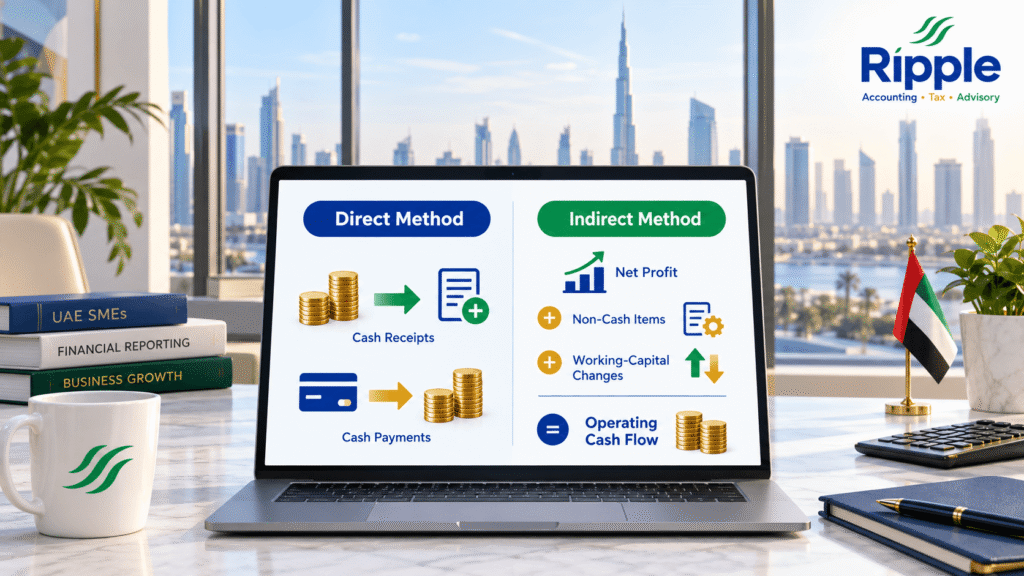
The major difference between the two methods is how operating cash flow is calculated. The investing and financing sections are generally presented in substantially similar ways.
The direct method shows actual major categories of cash receipts and cash payments.
The indirect method starts with accounting profit or loss and adjusts it for non-cash items and changes in working capital to arrive at operating cash flow.
The basic comparison is:
| Feature | Direct Method | Indirect Method |
| Starting point | Cash receipts and payments | Accounting profit/loss |
| Focus | Actual operating cash movements | Reconciliation from profit to cash |
| Customer receipts | Shown directly | Reflected through working-capital adjustments |
| Supplier payments | Shown directly | Reflected through working-capital adjustments |
| Non-cash items | Less prominent | Adjusted explicitly |
| Preparation | Can require detailed cash information | Often easier when accrual accounting records are available |
| Management usefulness | Strong visibility into cash sources and uses | Strong connection between profit and cash |
| Common practical approach | More detailed cash tracking required | Widely used because accounting records readily support it |
Under the direct method, operating cash flows are presented by showing major categories of cash received and cash paid.
For example:
Total operating cash receipts: AED 1,550,000
Total operating cash payments: AED 1,250,000
AED 1,550,000 − AED 1,250,000 = AED 300,000
This approach gives management a straightforward picture of where operating cash came from and where it went.
The direct method can be particularly useful for business owners who want to understand actual cash movements.
1. Easy to understand: A founder can quickly see how much cash customers paid and how much was paid to suppliers and employees.
2. Strong cash visibility: It provides a clearer view of cash receipts and payments instead of starting with an accounting profit figure.
3. Useful for cash management: Management can use the information to identify areas where cash is being consumed. For example, increasing supplier payments may indicate:
4. Useful for forecasting: Historical cash receipts and payments can help finance teams build future cash flow forecasts.
The direct method can require more detailed cash transaction data. Businesses may need to separate bank and cash transactions into categories such as:
If the accounting system does not capture these categories consistently, additional reconciliation may be necessary.
For SMEs with high transaction volumes, this can make preparation more time-consuming.
The indirect method begins with accounting profit or loss and adjusts it to determine cash generated from operating activities. The process generally involves:
Accounting profit/loss
For example, assume a UAE SME reports:
Net profit: AED 500,000
Add:
Adjust working capital:
The simplified operating cash flow would be:
AED 500,000
= AED 500,000 operating cash flow
This illustrates why profit and operating cash flow can be different even when the business is profitable.
The indirect method generally involves three important adjustments.
The calculation begins with the relevant accounting profit or loss. This connects the cash flow statement with the income statement.
Some accounting expenses reduce profit but do not represent current-period cash payments. Examples can include:
These amounts may need to be adjusted when reconciling accounting profit to operating cash flow.
Changes in working capital can have a major impact on cash. Important accounts include:
Working capital is one of the most important reasons a profitable company can experience cash pressure.
Consider a UAE wholesaler that makes AED 1 million in sales during a month. If customers purchase on 60-day credit terms, the company may recognise sales but wait weeks or months before receiving cash. At the same time, suppliers may require payment within 30 days.
The business therefore has to finance the gap.
This is why SMEs should monitor working capital alongside revenue and profit.
There is no universal answer. The better approach depends on the company’s accounting system, reporting requirements, transaction volume and management needs.
For many SMEs, the indirect method can be easier to prepare because the information needed is already available through the income statement and balance sheet.
Consider a UAE trading company with the following annual figures:
| Item | AED |
| Net profit | 600,000 |
| Depreciation | 100,000 |
| Increase in receivables | (150,000) |
| Increase in inventory | (100,000) |
| Increase in payables | 80,000 |
| Purchase of equipment | (200,000) |
| New bank loan | 300,000 |
| Loan principal repayment | (100,000) |
Starting with net profit:
AED 600,000
Add depreciation:
Less increase in receivables:
− AED 150,000
Less increase in inventory:
− AED 100,000
Add increase in payables:
Net operating cash flow = AED 530,000
Purchase of equipment:
− AED 200,000
New bank loan:
Loan repayment:
− AED 100,000
Net financing cash flow = AED 200,000
AED 530,000 − AED 200,000 + AED 200,000 = AED 530,000 increase in cash
This simplified example demonstrates how a business can generate substantial operating cash while simultaneously investing in assets and managing financing.
A reliable cash flow statement starts with accurate underlying accounting records.
Determine the financial period covered by the statement. For example: 1 January to 31 December
The opening cash and cash equivalents should correspond to the previous period’s closing balance.
All business bank accounts should be reconciled before preparing the statement.
Unreconciled transactions can distort cash flow reporting.
Identify the accounting profit or loss and relevant income and expense items.
Compare opening and closing balances for relevant accounts, particularly:
Each cash movement should be classified appropriately under the applicable accounting framework.
Non-cash transactions should not simply be treated as cash inflows or outflows.
For example, acquiring an asset through a non-cash financing arrangement requires careful accounting treatment.
The calculated closing cash should agree with the relevant cash and cash-equivalent balances in the accounting records, subject to the applicable presentation and classification rules.
A cash flow statement does not itself determine a company’s UAE Corporate Tax liability.
The starting point for determining taxable income is generally accounting income, followed by the relevant tax adjustments required under the Corporate Tax Law. Therefore, businesses should not assume that:
Cash received = taxable income or Cash paid = tax-deductible expense
For example, a business may receive a loan, but the loan proceeds are not simply treated as business revenue.
Similarly, purchasing a long-term asset involves a cash outflow, but its tax treatment is determined under the applicable Corporate Tax rules rather than simply by looking at the cash movement.
Businesses should therefore maintain proper accounting records and supporting documentation.
The FTA expects taxpayers to maintain records supporting the information reported for Corporate Tax purposes.
Before finalising a cash flow statement, finance teams can use this checklist:
A well-prepared cash flow statement is more than a year-end reporting document. Business owners can use it to identify potential financial problems earlier.
It can help answer:
Can we afford to hire more employees?
Review expected operating cash flows and upcoming commitments.
Can we purchase new equipment?
Assess operating cash generation alongside available financing.
Why is the bank balance falling despite higher sales?
Investigate receivables, inventory and other working-capital movements.
Can we repay debt comfortably?
Review recurring operating cash flows rather than relying solely on accounting profit.
Can we afford a dividend or owner distribution?
Consider available cash, financing obligations, working capital and applicable legal/accounting requirements before making distributions.
The choice should not be based simply on which method appears easier.
A business should consider:
For a small UAE business with a well-maintained accounting system, either approach can provide useful information when prepared correctly.
The more important issue is accuracy, consistency and reconciliation.
Preparing a reliable cash flow statement requires more than simply extracting numbers from a bank account. Operating, investing and financing transactions need to be identified and reconciled with the company’s wider financial records.
Ripple Accountants provides professional financial reporting and accounting support for UAE businesses, helping companies maintain accurate financial records, prepare clear financial statements and strengthen their reporting processes. Our team can support businesses with cash flow reporting, account reconciliation, financial statement preparation, and related accounting requirements.
Whether you need help preparing a cash flow statement, reviewing your financial records, or improving your regular reporting process, contact Ripple Accountants today to discuss your requirements and get professional accounting support for your UAE business.
A cash flow statement shows how cash and cash equivalents moved during a reporting period. It generally classifies cash flows into operating, investing and financing activities.
The direct method presents major operating cash receipts and payments directly. The indirect method starts with accounting profit or loss and adjusts it for non-cash items and changes in working capital to calculate operating cash flow.
Neither method is universally better. The appropriate approach depends on the applicable accounting framework, accounting system, available records and management’s reporting needs.
Yes. A complete set of financial statements under the applicable accounting standards includes a cash flow statement, and UAE Corporate Tax rules require taxable income to be determined using financial information prepared under accepted accounting standards, subject to the applicable rules.
No. Cash flow and accounting profit measure different things. A business can have positive cash flow because of borrowing or delayed payments to suppliers while still making an accounting loss. Conversely, a profitable business can experience cash shortages because money is tied up in receivables or inventory.
A cash flow statement helps UAE SMEs understand how cash moves through their business and identify potential liquidity issues. While the direct method shows actual cash receipts and payments, the indirect method reconciles accounting profit with operating cash flow. Choosing the right approach and maintaining accurate records can improve financial reporting, cash management and UAE compliance.
Disclaimer: This article provides general information about cash flow statements for UAE SMEs and is not a substitute for professional accounting, tax, legal or financial advice. UAE accounting and Corporate Tax requirements can depend on the nature, size, structure and activities of a business and may change over time. Businesses should review the applicable legislation, accounting standards and current Federal Tax Authority guidance and obtain professional advice where necessary.
Tell us a little about your business and our UAE tax experts will get back to you with clear, practical answers — no obligation.
 Corporate Tax
Have you missed a UAE Corporate Tax deadline and are unsure which penalty may apply to your business? UAE Corporate Tax compliance…
Read article Compliance
Could your UAE business need to prove its tax residency to a foreign tax authority before receiving cross-border tax benefits? A UAE…
Read article VAT
VAT
Has your UAE business accumulated more recoverable input VAT than output VAT, and are you unsure whether you can claim the difference…
Read articlePage 1 of 45
Book a free consultation and get clear answers for your business.
0 Comments