VAT and Excise Tax Due Dates: Building a Reliable Compliance Calendar
Missing a UAE tax deadline can be costly. With VAT and Excise Tax following different filing cycles, how can businesses stay compliant…
Read article
What is the accounting difference between operating a UAE branch and establishing a subsidiary?
For businesses expanding into the UAE, the choice affects more than legal structure. It can influence bookkeeping, financial reporting, intercompany balances, consolidation, and UAE Corporate Tax compliance. A branch is generally an extension of its parent, while a subsidiary is a separate legal entity with its own accounting records. Understanding branch vs subsidiary accounting helps finance teams record transactions correctly and avoid reconciliation problems.
A branch is generally an extension of its parent company rather than a separate juridical person. For UAE Corporate Tax purposes, the Federal Tax Authority describes a UAE branch of a UAE juridical person as an extension of the parent/head office.
A subsidiary, on the other hand, is a separate legal entity established and owned or controlled by another company, commonly referred to as the parent company.
This distinction has important accounting consequences.
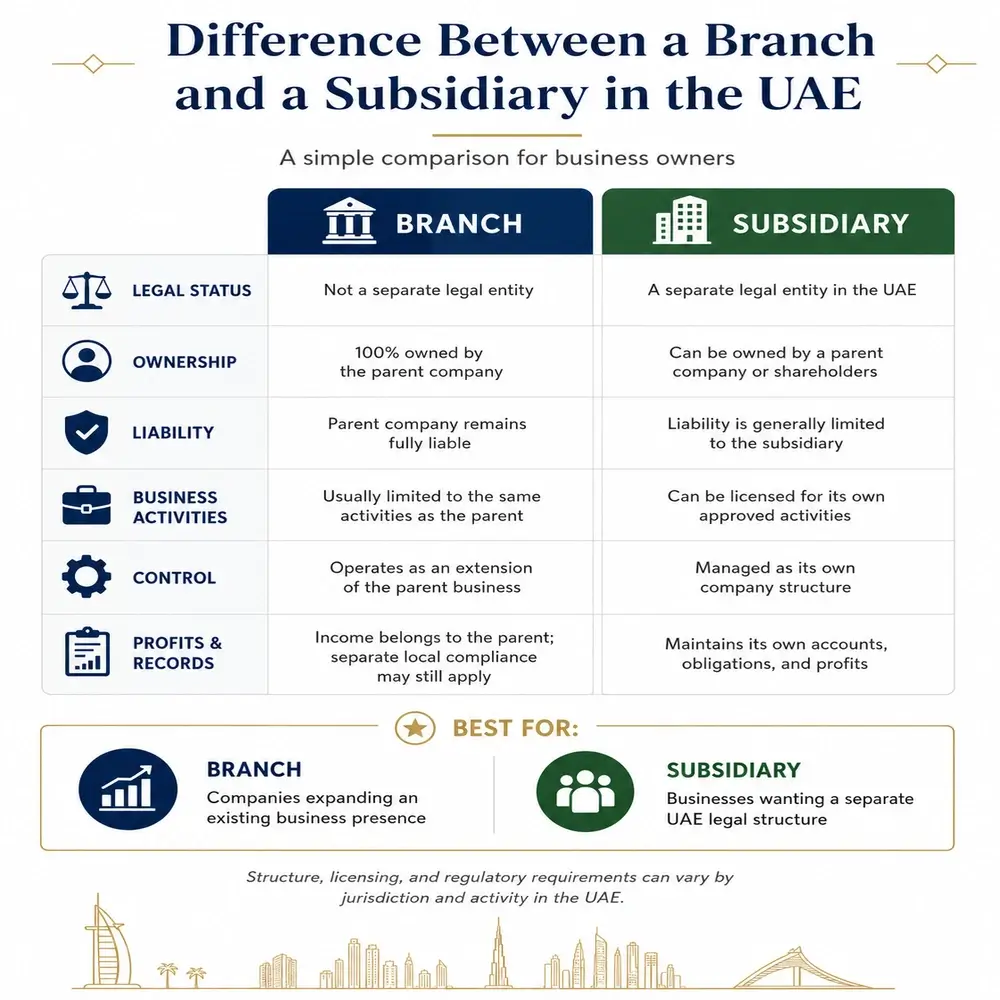
A branch may maintain separate accounting records for its UAE operations, but its financial activities ultimately belong to the parent entity. A subsidiary maintains its own books because it is a separate entity. Depending on the group’s structure and applicable accounting requirements, the subsidiary’s financial statements may then be consolidated with those of its parent.
| Accounting area | Branch | Subsidiary |
| Legal status | Extension of parent | Separate legal entity |
| Accounting records | Local records generally maintained | Separate accounting records |
| Equity | Generally linked to parent/head office | Share capital and reserves |
| Transactions with parent | Head-office/branch transactions | Intercompany transactions |
| Financial statements | Forms part of parent reporting | Standalone statements may be prepared |
| Consolidation | Not normally treated as a separate subsidiary for consolidation | May be consolidated with parent |
| Corporate Tax analysis | Depends on applicable structure and circumstances | Separate entity unless included in a Tax Group |
Therefore, businesses should not assume that branch and subsidiary accounting can be handled in exactly the same way.
Branch accounting UAE businesses use should clearly identify the transactions relating to the UAE operation while maintaining the connection with the parent company.
A branch may maintain separate ledgers for:
For example, if a foreign parent transfers AED 500,000 to its UAE branch to fund operations, the branch needs to record the receipt appropriately in its accounting records. The corresponding transaction in the parent company’s records should also be consistent.
Unlike an independent subsidiary, however, the branch does not normally have its own separate share capital structure in the same sense as a subsidiary. Its funding and financial position remain connected to the parent.
The FTA confirms that a UAE branch of a UAE business is included in the taxable income and Corporate Tax return of its UAE parent/head office.
This makes accurate branch-level accounting important even where the branch is not a separate juridical person.
Subsidiary accounting UAE businesses use is based on the subsidiary’s status as a separate legal entity. The subsidiary normally maintains its own:
For example, if a UAE subsidiary purchases goods from its foreign parent for AED 200,000, the subsidiary records the purchase and corresponding payable in its own accounting system. The parent records the related sale or receivable according to its applicable accounting treatment.
These balances become intercompany balances because they exist between separate entities within the same group.
The subsidiary’s standalone financial statements should therefore be capable of being reconciled independently before information is incorporated into group reporting.
The practical accounting difference becomes clearer when considering how transactions flow through the books.
A branch does not normally have share capital independent of its parent. Transactions with the head office may instead appear through branch or head-office accounts.
A subsidiary has its own share capital and equity balances. The parent’s investment in the subsidiary is generally reflected in the parent’s accounting records, subject to the applicable accounting framework.
Transactions between a branch and head office may be recorded as internal branch/head-office movements.
Transactions between a parent and subsidiary are transactions between separate legal entities and can create receivables, payables, loans, income and expenses.
A branch’s results form part of the parent company’s overall financial reporting. A subsidiary may prepare its own standalone financial statements and, where consolidation requirements apply, its financial results are incorporated into group financial statements.
This makes the distinction particularly important for businesses with multiple UAE and international operations.
Intercompany balances UAE businesses commonly deal with arise when two entities within the same corporate group transact with one another.
Common examples include:
For example, suppose a UAE subsidiary receives a AED 1 million loan from its parent.
The subsidiary may record:
Dr Bank — AED 1,000,000
Cr Intercompany Loan Payable — AED 1,000,000
The parent would record the corresponding receivable.
The two balances should agree. If the parent reports an AED 1 million receivable but the subsidiary’s ledger shows AED 950,000 payable, the difference needs to be investigated before financial reporting or consolidation.
Effective intercompany accounting UAE businesses use should include regular reconciliation rather than waiting until year-end. A practical reconciliation process includes:
The parent and subsidiary should compare their respective intercompany accounts.
Invoices, credit notes, bank transfers and other supporting documents should be matched.
One entity may record a transaction before the other. For example, a payment made on 30 June could be recorded by one entity in June and by the other in July.
Where transactions are denominated in different currencies, exchange-rate movements may create differences.
Unexplained balances should be investigated rather than carried forward indefinitely.
Once the reason for the difference is established, appropriate accounting adjustments can be recorded.
Both entities should agree on the final intercompany balance before the consolidation process.
Regular reconciliation reduces the risk of incorrect group reporting and makes the year-end close more efficient.
Consolidation accounting UAE businesses use, aims to present the parent and its subsidiaries as one economic group when consolidation is required. Because transactions between group companies are internal to the group, they should not continue to appear as transactions with external parties in consolidated financial statements.
For example, suppose a parent company provides services worth AED 100,000 to its subsidiary.
The parent records income and a receivable, while the subsidiary records an expense and payable. Before consolidation, the balances may appear as:
Parent:
Subsidiary:
During consolidation, the relevant intercompany income, expense, receivable and payable are eliminated, subject to the applicable accounting requirements.
The purpose is to ensure that the consolidated financial statements show the group’s transactions with external customers, suppliers, and other third parties, rather than overstating activity because of internal group transactions.
The FTA specifically states that, for UAE Tax Groups, the parent company consolidates the financial accounts of subsidiaries and eliminates transactions between Tax Group members.
The branch vs subsidiary UAE distinction also matters for Corporate Tax. A UAE branch of a UAE parent is generally treated as an extension of that parent for UAE Corporate Tax purposes. The FTA confirms that the income of such a branch is included with the UAE parent/head office rather than the branch being treated as a separate juridical person.
A subsidiary is different because it is a separate legal entity and may have its own UAE Corporate Tax obligations.
However, qualifying UAE companies may potentially form a Corporate Tax Group if the applicable conditions are met.
The FTA states that a UAE Tax Group requires the relevant conditions to be satisfied, including the required ownership and voting-rights conditions. Members must also generally use the same financial year and accounting standards.
Where a Tax Group is formed, the parent company generally prepares consolidated financial information for the group, and transactions between group members are eliminated in determining the group’s taxable income.
Parent-subsidiary transactions can also raise transfer-pricing considerations. Examples include:
The UAE Corporate Tax framework applies the arm’s-length principle to relevant transactions involving Related Parties and Connected Persons. Businesses should therefore ensure that applicable related-party transactions are supported by appropriate documentation and commercially reasonable terms.
This is particularly important where a UAE subsidiary has substantial transactions with its foreign parent.
A business should consider the nature of the transaction, functions performed, risks assumed, assets used and the commercial basis for the pricing.
Businesses managing branches and subsidiaries should watch for several recurring problems:
These mistakes can lead to inaccurate financial statements and make Corporate Tax compliance more difficult.
Consider a UAE business group with a parent company and a UAE subsidiary. The parent provides AED 2 million to the subsidiary as financing. During the year, the parent also charges AED 150,000 for management services.
The subsidiary records:
The parent records the corresponding receivable, financing income where applicable and management-service income.
Before preparing consolidated financial statements, the group should:
This example demonstrates why intercompany balances UAE businesses maintain need continuous monitoring rather than a year-end cleanup.
Managing branch and subsidiary accounting becomes increasingly complex as businesses add entities, currencies, and intercompany transactions.
Ripple Accountant can support UAE businesses with bookkeeping and financial reporting for branches and subsidiaries, including maintaining accounting records, reconciling intercompany balances, reviewing transactions between group entities, and supporting consolidation processes.
Expanding your business or struggling with intercompany reconciliations?
Contact Ripple Accountant to discuss your UAE accounting, consolidation, and financial reporting requirements and keep your branch or subsidiary records accurate and well organised.
Generally, no. A branch is an extension of its parent rather than a separate juridical person. This distinction is important for both accounting and UAE Corporate Tax treatment.
Yes. Because a subsidiary is a separate legal entity, it generally maintains its own accounting records, assets, liabilities, income, expenses, and equity balances.
Intercompany balances are amounts owed between entities within the same group, such as loans, receivables, payables, management fees, and expense recharges.
Generally, transactions and balances between entities included in consolidated financial statements are eliminated so that the group is presented as a single economic entity.
No. A branch is an extension of its parent, while a subsidiary is a separate legal entity. This affects equity, intercompany transactions, financial reporting, and consolidation.
A qualifying subsidiary may be able to join a UAE Corporate Tax Group if the applicable conditions are satisfied. These include ownership, voting rights, and other requirements prescribed under the UAE Corporate Tax rules.
Choosing between a branch and subsidiary has accounting consequences that UAE businesses should understand before expanding their operations. A branch remains connected to its parent as an extension of that entity, while a subsidiary maintains its own legal and accounting identity. This difference affects bookkeeping, intercompany transactions, reconciliations, financial reporting and consolidation.
Disclaimer: This article is provided for general informational purposes only and does not constitute legal, tax, accounting, or financial advice. Businesses should review their specific situation and consult a qualified UAE accounting or tax professional before making decisions regarding branch or subsidiary structures, consolidation, or Corporate Tax compliance.
Tell us a little about your business and our UAE tax experts will get back to you with clear, practical answers — no obligation.
 VAT
VAT
Missing a UAE tax deadline can be costly. With VAT and Excise Tax following different filing cycles, how can businesses stay compliant…
Read article Corporate Tax
What is the accounting difference between operating a UAE branch and establishing a subsidiary? For businesses expanding into the UAE, the choice…
Read article Compliance
Is your business profitable on paper but still struggling to maintain enough cash? The problem may be tied to working capital rather…
Read articlePage 20 of 45
Book a free consultation and get clear answers for your business.
0 Comments