Audit Sampling and Supporting Evidence for UAE Businesses
M Maria September 17, 2026 12 min read
If an auditor selects only a small number of your company’s transactions for testing, how can that sample provide reliable evidence about thousands of transactions?
That question goes to the heart of audit evidence UAE businesses need to understand. Auditors generally do not examine every invoice, payment or journal entry. Instead, they use risk assessment, audit sampling and other testing procedures to obtain sufficient appropriate evidence supporting their conclusions. For UAE finance managers, being audit-ready therefore means more than keeping invoices in a folder.
Here is how audit sampling works, what supporting evidence auditors commonly expect, and how businesses can prepare.
What Is Audit Evidence UAE?
Audit evidence is the information an auditor uses to reach conclusions about whether financial statement balances, transactions and disclosures are appropriately stated.
Under international auditing principles, the auditor designs and performs procedures to obtain sufficient appropriate audit evidence on which to base the audit opinion. “Sufficient” relates primarily to the quantity of evidence, while “appropriate” relates to its quality, including relevance and reliability.
For a UAE business, audit evidence can therefore come from accounting records as well as information supporting those records.
Examples may include supplier invoices, customer invoices, contracts, bank statements, payment records, purchase orders, delivery notes, inventory records, payroll files, expense claims, approvals, reconciliations, external confirmations and other records connected with a transaction.
An accounting entry by itself does not necessarily prove that the underlying transaction occurred exactly as recorded. Auditors therefore often trace entries back to supporting documents and, where appropriate, independent external evidence.
What Does UAE Law Say About an Auditor’s Access to Evidence?
UAE legislation provides an important legal basis for an auditor’s access to company records.
Under Federal Decree-Law No. 32 of 2021 on Commercial Companies, Article 248 states that a company’s auditor is responsible for auditing the company’s accounts, inspecting the balance sheet and profit and loss account, reviewing transactions with concerned parties, and checking compliance with the law and the company’s Articles of Association.
The same Article requires the auditor to verify the accuracy of accounting records and their conformity with company records. It also provides the auditor with the ability to review the company’s records, paperwork and other documents.
The UAE also has a specific regulatory framework for the auditing profession under Federal Decree by Law No. 41 of 2023on Regulating the Auditing and Accounting Professions.
These rules should not be interpreted as meaning every UAE entity has exactly the same statutory audit requirement. Requirements can vary depending on the company’s legal form, licensing authority, regulator, free zone, constitutional documents and other circumstances.
What Is Audit Sampling?
Audit sampling UAE businesses encounter during an audit is a method of testing part of a larger population rather than examining every transaction individually.
Imagine that a business processed 12,000 sales invoices during the year.
The auditor may not need to manually inspect all 12,000. Instead, the auditor may identify the risks associated with revenue, analyse the population and select transactions for detailed testing.
The purpose is not simply to reduce the auditor’s workload. The sample must be designed so that the work performed provides a reasonable basis for drawing conclusions about the relevant population.
ISA 530 specifically addresses audit sampling, while the wider audit-evidence framework addresses whether the evidence obtained is sufficient and appropriate. The IAASB continues to maintain the international framework around audit evidence and risk response.
Does Audit Sampling Mean Transactions Are Selected Randomly?
Not always.
Auditors may use statistical or non-statistical approaches depending on the audit objective, assessed risk, characteristics of the population and professional judgment.
For example, an auditor could select items using random or systematic techniques. In other situations, additional attention may be given to large transactions, unusual entries, transactions near year-end, related-party dealings or other items carrying a higher risk of material misstatement. There is also an important distinction between audit sampling and selecting specific high-risk items.
If an auditor deliberately selects certain transactions because of their size or unusual characteristics, that targeted testing does not necessarily represent the entire population in the same way that an audit sample is intended to do.
Finance teams should therefore not assume that only large transactions will be inspected.
What Determines the Audit Sample Size?
There is no universal rule stating that an auditor must examine, for example, exactly 20, 50 or 100 transactions. Sample size depends on the circumstances.
Factors can include:
The size and nature of the population
Assessed audit risk
Expected error rate and materiality
Effectiveness of internal controls
Audit objective
Degree of assurance required from the procedure
A business with strong, consistently operating controls may therefore present a different audit environment from one with weak approval processes, missing reconciliations or repeated accounting errors.
Similarly, where auditors discover exceptions during testing, additional work may be required.
That is why the question “How many invoices will the auditor check?” often cannot be answered accurately before the audit strategy and risks have been assessed.
What Supporting Documents Count as Audit Evidence?
Finance managers sometimes assume that keeping an invoice automatically creates a complete audit trail. In practice, the auditor may need evidence covering several parts of the transaction.
Consider a purchase. A supplier invoice establishes important information, but the auditor may also examine the purchase order, approval, goods-received documentation, supplier statement, payment record, bank transaction and accounting entry.
Together, those records can help answer different audit questions.
Did the purchase actually occur?
Was it authorised?
Was the amount correct?
Was it recorded in the right period?
Was the liability complete?
Was the supplier genuine?
Was payment properly processed?
The strength of the evidence therefore often comes from the audit trail connecting the transaction from initiation to financial reporting, rather than from a single document viewed in isolation.
Common Supporting Evidence UAE Businesses Should Maintain
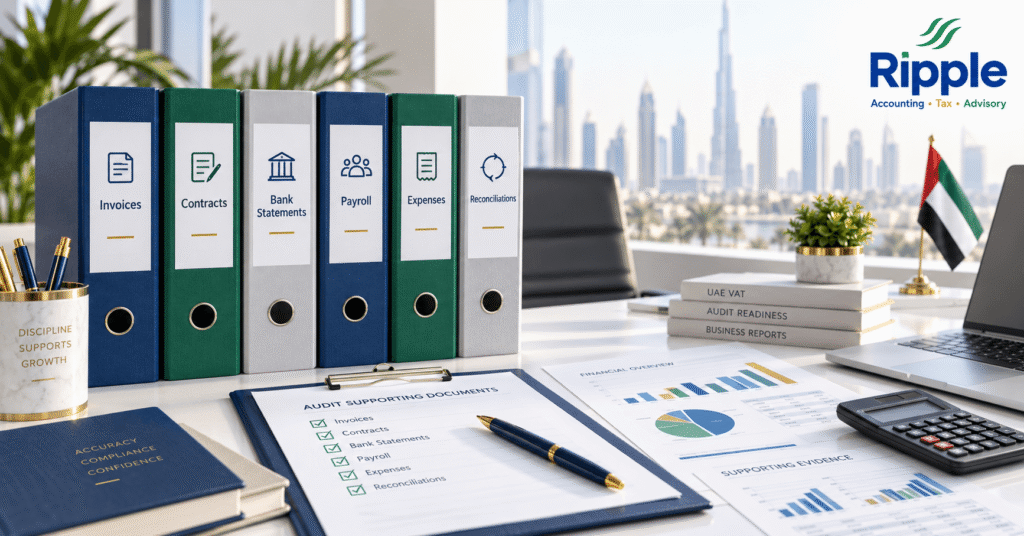
A practical audit-supporting-document checklist may include:
sales invoices, supplier invoices, credit notes and debit notes;
bank statements, payment confirmations and bank reconciliations;
contracts, agreements, purchase orders and customer orders;
delivery notes, goods-received notes and inventory movement records;
payroll reports, employment documentation and supporting payment records;
fixed-asset invoices, registers, disposals and depreciation schedules;
VAT and corporate tax records, calculations, returns and reconciliations;
related-party agreements and transaction records;
expense claims, receipts and management approvals;
loan agreements, financing documents and balance confirmations;
customer and supplier statements and external confirmations;
management calculations supporting provisions, accruals and estimates;
general-ledger extracts, journals and evidence of journal approvals;
board or management approvals where relevant; and
year-end schedules reconciling financial statement balances to underlying accounting records.
The exact documentation required will depend on the transaction and audit objective.
How Do Auditors Test Transactions?
Auditors can use several types of procedures to test financial information.
1. Inspection
The auditor examines records or documents such as invoices, contracts, bank statements or approval documents. For example, a recorded expense might be traced from the general ledger to the invoice and payment record.
2. External Confirmation
Evidence may be requested directly from a third party. Common examples include obtaining confirmation of a bank balance, customer receivable or other external balance.Evidence from independent sources can be particularly valuable because its reliability is not dependent solely on documentation generated internally by the company. The reliability of audit information is influenced by its source, nature and the circumstances in which it was obtained.
3. Recalculation
The auditor may independently check a mathematical calculation. Examples include recalculating depreciation, interest, payroll calculations or another financial computation.
4. Reperformance
An auditor may independently perform a control or procedure that the company originally performed. For example, the auditor could reproduce part of a reconciliation to determine whether it operates as expected.
5. Observation
Certain procedures may involve observing a process. Physical inventory counts are a familiar example where auditors may observe how the company’s counting procedures are performed and perform their own test counts.
6. Analytical Procedures
Auditors may compare relationships between financial and non-financial information. An unexpected change in gross margin, payroll cost, inventory turnover or monthly revenue may lead to further investigation.
7. Inquiry
Management and employees may be asked questions about processes or transactions. Inquiry is useful, but an explanation from management will often need to be considered alongside other evidence rather than automatically accepted on its own.
What Happens When a Sample Contains an Error?
Finding one error does not automatically mean the entire financial statements are incorrect. The auditor first assesses the nature and cause of the exception.
An isolated clerical mistake may have different implications from a recurring control failure affecting an entire transaction population.
The auditor may expand the sample, perform alternative procedures, investigate similar transactions or reconsider the assessed risk.
Where errors identified in a sample could indicate wider misstatements, the auditor evaluates their potential effect on the population and ultimately on the financial statements.
This is one reason businesses should investigate audit exceptions rather than simply providing a corrected invoice or journal entry. The underlying cause matters.
Why Missing Supporting Evidence Can Become a Serious Audit Issue
A transaction may be commercially genuine but still become difficult to audit if the business cannot produce adequate documentation.
Suppose the ledger contains an AED 180,000 consultancy expense, but the company cannot provide a contract, clear invoice description, deliverables, management approval or reliable payment trail.
The problem is no longer simply document organisation.
The auditor must determine whether sufficient appropriate evidence exists to support the accounting treatment.
ISA 500’s underlying principle requires auditors to obtain sufficient appropriate evidence before drawing their conclusions. Where necessary evidence cannot be obtained, the auditor may need alternative procedures, and unresolved evidence limitations can ultimately affect the audit conclusion or report.
Common Audit Evidence Problems in UAE Businesses
Audit delays frequently arise when the accounting records and underlying documents do not align.
Examples include invoices recorded in a different period from the related supply, payments without clearly linked invoices, unreconciled customer balances, unexplained manual journal entries, undocumented related-party transactions, missing agreements, differences between inventory records and physical stock, or year-end adjustments without supporting calculations.
Another challenge occurs when files exist but cannot be retrieved efficiently.
If the finance team needs several days to locate evidence for each sample, the audit becomes slower and more disruptive.
Audit readiness is therefore partly an accounting issue and partly a documentation and internal-control issue.
How Finance Teams Can Improve Audit Readiness
Start audit preparation before the auditor sends the first document request.
Maintain a clear connection between the general ledger and supporting records throughout the year.
Complete and review monthly bank reconciliations.
Reconcile customer and supplier balances regularly.
Attach supporting documents to transactions or store them through a consistent document-management process.
Ensure significant manual journal entries have clear explanations and appropriate approvals.
Make Related Party transactions easily identifiable rather than discovering them only at year-end.
Review supporting files for completeness before closing the financial year.
Remember that a clean ledger with missing evidence can still cause audit delays.
Likewise, excellent supporting documents cannot compensate for accounting records that are inconsistent with the evidence.
The strongest audit file combines accurate accounting records with complete, organised supporting evidence.
How Ripple Accounting, Tax & Advisory Can Support Audit Readiness
Preparing for an audit should not begin only after the auditor issues a long request list.
Ripple Accounting, Tax & Advisory can help UAE businesses review accounting records, reconciliations, supporting documents and audit-readiness gaps before or during the audit process. We can assist finance teams in organizing schedules, reviewing supporting documentation, identifying unreconciled balances and improving the connection between accounting records and the underlying transaction evidence.
Audit evidence can include accounting records and supporting information such as invoices, contracts, bank statements, payment records, confirmations, reconciliations, inventory records and other documents relevant to the auditor’s procedures. The exact evidence required depends on the balance or transaction being tested.
2. Do UAE auditors check every transaction?
Generally, an audit does not require every transaction to be manually inspected. Auditors use risk assessment, sampling, analytical procedures and other methods to obtain sufficient appropriate evidence. Higher-risk or unusual transactions may receive additional attention.
3. How do auditors choose transactions for audit sampling?
Selection depends on the audit objective, population, risk, materiality and sampling approach. Auditors may use statistical or non-statistical methods and may separately test specific high-value or unusual transactions.
4. Is an invoice enough evidence for an auditor?
Not necessarily. An invoice may support part of a transaction, but an auditor may also require a contract, purchase order, delivery evidence, approval, bank payment or other supporting information depending on what is being tested.
5. What should a finance manager prepare before an audit?
Finance managers should ensure ledgers are reconciled, supporting records can be retrieved quickly, material balances have clear schedules, year-end adjustments are supported, bank and third-party balances are reconciled, and significant or unusual transactions have appropriate documentation and approvals.
Conclusion
Understanding audit evidence UAE requirements and audit sampling UAE practices can help finance teams prepare for an audit more efficiently. The objective is not to predict exactly which invoices the auditor will select. It is to ensure that any material transaction selected can be traced through a reliable and consistent audit trail. Strong accounting records, properly maintained supporting documents, reconciliations and clear internal approvals make that process significantly easier. For UAE businesses, year-round audit readiness can reduce delays, improve financial control and make it easier to respond when auditors request evidence.
Disclaimer: This article is provided for general educational and informational purposes only and does not constitute audit, accounting, tax or legal advice. Audit requirements and procedures can vary according to the entity’s legal form, licensing authority, regulator, free zone, financial reporting framework and individual circumstances. Professional standards and UAE legislation may also be amended from time to time. Businesses should verify the requirements applicable to their specific circumstances and obtain professional advice where necessary.
Environmental responsibilities have become an essential part of modern business operations. Companies across industries must consider not only their financial performance but…
Non-profit organizations play a vital role in supporting communities, advancing education, promoting healthcare, protecting the environment, and delivering humanitarian aid across the…
Businesses have traditionally relied on financial reports such as revenue, profit, cash flow, and expenses to evaluate performance. While these metrics remain…





0 Comments