UAE Tax Residency Certificate Fees, Processing Time and Validity
How much does a UAE Tax Residency Certificate cost, how long does it take to obtain, and when does it expire? Understanding…
Read article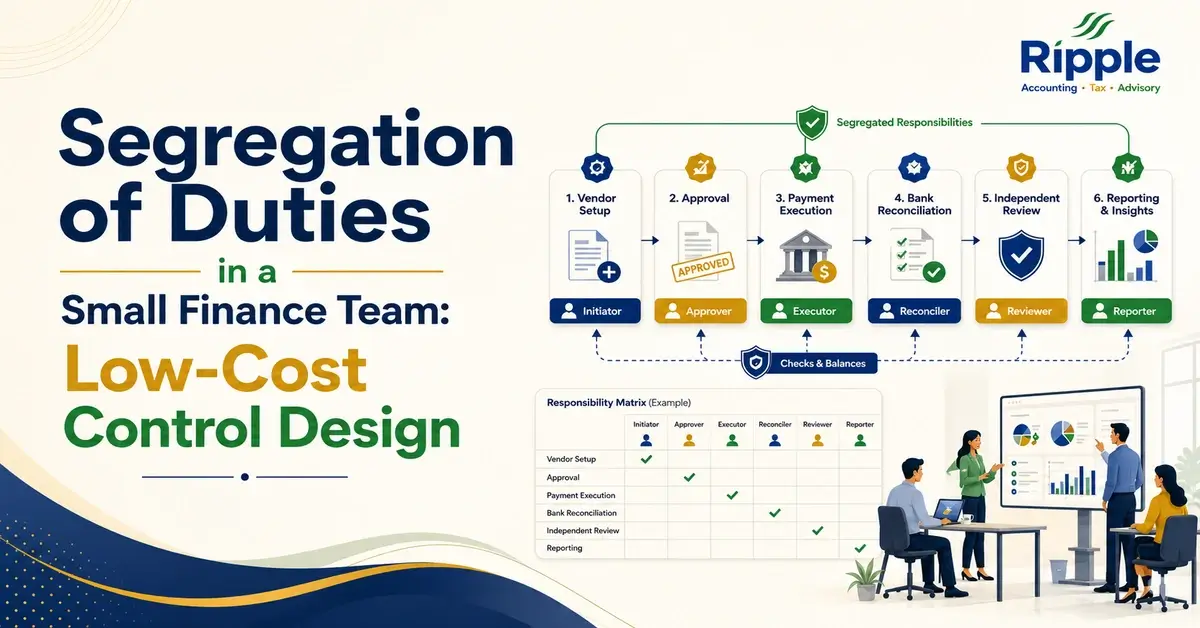
Can a small UAE business really maintain strong financial controls without hiring a large finance team?
For many SMEs, the finance team may consist of only two or three people. One employee may record invoices, prepare payments, manage suppliers, and even perform bank reconciliations. While this approach may save time and money, it can also create a significant control weakness.
This is where segregation of duties in UAE SME becomes important. It means dividing key financial responsibilities so that one person does not control an entire transaction from beginning to end.
Segregation of duties is an internal control principle that divides important financial responsibilities among different people. In simple terms, the person who creates a transaction should not normally be the same person who approves, processes, and reconciles it. For example, consider a supplier payment:
Vendor creation → Invoice entry → Payment approval → Payment processing → Bank reconciliation
Ideally, these steps should not all be controlled by one individual.
The purpose is to reduce the risk of:
The COSO Internal Control—Integrated Framework recognizes internal controls as an important part of reliable information, effective operations, and organizational integrity.
However, segregation of duties is not the same as simply having multiple employees. The important question is whether incompatible responsibilities are separated.
Small businesses often operate with limited staff and resources. This makes it difficult to create the same level of separation found in large organizations. A single finance employee may be responsible for:
This creates a situation where mistakes or unauthorized transactions may go unnoticed.
The Association of Certified Fraud Examiners (ACFE) has specifically highlighted the vulnerability of small organizations where limited staffing creates fewer checks and balances. Its 2024 Report to the Nations also shows that smaller organizations generally have fewer anti-fraud controls than larger organizations.
For UAE businesses, reliable accounting controls also support proper financial recordkeeping. The UAE Federal Tax Authority expects taxable persons to maintain records and documents supporting information reported in corporate tax returns.
For VAT-registered businesses, maintaining a clear audit trail is also important. FTA guidance states that records should allow VAT amounts to be traced from source documents through to the tax return.
Therefore, SoD is not simply an accounting theory. It can form part of a broader financial control environment that supports accurate records and better business governance.
The main challenge is simple: there may not be enough people to separate every task.
Imagine a UAE company with only:
This may not provide perfect segregation, but it can still create meaningful checks. The objective for a small business should not be to copy the structure of a multinational company. Instead, the objective should be
Separate the highest-risk duties and introduce independent checks where complete separation is impossible.
This approach makes SoD practical for SMEs.
Not every accounting task carries the same level of risk. Small businesses should focus first on activities involving money, assets, financial reporting, and sensitive system access.
The person who creates or changes supplier details should ideally not be the person who approves the supplier payment.
For example:
This can reduce the risk of fictitious vendors or unauthorized bank account changes.
The person entering an invoice should not normally have unrestricted authority to approve and release its payment.
A simple arrangement could be:
This creates an additional review without requiring another full-time employee.
Bank reconciliation is an important control because it compares accounting records with actual bank activity. Ideally, the person processing payments should not be the only person reconciling the bank account. If staffing makes this impossible, an owner, manager, or external accountant can perform an independent review.
ACFE guidance for small businesses specifically recommends that someone who does not handle deposits or payments perform the monthly bank reconciliation, with an independent contractor being an option where staffing is limited.
Payroll should also receive appropriate separation.
For example:
This reduces the opportunity for unauthorized employees, altered salaries, or unsupported payroll adjustments.
Complete SoD may not be possible for every SME. Fortunately, several practical controls can provide additional protection without significant expense.
An approval matrix defines who can approve specific financial activities. For example:
| Transaction | Finance Team | Manager | Owner |
| Routine expense | Prepare | Review | — |
| Supplier payment | Prepare | Approve | — |
| High-value payment | Prepare | Review | Approve |
| New vendor | Enter | Review | Approve |
| Refund | Prepare | Approve | — |
| Major contract | Review | Recommend | Approve |
The exact thresholds should be based on the company’s size and risk profile. For example, an SME could decide that payments above AED 10,000 require owner approval.
The important point is to document the rules rather than rely on verbal instructions.
A dual-approval control means two authorized people must approve an important transaction. This can be particularly useful for:
For a two-person finance team, the second approver could be the business owner or senior manager. This is often much cheaper than hiring another accountant.
Small businesses can periodically rotate selected finance duties.
For example:
The change gives another employee an opportunity to notice unusual transactions or inconsistencies. Job rotation is not a substitute for permanent separation where stronger controls are necessary, but it can provide an additional layer of review.
When two people cannot perform every step separately, an independent review can act as a compensating control. For example, if the same accountant must process payments and prepare the bank reconciliation, the owner can review:
The review should be documented rather than being a simple verbal conversation. Small businesses can also use an external accountant periodically to review important financial processes.
ACFE notes that small businesses can use basic controls such as segregation of duties, restricted system access, and independent reconciliations without creating an unnecessarily expensive control environment.
Technology can help small teams implement accounting segregation of duties without increasing headcount.
Most modern accounting systems allow businesses to assign different permissions to different users. For example:
Accounts Assistant
Accountant
Manager/Owner
Avoid giving every finance employee administrator-level access simply because it is convenient. Access should match job responsibilities.
Businesses should also periodically review user permissions, particularly when employees change roles or leave the organization.
A checklist is one of the simplest low-cost accounting controls for SMEs.
Before adding a supplier, confirm:
The person entering the vendor should not be the only person verifying the information.
Before releasing a payment, confirm:
For manual journal entries, review:
These simple checklists create consistency and provide an audit trail.
This is one of the most common SME challenges. Suppose a company has only:
Accountant + Accounts Assistant
The accountant may prepare payments and reconciliations because there is no third finance employee. In this situation, the business can use compensating controls. For example:
The goal is to prevent one person from having unchecked control over the entire process.
ACFE has long emphasized that small businesses can improve controls even when staffing is limited, including through independent reviews and appropriate segregation of responsibilities.
Consider a UAE trading company with three finance-related employees.
Responsible for:
Responsible for:
Responsible for:
This arrangement does not create perfect segregation. However, it introduces important independent checkpoints.
The company can strengthen it further by using system permissions and periodic external reviews.
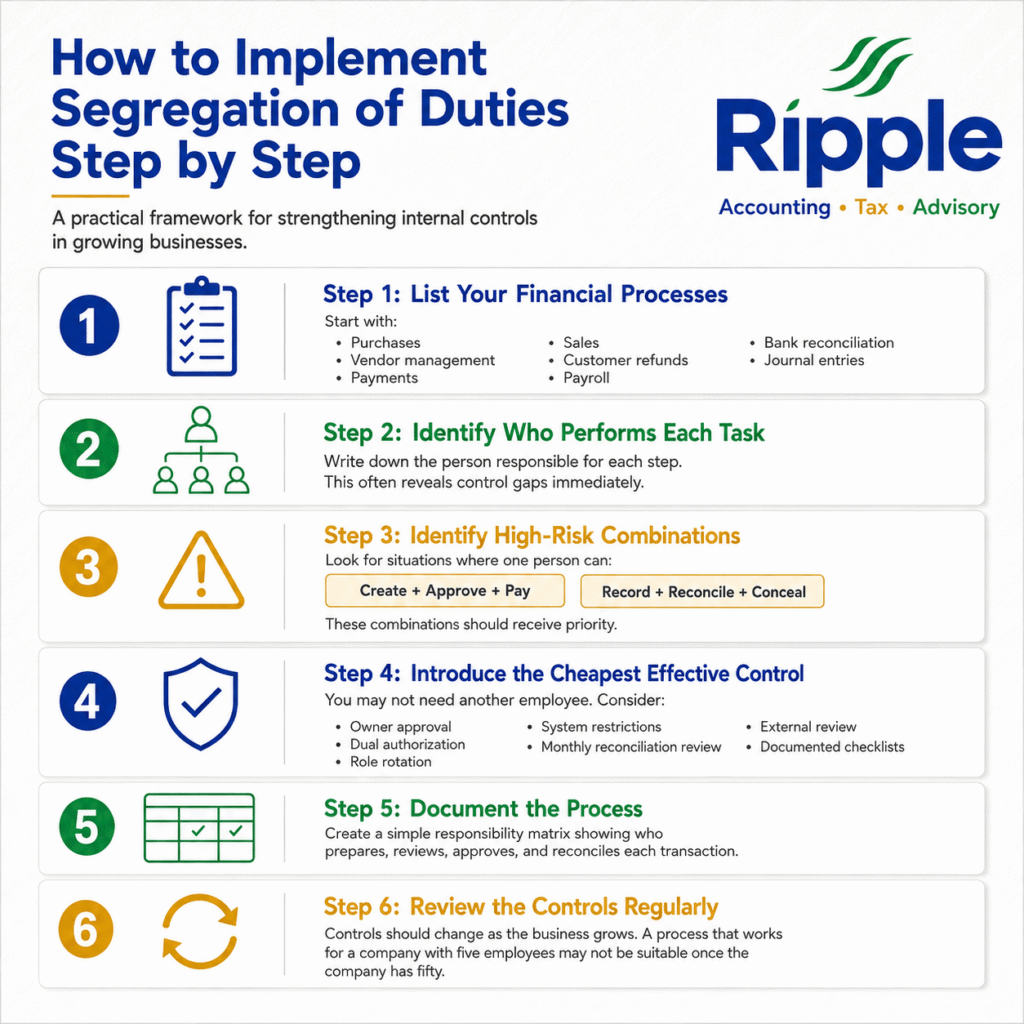
Start with:
Write down the person responsible for each step. This often reveals control gaps immediately.
Look for situations where one person can:
Create + Approve + Pay
or
Record + Reconcile + Conceal
These combinations should receive priority.
You may not need another employee.
Consider:
Create a simple responsibility matrix showing who prepares, reviews, approves, and reconciles each transaction.
Controls should change as the business grows. A process that works for a company with five employees may not be suitable once the company has fifty.
Designing segregation of duties for an SME can be difficult when business owners are already managing sales, employees, customers, and daily operations.
Ripple Accountant can support UAE SMEs in developing a more structured financial control and reporting environment. We also review the existing finance process and identify where responsibilities overlap. We help businesses improve payment records, bank reconciliations, financial reporting, and transaction reviews. We can also help management establish clearer processes to monitor cash movements and identify discrepancies.
Contact the Ripple Accountant support team today to discuss your payment, reconciliation, and financial control requirements.
Segregation of duties is an internal control approach that separates important financial responsibilities among different people. The aim is to prevent one person from controlling an entire transaction process.
No. It is particularly useful for small businesses because limited staffing can create significant control gaps. Small companies may use simpler controls and compensating reviews instead of creating separate departments.
Use compensating controls. For example, one employee can prepare transactions while the owner or manager approves them. The owner can also independently review bank reconciliations and unusual transactions.
Examples include separating invoice entry from payment approval, vendor creation from payment processing, payroll preparation from payroll approval, and payment processing from bank reconciliation.
Yes. User permissions can restrict what each employee can create, edit, approve, or access. Audit logs can also help management review financial activity.
No. SoD reduces risk but cannot eliminate it. Collusion, management override, weak monitoring, or other control failures can still create risks. Preventive controls should therefore be supported by monitoring and independent reviews.
Segregation of duties for UAE SMEs does not have to mean hiring a large finance department. The most important step is identifying where one person has too much control over a financial process and introducing an independent checkpoint. A simple approval matrix, restricted accounting-system access, monthly bank reconciliation review, dual approval for high-value payments, and documented checklists can significantly strengthen SME accounting controls without creating high costs.
Disclaimer: This article is intended for general educational and informational purposes only. It does not constitute legal, tax, accounting, audit, or regulatory advice. UAE requirements can vary depending on the business structure, activity, location, tax status, and applicable regulatory framework. Businesses should obtain professional advice based on their specific circumstances.
Tell us a little about your business and our UAE tax experts will get back to you with clear, practical answers — no obligation.
 Corporate Tax
How much does a UAE Tax Residency Certificate cost, how long does it take to obtain, and when does it expire? Understanding…
Read article Corporate Tax
Are you planning to apply for a UAE Tax Residency Certificate but unsure which documents you need or whether you qualify? Understanding…
Read article Corporate Tax
Do you need a UAE Tax Residency Certificate for a local administrative requirement or to claim benefits under a double taxation agreement?…
Read articlePage 1 of 58
Book a free consultation and get clear answers for your business.
0 Comments