UAE Tax Residency Certificate for Individuals: Eligibility and Application Guide
Are you living in the UAE and need proof of your tax residency for a foreign tax authority, bank or tax-related process?…
Read article
Could unusual vendors, frequent refunds, or unexpected journal entries be warning signs of financial fraud?
Financial fraud does not always begin with a large or obvious transaction. Sometimes, it appears through small accounting irregularities that are easy to overlook. Unusual vendor activity, repeated refunds, unusual payment patterns, and unexplained journal entries can all deserve closer review.
For UAE businesses, identifying these financial fraud red flags early can help strengthen internal controls, improve financial reporting, and reduce the risk of financial loss. A structured accounting review can help businesses identify unusual patterns before they become larger problems.
Financial fraud red flags are unusual activities, transactions, behaviors, or accounting patterns that may indicate a higher risk of fraudulent activity.
A red flag does not automatically mean fraud has occurred. Businesses may have legitimate reasons for unusual transactions. However, unusual activity should prompt further investigation and appropriate documentation.
Common areas where red flags may appear include:
An effective accounting review looks beyond individual transactions and examines patterns, frequency, timing, authorization, and supporting documentation.
Businesses operating in the UAE need reliable financial records for decision-making, tax compliance, audits, management reporting, and regulatory requirements.
Weak financial controls can create opportunities for unauthorized transactions, manipulation of accounts, duplicate payments, or misuse of company funds.
Fraud can also damage more than a company’s finances. It may affect:
For this reason, businesses should not wait until an external audit or financial loss exposes a problem. Regular accounting review procedures can help identify unusual activity at an earlier stage.
An unusual vendor does not necessarily indicate fraud.
However, businesses should investigate vendors that have characteristics such as:
Unusual vendors may sometimes be used to disguise unauthorized or fraudulent payments. A fictitious supplier, for example, could be created to redirect company funds to an inappropriate account.
Review the vendor master file against purchase orders, contracts, invoices, goods received notes, payment records, bank information, and approval records to confirm the vendor is genuine and the transaction has a legitimate business purpose.
Duplicate payments can happen because of administrative errors, but repeated or unusual duplicates deserve attention. During an accounting review, accountants can compare:
For example, two invoices with slightly different numbers but identical amounts and descriptions may require further investigation.
Businesses should also look for payments that are split into smaller amounts to avoid established approval thresholds. This does not prove fraudulent activity, but it can identify transactions that require additional review.
Refunds are another area that can reveal financial irregularities. Businesses naturally process legitimate refunds. However, an unusual increase in refunds or refunds that do not follow established procedures may require investigation.
Potential warning signs include:
An accountant can compare refund transactions with the original sales records. The review should establish:
This creates an audit trail that makes unusual refund activity easier to identify.
Journal entries are an essential part of accounting, but they can also be an important area for fraud risk assessment. Some fraudulent financial reporting schemes involve inappropriate adjustments to accounting records.Red flags may include:
A business may process thousands of accounting transactions. Reviewing every transaction manually may not be practical. Instead, accountants can use journal entry testing to identify transactions that meet specific risk criteria. For example, a review could focus on entries that are:
The purpose is not to assume that these entries are fraudulent. The purpose is to identify transactions that deserve additional examination.
Timing can sometimes provide useful information during an accounting review. For example, transactions posted late at night, during weekends, or close to financial reporting deadlines may deserve additional attention if they are inconsistent with normal business activity.
However, businesses with international operations, remote teams, or automated systems may naturally have transactions outside standard working hours. Therefore, unusual timing should be considered together with other indicators rather than treated as proof of fraud.
Large transactions with perfectly rounded amounts can sometimes warrant investigation. For example:
Round amounts can be completely legitimate. A large contract or agreed payment may naturally have a round value. The red flag appears when a transaction is unusual and lacks a clear business explanation or supporting documentation. Accountants should therefore examine the transaction’s:
Identifying red flags is only the first step. Businesses need a systematic approach to reviewing them.
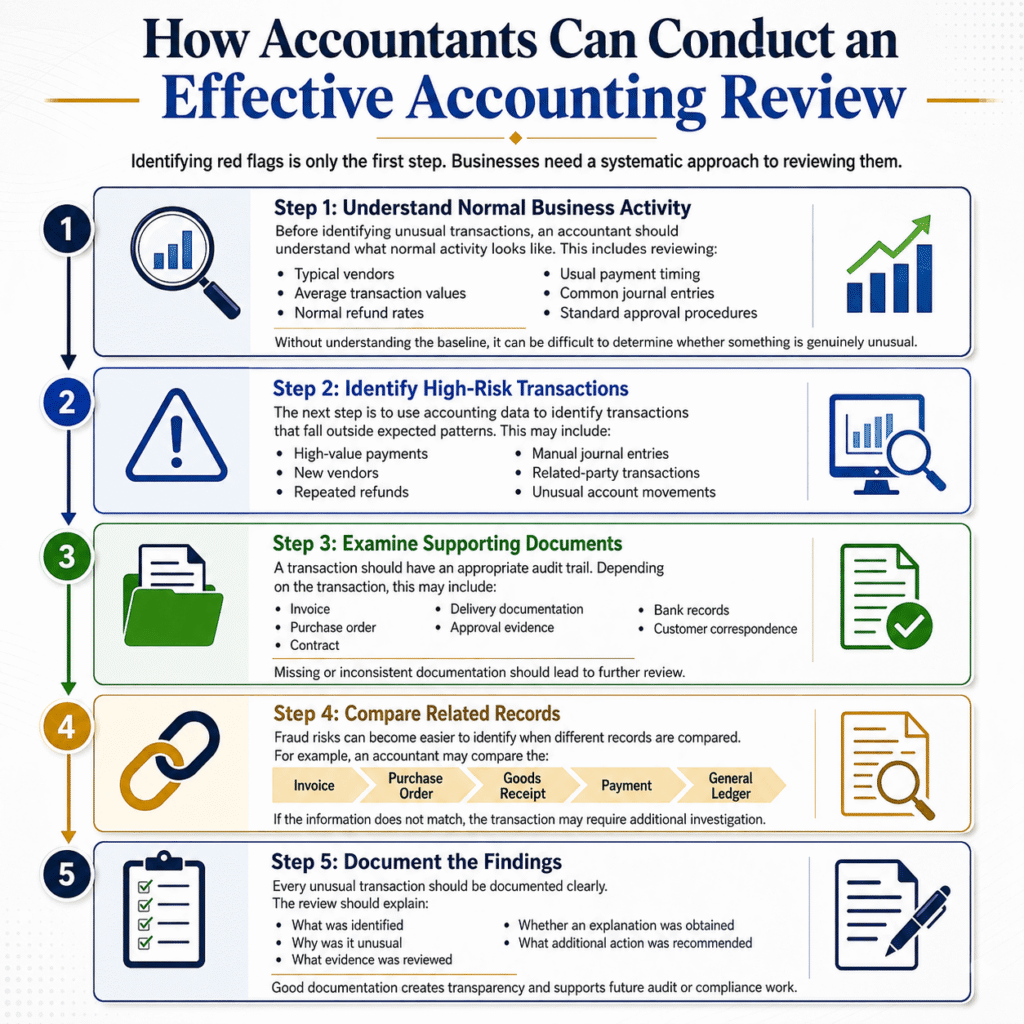
Before identifying unusual transactions, an accountant should understand what normal activity looks like. This includes reviewing:
Without understanding the baseline, it can be difficult to determine whether something is genuinely unusual.
The next step is to use accounting data to identify transactions that fall outside expected patterns. This may include:
A transaction should have an appropriate audit trail. Depending on the transaction, this may include:
Missing or inconsistent documentation should lead to further review.
Fraud risks can become easier to identify when different records are compared. For example, an accountant may compare the:
Invoice → Purchase Order → Goods Receipt → Payment → General Ledger
If the information does not match, the transaction may require additional investigation.
Every unusual transaction should be documented clearly. The review should explain:
Good documentation creates transparency and supports future audit or compliance work.
Businesses can reduce fraud risk by establishing clear financial controls rather than relying solely on after-the-fact reviews.
Important controls include:
Identifying a potential fraud red flag can be difficult when business owners and finance teams are focused on day-to-day operations.
A Ripple accountant can support businesses with structured accounting review and financial control processes designed to identify unusual transactions and improve the reliability of financial records. Support may include:
If your business needs professional support with accounting review, financial controls, or identifying unusual accounting activity, contact Ripple for assistance.
Contact Details:
Phone: +971 52 356 5409
WhatsApp: +971 4 250 0833
Email: info@uaetaxcompliance.ae
Common warning signs include unusual vendors, unexplained payments, repeated refunds, duplicate transactions, unusual journal entries, missing documentation, and transactions that do not follow established approval procedures.
No. A red flag is an indicator that may justify further investigation. An unusual transaction can have a completely legitimate explanation.
Journal entries can affect important financial statement balances. Reviewing unusual, manual, high-value, or period-end entries can help identify transactions that require additional investigation.
Businesses can review their vendor master file and compare supplier details with invoices, contracts, purchase orders, payment records, and approval documentation.
Refunds are a legitimate part of many businesses. However, frequent, unusual, unsupported, or improperly authorized refunds can indicate weaknesses in financial controls and should be reviewed.
The appropriate frequency depends on the size, complexity, and risk profile of the business. Regular reviews combined with ongoing transaction monitoring can provide stronger protection than relying on a single annual review.
Yes. Accounting and data-analysis tools can help identify duplicate payments, unusual transaction amounts, unusual timing, repeated refunds, and other patterns. Human review is still important because an unusual pattern does not automatically establish fraud.
Financial fraud can sometimes hide within ordinary accounting activity. Unusual vendors, repeated refunds, unexplained journal entries, and irregular payment patterns can provide valuable warning signs when reviewed properly. For UAE businesses, a structured accounting review can help identify unusual activity, strengthen internal controls, improve financial record accuracy, and support better financial decision-making.
Disclaimer: This article is provided for general informational and educational purposes only. UAE businesses should obtain professional accounting, audit, legal, or regulatory advice based on their specific circumstances and applicable UAE laws and regulations.
Tell us a little about your business and our UAE tax experts will get back to you with clear, practical answers — no obligation.
 Corporate Tax
Are you living in the UAE and need proof of your tax residency for a foreign tax authority, bank or tax-related process?…
Read article Corporate Tax
Why might a UAE Tax Residency Certificate application be rejected even when an applicant lives or operates a business in the country?…
Read article Corporate Tax
How much does a UAE Tax Residency Certificate cost, how long does it take to obtain, and when does it expire? Understanding…
Read articlePage 1 of 59
Book a free consultation and get clear answers for your business.
0 Comments