UAE Tax Residency Certificate for Individuals: Eligibility and Application Guide
Are you living in the UAE and need proof of your tax residency for a foreign tax authority, bank or tax-related process?…
Read article
Are your UAE intercompany loans properly priced, accounted for, and monitored?
An intercompany loan may seem simple, but it can involve IFRS accounting, UAE transfer pricing, arm’s-length interest, corporate tax, credit risk, and Expected Credit Loss UAE considerations. For groups using centralized treasury arrangements, Cash Pooling UAE introduces additional accounting and transfer-pricing considerations.
The UAE corporate tax regime generally applies a 9% rate to taxable income exceeding AED 375,000, while related-party transactions must comply with the arm’s-length principle. The FTA specifically confirms that intra-group loans should be assessed for factors such as interest rate and duration.
Read on to understand the key accounting, tax, transfer-pricing, and treasury considerations for UAE intercompany financing.
A UAE intercompany loan is a financing arrangement between two companies that belong to the same corporate group or are otherwise treated as related parties. The lender may be a parent company, subsidiary, sister company, or central treasury entity. The borrower may use the funds for working capital, expansion, acquisitions, capital expenditure, or temporary liquidity requirements.
For example, assume UAE Holding Company owns UAE Trading LLC. UAE Trading LLC needs AED 5 million to purchase inventory. Instead of borrowing from an external bank, the parent company provides AED 5 million for three years at an agreed interest rate. The arrangement creates:
The fact that both entities belong to the same group does not mean the transaction can be priced or documented arbitrarily.
The FTA confirms that transfer-pricing rules apply to related-party transactions and specifically states that loans obtained from or granted to related parties should be at arm’s length, including the interest rate and duration.
Intercompany financing can create problems when groups treat it as an informal transfer of cash rather than a genuine financing transaction. For example, a parent company may transfer AED 10 million to a subsidiary with no written agreement, no maturity date, and no interest. The amount may remain outstanding for several years.
The finance team may record it as a simple intercompany receivable and payable. However, questions immediately arise:
These questions demonstrate why groups need a structured intercompany financing policy. A strong process should connect the legal agreement, accounting records, transfer-pricing analysis, tax treatment, and treasury monitoring.
Under IFRS, an intercompany loan is generally treated as a financial instrument. The exact accounting depends on the terms, the relationship between the entities, and applicable IFRS requirements. An important concept is that the accounting treatment should reflect the economic substance and contractual terms of the financing arrangement.
Consider a parent company providing a three-year loan of AED 5 million to its subsidiary. If the loan carries a market interest rate, the initial measurement may be relatively straightforward.
However, suppose the parent provides AED 5 million with no interest, and the amount is not repayable for three years. The AED 5 million cash received by the subsidiary may not necessarily represent the entire initial carrying amount of the financial liability under IFRS 9. A below-market or interest-free loan can require discounting to present value using an appropriate market rate.
For example, assume the appropriate market rate is 6%. The future AED 5 million repayment would be discounted to its present value. The difference between the cash advanced and the initial accounting measurement may require separate consideration depending on the facts and the relationship between the entities.
The important point is that an IFRS intercompany loan is not always accounted for simply by recording the cash transferred as the initial carrying amount.
The UAE’s transfer-pricing framework requires related-party transactions to follow the arm’s length principle. In simple terms, the question is: What would independent parties have agreed if they were negotiating the same financing transaction under comparable circumstances?
The FTA explains that transfer pricing seeks to ensure related-party transactions are carried out on arm’s length terms, as if the transaction had occurred between independent parties. For an intercompany loan, the analysis may consider:
The UAE’s transfer-pricing legislation also requires the appropriate method to be selected after considering contractual terms, transaction characteristics, economic circumstances, functions, assets, risks, and business strategies. Therefore, a group should not simply apply the same interest rate to every subsidiary.
Arm’s Length Interest is the interest rate that independent parties would reasonably have agreed to for a comparable financing arrangement. Suppose a UAE parent lends AED 20 million to a subsidiary. The subsidiary has:
A comparable independent borrower with similar characteristics might obtain financing at 5.5%. The group could use relevant market evidence and a transfer-pricing analysis to determine whether an interest rate around that range is appropriate.
By contrast, if the subsidiary has weak cash flows and high leverage, a higher rate may be commercially justified. The objective is not to select the highest or lowest possible rate. It is to establish a rate that can be supported using the facts and circumstances of the transaction.
The UAE FTA’s transfer-pricing guidance explains that comparability analysis is important when determining arm’s length outcomes.
Transfer pricing determines how the loan should be priced for tax purposes, but accounting also requires consideration of credit risk. Under IFRS 9, companies generally assess financial assets subject to the expected credit loss model. This means the lender should consider whether there is a risk that the borrower will fail to repay amounts due.
For example, suppose a UAE parent has an AED 10 million receivable from a subsidiary.
The subsidiary is currently profitable, but its cash flow has deteriorated significantly. Management expects that only AED 9.2 million may ultimately be recovered. The lender may need to recognize an expected credit loss based on the relevant IFRS 9 requirements.
This is why Expected Credit Loss UAE should not be treated as a purely tax issue. It is primarily an accounting and financial-reporting consideration. The assessment may consider the borrower’s:
A common mistake is to assume that an intercompany balance has no credit risk simply because the borrower belongs to the same group. Group relationships can influence the assessment, but they do not automatically eliminate the need to consider expected credit losses.
Cash Pooling UAE arrangements allow companies within a group to manage liquidity centrally rather than leaving excess cash idle in individual bank accounts. Under a cash-pooling arrangement, one group company may have surplus cash while another needs short-term funding. Instead of each company separately borrowing or investing cash, a central treasury function coordinates the group’s liquidity.
For example:
Rather than Company B and Company C borrowing externally while Company A keeps excess cash unused, the group can potentially use a cash-pooling structure to optimize liquidity.
This is an important part of Corporate Treasury UAE because centralized liquidity management can improve visibility over cash requirements and funding needs.
Cash pooling is more complex than simply combining bank balances.
The group should determine:
Suppose Company A contributes AED 10 million of surplus cash to a pool while Company B uses AED 6 million.
The group needs to establish how interest is allocated between the participants and whether the central treasury entity performs functions that justify separate remuneration.
The arrangement should also be consistent with the actual functions and risks of the entities involved.
The UAE’s transfer-pricing framework applies to related-party transactions, so cash-pooling arrangements should not automatically be treated as outside the transfer-pricing analysis.
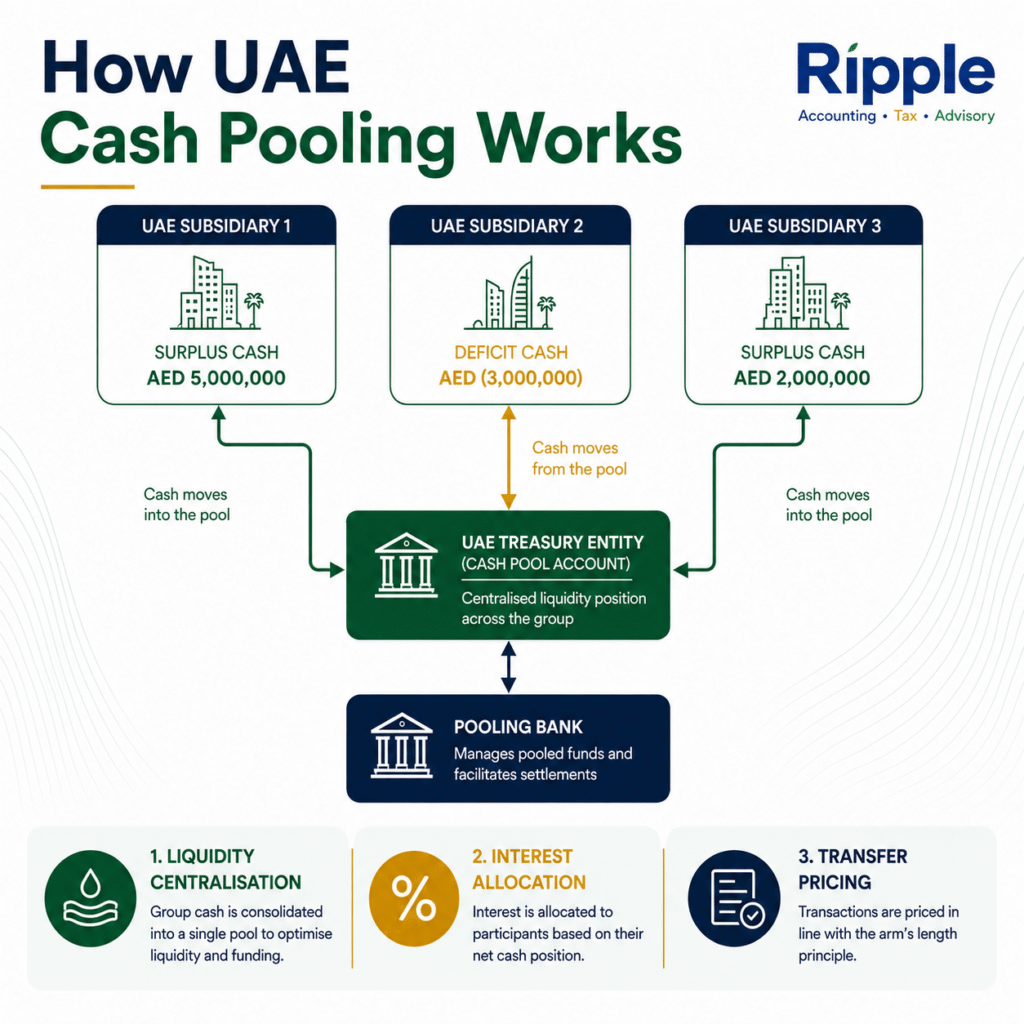
An intercompany loan is normally a specific financing arrangement between entities. Cash pooling is a broader liquidity-management structure involving multiple participants and centralized cash management.
For example, a three-year AED 5 million loan from Parent Company to Subsidiary A is an intercompany loan.
By contrast, a structure where several subsidiaries continuously deposit surplus balances with a central treasury company and draw funds when required is a cash-pooling arrangement. The accounting and transfer-pricing analysis therefore needs to reflect the actual structure rather than simply applying a generic “intercompany financing” label.
Intercompany financing can also affect UAE corporate tax calculations. The UAE Corporate Tax Law contains rules limiting the deductibility of net interest expenditure for businesses subject to the general interest deduction limitation rule. The legislation provides for a limitation based on adjusted EBITDA, subject to the applicable rules and exceptions.
The UAE rules also contain specific restrictions concerning certain interest expenses on loans obtained directly or indirectly from related parties. This means a business should not assume that every dirham of intercompany interest expense is automatically deductible. The tax analysis should consider:
Because the tax treatment depends on the facts, businesses should review the current corporate tax law and applicable implementing decisions before determining the final treatment.
A strong intercompany financing file should contain more than a journal entry. Businesses should maintain documentation such as:
The UAE Ministry of Finance has issued transfer-pricing documentation requirements designed to allow taxpayers to demonstrate the arm’s length basis of related-party transactions. Documentation is particularly important when the financing involves significant amounts or cross-border related parties.
Imagine ABC Holding UAE lends AED 10 million to its subsidiary, ABC Trading UAE, for five years. The agreement specifies a 5% annual interest rate.
The finance team should consider the transaction from several perspectives.
This example demonstrates why intercompany financing should be managed as a coordinated finance process rather than as an isolated accounting transaction.
A practical process can follow these stages:
Ripple Accountant can support UAE businesses in creating a more structured approach to intercompany financing, accounting, and financial reporting.
Our support can help businesses organize and reconcile intercompany loan balances, review financial records, support management reporting, and maintain clearer documentation around related-party financing.
Need help managing your UAE intercompany loans or cash-pooling records? Contact the Ripple Accountant support team today to discuss your requirements and get tailored accounting and financial reporting support.
Yes. The FTA confirms that transfer-pricing rules apply to transactions with related parties and connected persons. It specifically states that loans obtained from or granted to related parties should be at arm’s length, including factors such as interest rate and duration.
Not necessarily in every circumstance, but the absence or level of interest needs to be considered carefully under the applicable accounting and transfer-pricing rules. A below-market or interest-free loan may have accounting and transfer-pricing consequences.
An expected credit loss represents the credit loss a lender expects to incur based on the relevant IFRS 9 impairment requirements. An intercompany relationship does not automatically eliminate the need to assess credit risk.
Potentially, yes. Where related parties participate in a cash-pooling arrangement, the structure and terms should be considered under the UAE transfer-pricing framework. The appropriate analysis depends on the actual functions, risks, contractual terms, and economic circumstances.
No. Interest deductibility can be affected by the UAE Corporate tax interest limitation rules and other provisions. Related-party financing may also require transfer-pricing analysis. Businesses should assess the specific facts before claiming a deduction.
Companies should generally maintain the financing agreement, repayment schedule, interest calculations, accounting records, transfer-pricing support, credit assessment, ECL analysis, and evidence supporting payments and reconciliations, together with any other records required under applicable UAE rules.
UAE intercompany loans involve more than transferring funds between related companies. They can affect IFRS accounting, UAE transfer pricing, corporate tax, credit-risk assessment, and treasury management. Businesses should maintain clear loan agreements, apply appropriate Arm’s Length Interest, assess expected credit Loss UAE requirements, and retain supporting tax documentation. Groups using cash pooling UAE structures also need strong governance and monitoring controls.
Disclaimer: This article provides general information for educational purposes only and does not constitute legal, tax, accounting, financial, or professional advice. Rules, regulations, and requirements may vary depending on the specific circumstances, industry, location, and applicable laws. Readers should verify the latest requirements with the relevant authorities and consult a qualified professional before making any business, financial, tax, or compliance decisions.
Tell us a little about your business and our UAE tax experts will get back to you with clear, practical answers — no obligation.
 Corporate Tax
Are you living in the UAE and need proof of your tax residency for a foreign tax authority, bank or tax-related process?…
Read article Corporate Tax
Why might a UAE Tax Residency Certificate application be rejected even when an applicant lives or operates a business in the country?…
Read article Corporate Tax
How much does a UAE Tax Residency Certificate cost, how long does it take to obtain, and when does it expire? Understanding…
Read articlePage 1 of 59
Book a free consultation and get clear answers for your business.
0 Comments