UAE Tax Residency Certificate for Individuals: Eligibility and Application Guide
Are you living in the UAE and need proof of your tax residency for a foreign tax authority, bank or tax-related process?…
Read article
Could a UAE company remain profitable and still breach a bank covenant?
Yes. A business can report healthy revenue and even generate accounting profits while falling short of a financial covenant because of declining cash flow, excessive leverage, weak interest coverage, reduced liquidity, or a change in the calculation required by its financing agreement.
This is why Bank Covenant Reporting should not be treated as a compliance exercise performed only when the bank requests financial statements. For businesses with significant borrowing, covenant monitoring is an ongoing financial-control process that connects accounting data, loan agreements, management forecasts, and treasury decisions.
Bank covenant reporting is the process of calculating, reviewing, and communicating whether a borrower is complying with the financial and non-financial conditions contained in its financing agreements.
A bank loan agreement may require the borrower to maintain specific financial conditions. These could include requirements relating to:
The borrower may then be required to provide periodic information demonstrating compliance. For example, a facility agreement could require a company to maintain:
Net Debt / EBITDA ≤ 3.50x
Suppose the company has:
The ratio would be:
AED 80 million ÷ AED 30 million = 2.67x
The company would therefore be within the hypothetical 3.50x covenant. But what happens if EBITDA falls to AED 22 million?
AED 80 million ÷ AED 22 million = 3.64x
The company could now be outside the stated threshold. The important point is that profitability alone does not determine covenant compliance. The specific calculation and definitions in the loan agreement determine whether a covenant has been satisfied.
Borrowers often focus on their income statement, balance sheet, and cash flow statement. These are essential, but they may not tell management whether a bank covenant is approaching a breach. A covenant report provides a different perspective.
It asks, “Are we meeting the financial conditions that our lenders require?”
This matters for several reasons.
One of the most important principles of loan covenant monitoring is that the ratio shown in a generic finance textbook may not be the same ratio defined in a loan agreement. The agreement may contain specific definitions for:
It may also permit specific adjustments.
Example: A company calculates EBITDA under its normal management reporting as:
AED 40 million
But the loan agreement permits certain contractual adjustments of AED 5 million. The covenant EBITDA might therefore be
AED 45 million
If net debt is AED 135 million:
135 ÷ 45 = 3.0x
Using management EBITDA of AED 40 million would produce:
135 ÷ 40 = 3.38x
That is a significant difference. Therefore, covenant reporting should always begin with a covenant definition matrix derived from the actual financing documentation.
The specific financial covenant ratios used in UAE financing arrangements vary according to the lender, borrower, industry, and facility structure. Several common measures deserve particular attention.
This measures leverage relative to operating earnings.
Formula: Net Debt ÷ EBITDA
Suppose:
Net Debt/EBITDA:
100 ÷ 40 = 2.50x
If the contractual maximum is 3.00x, the borrower remains within the hypothetical threshold. However, if EBITDA falls to AED 32 million:
100 ÷ 32 = 3.13x
The covenant position has deteriorated.
This measures the company’s ability to cover interest expense from earnings. A common simplified formula is
EBITDA ÷ Interest Expense
For example:
Interest coverage:
50 ÷ 10 = 5.0x
If the required minimum is 3.0x, the company has substantial headroom under this simplified calculation. Again, the actual loan agreement may specify a different definition.
DSCR measures the ability to generate sufficient cash or earnings to service debt obligations. A simplified formula may be expressed as:
Cash Flow Available for Debt Service ÷ Debt Service
Suppose:
DSCR:
30 ÷ 20 = 1.50x
If the agreement requires at least 1.25x, the company has a 0.25x buffer.
Some facilities may require the borrower to maintain a minimum level of cash or liquidity. For example:
Minimum cash balance = AED 10 million
If the company falls to AED 8 million, management needs to understand whether this represents a covenant issue under the agreement.
A lender may also monitor total debt relative to shareholders’ equity. A simplified formula is:
Total Debt ÷ Equity
For example:
Debt-to-equity: 1.50x
Whether this is acceptable depends entirely on the financing agreement.
Knowing that a company is technically compliant is not enough. Management should also know how close it is to the limit. This is called covenant headroom.
Suppose the maximum permitted leverage is 3.50x. The company’s current leverage is 3.10x.
Headroom: 3.50x − 3.10x = 0.40x
The company is compliant, but a 0.40x buffer may not be particularly comfortable if earnings are volatile.
A dashboard should therefore show:
Actual → Limit → Headroom → Forecast → Trend
This makes the report much more useful than simply displaying “Compliant.”
Historical compliance tells management what happened. Covenant forecasting models tell management what could happen next. This is particularly important because many covenant breaches are predictable. A forecast model can incorporate:
The model can then calculate projected covenant ratios for future periods.
Example: Assume
Current leverage: 100 ÷ 35 = 2.86x
The bank’s hypothetical maximum is 3.50x. Management forecasts EBITDA to decline to AED 29 million. Projected leverage:
100 ÷ 29 = 3.45x
The company technically remains below 3.50x, but the headroom has reduced dramatically. A further decline could produce a breach. This is precisely why forecasting should happen before the formal reporting date.
A base-case forecast may not be sufficient. Management should also test adverse scenarios. Possible scenarios include:
Example: Revenue Stress
Base case:
Stress case:
Leverage becomes: 125 ÷ 32 = 3.91x
If the hypothetical covenant limit is 4.00x, the company remains technically compliant but has only 0.09x headroom. That should trigger management attention.
A strong covenant early warning process does not wait for a breach. Instead, management establishes internal warning levels. For example:
| Status | Leverage | Management action |
| Green | < 3.00x | Normal monitoring |
| Amber | 3.00–3.25x | Increased monitoring |
| Orange | 3.25–3.40x | Management action plan |
| Red | > 3.40x | Immediate escalation |
The exact thresholds should be determined according to the company’s financing documents, risk appetite, and internal policies. The key principle is that the internal warning threshold should generally provide enough time to act before the contractual limit is reached.
For example, if the contractual maximum is 3.50x, waiting until 3.49x before taking action is poor risk management.
A covenant compliance dashboard should be simple enough for senior management to understand quickly while retaining enough detail for finance and treasury teams.
A useful dashboard can contain:
A covenant report is only as reliable as the information behind it. Typical data sources include:
The finance team should establish a controlled process for collecting this information. For example, the covenant reporting workbook should not depend on manually copying figures from multiple uncontrolled spreadsheets every month. A better approach is to establish:
Source → Calculation → Review → Approval → Report
Covenant reporting should have clearly defined ownership, with responsibilities distributed across finance, treasury, FP&A, risk, senior management, and the Board.
In the UAE, businesses should distinguish between contractual bank covenants imposed on corporate borrowers and prudential requirements applicable to regulated financial institutions. These frameworks address financial risk but serve different purposes.
For CBUAE-regulated banks, the regulatory framework emphasises risk monitoring, reporting, governance, forward-looking capital planning, stress testing, and early-warning processes. Similarly, financial institutions operating in DIFC under the DFSA or ADGM under the FSRA must comply with the prudential and regulatory reporting requirements applicable to their activities.
However, these regulatory requirements do not automatically become the contractual covenant requirements of a corporate borrower. A company’s obligations are primarily determined by its loan agreement, facility terms, financial covenants, reporting requirements, and lender-specific conditions.
For UAE businesses, the practical approach is to identify the applicable regulator and financing structure, review the relevant loan documentation, and then establish covenant reporting and monitoring controls accordingly.
Even financially sophisticated businesses can experience covenant reporting problems.
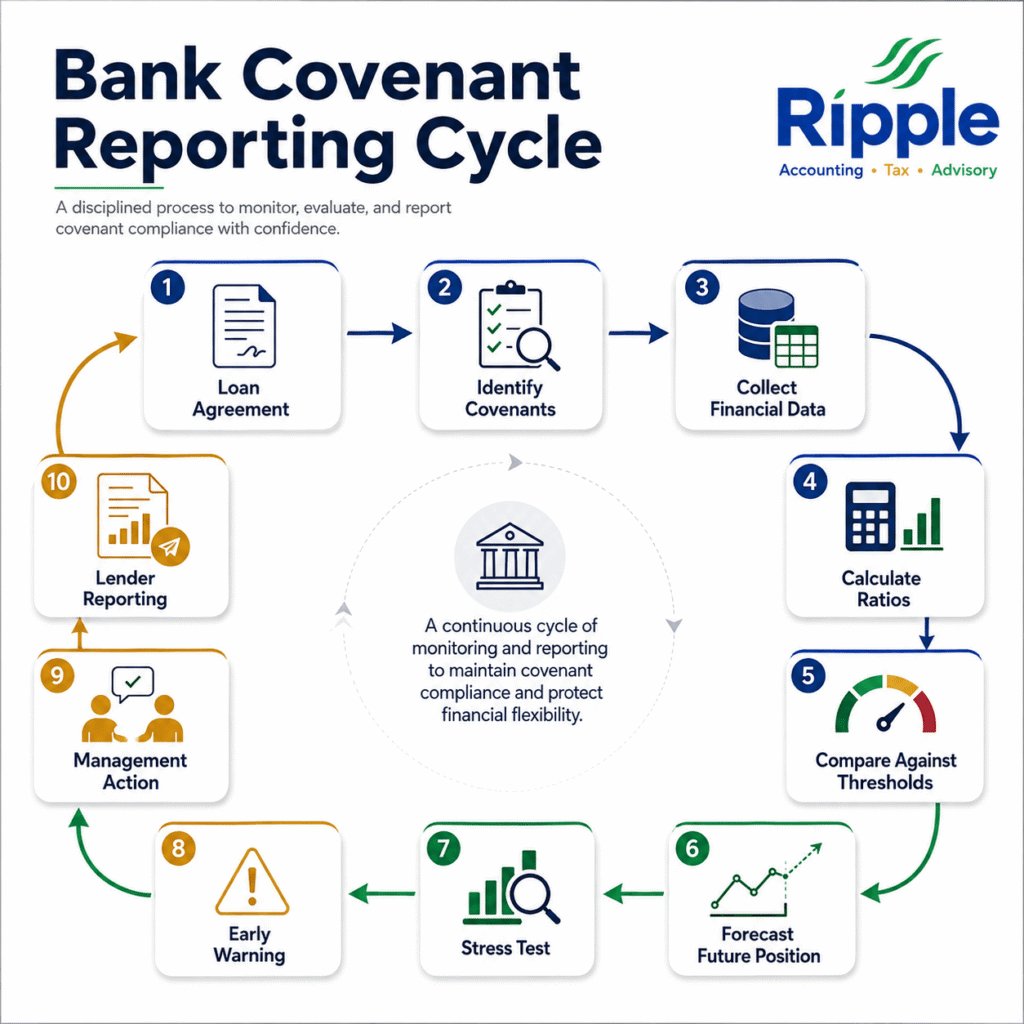
A practical bank covenant reporting process can be implemented through eight structured stages, starting with the collection of financing documents and ending with clear governance and escalation procedures.
Begin by gathering all relevant financing documents, including loan agreements, facility letters, amendments, waivers, side letters, security documents, and previous compliance certificates. These documents provide the contractual basis for identifying and interpreting covenant requirements.
Create a covenant register for each financing facility that records the covenant name, calculation formula, threshold, testing date, reporting frequency, data source, responsible person, reviewer, and escalation level.
Map every covenant input to its underlying financial data source. For example, EBITDA may be calculated using the general ledger and approved adjustments, debt may be obtained from the loan schedule, cash from bank reconciliations, and interest from loan statements.
Develop a standardised calculation model that applies the contractual covenant formulas consistently. Where practical, automate calculations to reduce manual errors and improve reporting efficiency.
Extend the model beyond the current reporting period by forecasting future covenant ratios. This helps management identify potential breaches before they occur.
Apply downside scenarios to test how changes in revenue, EBITDA, interest costs, debt, working capital, or other relevant factors could affect covenant compliance.
Develop a covenant dashboard that presents the actual position, contractual limit, available headroom, forecast position, and overall risk status in a clear format.
Define review, approval, monitoring, and escalation responsibilities so that covenant calculations are independently checked and potential breaches are communicated to the appropriate stakeholders promptly.
Ripple Accountant can support UAE businesses in building a more structured financial reporting and covenant-monitoring process.
Our support team can help connect accounting records, loan documentation, financial forecasts, and management reporting to improve covenant visibility and control.
Need help strengthening your bank covenant reporting process? Contact the Ripple Accountant support team today to discuss your business requirements and get tailored financial reporting support.
Bank covenant reporting is the process of calculating and reporting whether a borrower complies with the financial and other requirements contained in its loan or financing agreements.
Historical results show the current position, while forecasting identifies where the business may be heading. Forecasting can therefore provide management with time to address a potential covenant issue before the testing date.
Covenant headroom is the difference between the company’s current or projected financial ratio and the contractual covenant threshold. For example, if the maximum leverage is 3.50x and the actual leverage is 3.10x, the headroom is 0.40x.
A covenant early-warning system establishes internal thresholds below the contractual limit. When the borrower approaches those thresholds, management receives an alert and can take corrective action.
A useful dashboard can show:
No. Bank covenants are contractual requirements agreed between a lender and borrower, while CBUAE prudential ratios and requirements apply to regulated institutions within the relevant regulatory framework. A corporate borrower should therefore review its own financing agreements separately from regulatory requirements applicable to its bank.
The company should review the exact financing agreement, validate the calculation, identify the cause, assess available remediation options, and communicate with the lender as appropriate. Depending on the agreement, potential outcomes may include a waiver, amendment, remediation, or other contractual consequences.
Bank Covenant Reporting is much more than a compliance certificate. For UAE businesses with significant bank financing, it can become an important part of financial planning, liquidity management, and risk governance.
The process should begin with a detailed understanding of the financing agreements. Management then needs reliable accounting data, clearly defined financial covenant ratios, accurate calculations, and a documented reconciliation process.
Disclaimer: This article provides general information for educational purposes only and does not constitute legal, tax, accounting, financial, or professional advice. Rules, regulations, and requirements may vary depending on the specific circumstances, industry, location, and applicable laws. Readers should verify the latest requirements with the relevant authorities and consult a qualified professional before making any business, financial, tax, or compliance decisions.
Tell us a little about your business and our UAE tax experts will get back to you with clear, practical answers — no obligation.
 Corporate Tax
Are you living in the UAE and need proof of your tax residency for a foreign tax authority, bank or tax-related process?…
Read article Corporate Tax
Why might a UAE Tax Residency Certificate application be rejected even when an applicant lives or operates a business in the country?…
Read article Corporate Tax
How much does a UAE Tax Residency Certificate cost, how long does it take to obtain, and when does it expire? Understanding…
Read articlePage 1 of 59
Book a free consultation and get clear answers for your business.
0 Comments