UAE Tax Residency Certificate Fees, Processing Time and Validity
How much does a UAE Tax Residency Certificate cost, how long does it take to obtain, and when does it expire? Understanding…
Read article
Why can a healthcare provider have strong patient volumes and substantial billed revenue, yet still struggle with cash flow?
The answer is often found in the gap between services delivered, insurance claims submitted, amounts approved, payments received, and receivables actually collected.
For UAE clinics, medical centers, and healthcare providers, insurance revenue can pass through several stages before it becomes cash. A claim may be submitted correctly but partially paid. Another may be rejected because of eligibility, coding, or authorization issues. Some balances may remain pending for months, while others may require appeals or contractual adjustments.
Medical insurance receivables are amounts that a healthcare provider expects to collect from insurance companies, third-party administrators (TPAs), government-related healthcare schemes, or other payers for services already provided.
The receivable is generally created after a healthcare service has been delivered and a claim or invoice has been generated. However, the amount initially billed should not automatically be treated as the amount that will ultimately be collected. Consider a UAE clinic that provides AED 500,000 worth of insured services during a month.
After claims are processed:
The original AED 500,000 of billed services has therefore moved into several different financial categories.
This distinction is fundamental to insurance receivables management. A finance team needs to know not just the gross amount billed, but also:
What was submitted? → What was accepted? → What was rejected? → What was paid? → What was adjusted? → What remains collectible?
Without this visibility, management can overestimate the quality of its receivables and underestimate potential cash-flow problems.
Insurance receivables directly influence cash flow, working capital, profitability, and financial reporting.
A clinic can generate significant accounting revenue while still waiting months for insurers to settle claims. This creates an important distinction: Revenue recognition and cash collection are not the same thing.
A service can generate revenue and a corresponding receivable, but the healthcare provider still needs to convert that receivable into cash.
The cash-flow problem
Suppose a clinic bills AED 2 million in one month. If insurers take longer than expected to settle claims, the clinic may need to finance:
The clinic may therefore be profitable but experience working-capital pressure because too much cash is tied up in receivables.
The reporting problem
A second risk occurs when management does not accurately assess the collectability of older balances. If a large amount of insurance AR remains outstanding for an extended period, management should investigate why. Is the balance:
These questions make receivables reconciliation essential.
Insurance receivables are created at the end of a much larger operational process. A simplified healthcare revenue cycle looks like this:
Patient Registration → Eligibility → Authorization → Treatment → Documentation → Coding → Claim Submission → Adjudication → Payment/Rejection → Reconciliation → Collection
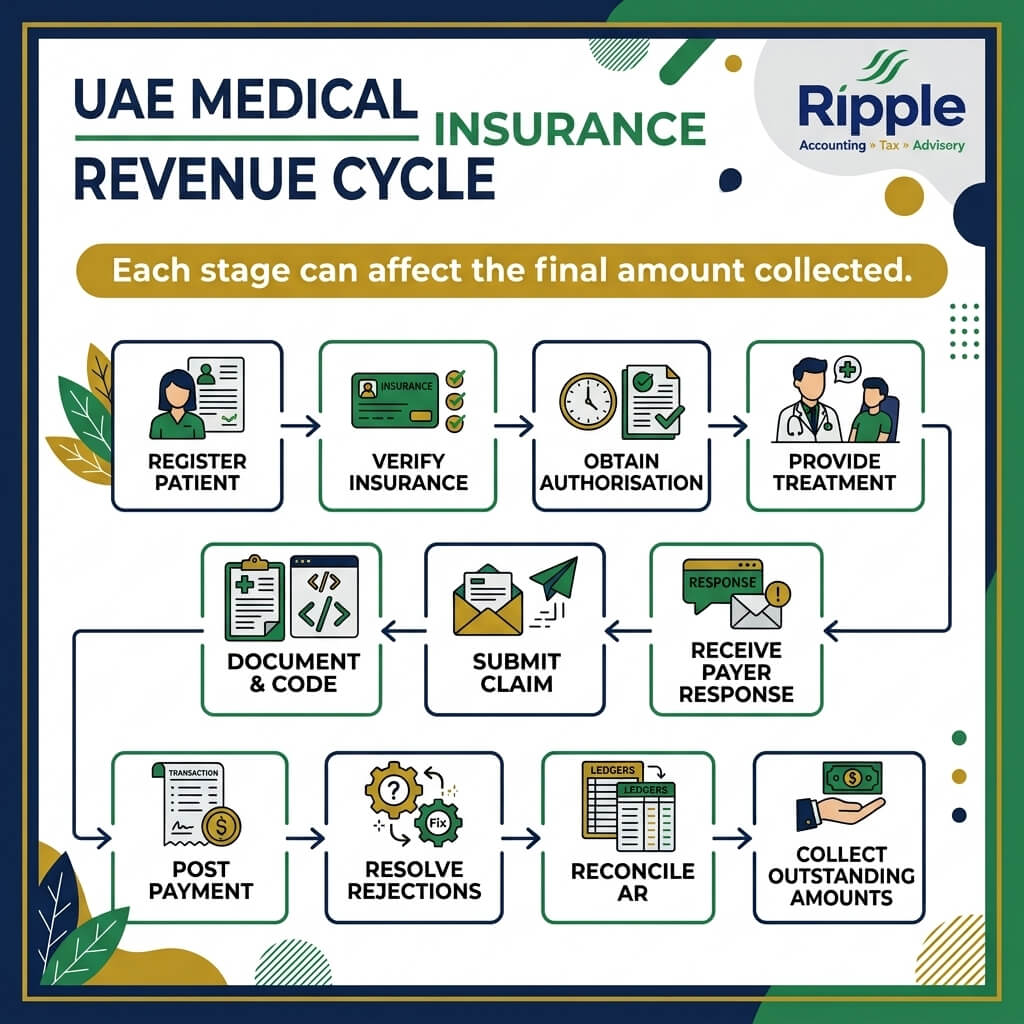
Each stage can affect the final amount collected.
Revenue-cycle control begins before the medical service is provided. Patient and insurance information should be captured accurately and verified where required. The process may involve checking:
An error here can create a financial problem later.
Example: A patient visits a specialist and provides an insurance card.
The clinic enters the member number incorrectly. The patient receives AED 1,500 of treatment, and the claim is submitted using incorrect information. The payer rejects the claim because the member cannot be identified. The medical service was legitimate, but the clinic has now created an avoidable receivable problem. A strong revenue-cycle process therefore treats registration as an important financial control, not merely a front-desk task.
Certain services may require prior approval or authorization.
If authorization is required, the clinic needs a process for:
Documentation is equally important. The clinical record should support the service that appears on the claim.
Example: A clinic performs a procedure worth AED 3,000. The insurer had authorized a specific procedure subject to particular conditions, but the clinic’s submitted claim does not match the approved service. The payer may reject or reduce the claim.
This demonstrates why medical billing and claims UAE processes must connect clinical documentation, authorization, and billing information.
Before an insurance claim can be successfully processed, the clinic needs to accurately capture the services provided. This involves appropriate coding and charge capture. Potential problems include:
Dubai’s healthcare data environment uses defined coding requirements, including ICD-10-CM diagnosis codes and CPT4 procedure codes within relevant electronic healthcare information flows.
Example: missed charge
A physician performs:
The total should be AED 1,450.
This is revenue leakage before the receivable even reaches the collections stage.
Medical insurance claims reconciliation is the process of comparing claims, payer responses, payments, adjustments, outstanding balances, and accounting records to confirm that the financial information is complete and accurate. A strong reconciliation should answer:
A practical reconciliation example: Suppose a medical center submits claims worth:
AED 1,000,000
Payer responses show:
| Claim status | Amount |
| Paid by insurers | AED 700,000 |
| Approved but unpaid | AED 100,000 |
| Rejected | AED 80,000 |
| Pending | AED 50,000 |
| Patient responsibility | AED 40,000 |
| Contractual adjustments | AED 30,000 |
| Total | AED 1,000,000 |
The finance team should be able to explain the entire AED 1 million. If the general ledger instead shows AED 350,000 of insurance receivables, the difference must be investigated. It could result from:
This is why reconciliation should be performed regularly rather than only at year-end.
Medical claims rejection management is the process of identifying, correcting, tracking, and resolving claims that have not been accepted or paid as expected.
A rejected claim should trigger an investigation rather than simply being moved into an older AR category. Common rejection causes include:
The exact rejection codes and workflows depend on the relevant payer and healthcare system. The objective is not simply to recover rejected claims. The bigger objective is to prevent recurring rejections.
One of the biggest mistakes in revenue-cycle management is treating every rejection as an isolated transaction. Suppose a clinic receives 1,000 rejected claims during a quarter. After analysis, management discovers:
Instead of assigning employees to repeatedly correct all 1,000 claims, management can address the underlying process weaknesses. For example, if eligibility errors account for 30% of rejections, the clinic could introduce:
The result is more valuable than simply recovering the existing rejected claims. The clinic is reducing future revenue leakage.
Not every outstanding balance carries the same level of risk. A practical healthcare accounts receivable UAE report should segment balances according to age.
For example:
| Aging category | Interpretation |
| 0–30 days | Current |
| 31–60 days | Monitor |
| 61–90 days | Follow up closely |
| 91–120 days | Higher attention |
| 121–180 days | High-risk category |
| 180+ days | Requires detailed review |
The exact thresholds should reflect the provider’s payer mix, contracts, normal payment cycles and internal policy.
Example
A clinic has:
Total AR is AED 1.1 million. Looking only at the total can make the position appear manageable. But the AED 300,000 in 180+ day receivables deserves immediate investigation. Management should determine:
Payer-level analysis is equally important. Consider a healthcare provider with AED 2 million in total insurance receivables.
| Payer | Outstanding AR | Aging |
| Payer A | AED 900,000 | Mostly current |
| Payer B | AED 500,000 | 30–90 days |
| Payer C | AED 350,000 | 90–120 days |
| Payer D | AED 250,000 | 180+ days |
The total AR figure does not tell the complete story.
Payer D may represent the greatest collection risk even though it has the smallest balance.
This is why insurance receivables management should combine:
Value + Age + Payer + Rejection Status + Collectability
rather than relying on total AR alone.
This is one of the most important areas where accounting and revenue-cycle management meet. An outstanding receivable is not necessarily equal to the amount that will ultimately be collected.
Healthcare providers should assess receivables under their applicable financial reporting framework and approved accounting policies. Factors that can affect expected recoverability include:
Example
A clinic has AED 1 million in outstanding insurance receivables.
However:
The entire AED 1 million should not necessarily be treated as having the same risk profile.
The finance team should apply its relevant accounting policy and financial reporting requirements to determine the appropriate treatment.
A provision or allowance is therefore not simply a write-off.
It is an accounting mechanism used to reflect the expected recoverability of receivables according to the applicable framework.
Healthcare revenue cycle management UAE encompasses much more than insurance collections. It connects clinical operations with financial outcomes. The cycle can be understood as:
Patient → Service → Documentation → Coding → Claim → Payer Response → Payment → Reconciliation → Financial Reporting
A failure at any stage can affect the final financial result. For example:
Alternatively:
This demonstrates why revenue-cycle management should not be viewed as the responsibility of the billing department alone. Reception, clinical staff, coders, billing teams, finance professionals and management all influence the outcome.
1. Establish Clear Ownership: Every stage should have a responsible team or employee. For example:
2. Use Pre-Submission Controls
Review claims before submission for:
3. Analyze Rejections by Cause
Do not report only the total rejected claims. Categorise them by reason and department.
4. Reconcile Regularly
Compare:
Billing system ↔ Claims system ↔ Payer response ↔ Bank/payment records ↔ General ledger
5. Prioritise Old Receivables
Older balances should receive increasing attention.
6. Monitor Underpayments
A claim marked “paid” is not necessarily correctly paid. Expected reimbursement should be compared with actual payment where contractual information is available.
7. Separate Insurance and Patient Receivables
Patient responsibility should not remain mixed with insurer balances.
8. Review Recoverability
Old, disputed, or repeatedly rejected claims should be assessed for collectability under the relevant accounting policy.
Technology can significantly improve medical claims management UAE, particularly where a provider handles a large volume of transactions. A modern healthcare environment may involve:
A well-connected environment can create a workflow such as:
EMR → Billing → Claims → Payer Response → Payment Posting → Accounting → Reporting
Automation can help identify:
However, software should not replace internal controls. A system can automate an incorrect process just as efficiently as a correct one. Therefore, technology should be combined with:
VAT is another area that should be considered when reconciling healthcare revenue. The UAE Federal Tax Authority states that certain healthcare services are zero-rated, subject to the applicable conditions.
The Executive Regulation specifies conditions for healthcare services to qualify for zero-rating, including requirements relating to the licensed healthcare provider and the wellbeing of a human being. It also identifies certain exclusions, including elective cosmetic treatment that is not prescribed for treating or preventing a medical condition.
This means healthcare providers should not assume that every transaction associated with a medical business automatically receives identical VAT treatment.
A clinic may generate revenue from:
The VAT treatment should be assessed according to the nature of each supply and the applicable UAE VAT rules. The FTA also notes that VAT generally applies at 5% unless a transaction is specifically zero-rated or exempt. Consequently, revenue reconciliation should be sufficiently detailed to support appropriate VAT classification and reporting.
Medical insurance receivables can become difficult to manage when healthcare providers have to track insurance claims, patient co-payments, outstanding balances, and payments received from different insurers. Accurate accounting helps ensure that expected reimbursements are recorded correctly and that overdue amounts do not remain unnoticed.
Ripple Accountants can support healthcare businesses by maintaining organized receivable records, reconciling transactions, and providing clear financial reports. Its accounting services include accounts receivable management, account reconciliation, bookkeeping, and financial reporting. To avail these services, you can contact our Ripple team!
Phone: +971 52 356 5409
WhatsApp: +971 4 250 0833
Email: info@uaetaxcompliance.ae
Medical insurance receivables are amounts that healthcare providers expect to collect from insurers, TPAs, or other payers for healthcare services already provided and billed.
Medical insurance claims reconciliation is the process of matching claims submitted, payer responses, payments, adjustments, and outstanding balances with the healthcare provider’s accounting records.
Claims may be rejected because of eligibility problems, missing authorization, coding errors, incomplete documentation, duplicate submissions, non-covered services, incorrect patient information, or other payer-specific requirements.
They can strengthen eligibility verification, authorization controls, clinical documentation, coding accuracy, pre-submission claim checks, and rejection root-cause analysis.
Insurance receivables management involves monitoring, reconciling, following up and collecting amounts owed by healthcare payers while assessing the status and recoverability of outstanding balances.
A rejected claim is not automatically a bad debt. A rejected claim may be corrected, resubmitted or appealed. A receivable becomes a potential collection concern when there is evidence that recovery may be difficult or uncertain, subject to the organisation’s accounting framework and policy.
AR aging helps management identify how long balances have remained outstanding. Older balances generally require greater investigation because prolonged delays may indicate disputes, rejection issues, payer problems, or collection risk.
Medical insurance receivables are a critical part of financial management for UAE healthcare providers. The process does not end when a claim is submitted. A healthcare organization needs to follow the claim through adjudication, payment, rejection management, reconciliation, and collection before it can fully understand the financial outcome of the service.
Disclaimer: This article provides general information for educational purposes only and does not constitute legal, tax, accounting, financial, or professional advice. Rules, regulations, and requirements may vary depending on the specific circumstances, industry, location, and applicable laws. Readers should verify the latest requirements with the relevant authorities and consult a qualified professional before making any business, financial, tax, or compliance decisions.
Tell us a little about your business and our UAE tax experts will get back to you with clear, practical answers — no obligation.
 Corporate Tax
How much does a UAE Tax Residency Certificate cost, how long does it take to obtain, and when does it expire? Understanding…
Read article Corporate Tax
Are you planning to apply for a UAE Tax Residency Certificate but unsure which documents you need or whether you qualify? Understanding…
Read article Corporate Tax
Do you need a UAE Tax Residency Certificate for a local administrative requirement or to claim benefits under a double taxation agreement?…
Read articlePage 1 of 58
Book a free consultation and get clear answers for your business.
0 Comments