Why UAE Tax Residency Certificate Applications Get Rejected: Common Mistakes to Avoid
Why might a UAE Tax Residency Certificate application be rejected even when an applicant lives or operates a business in the country?…
Read article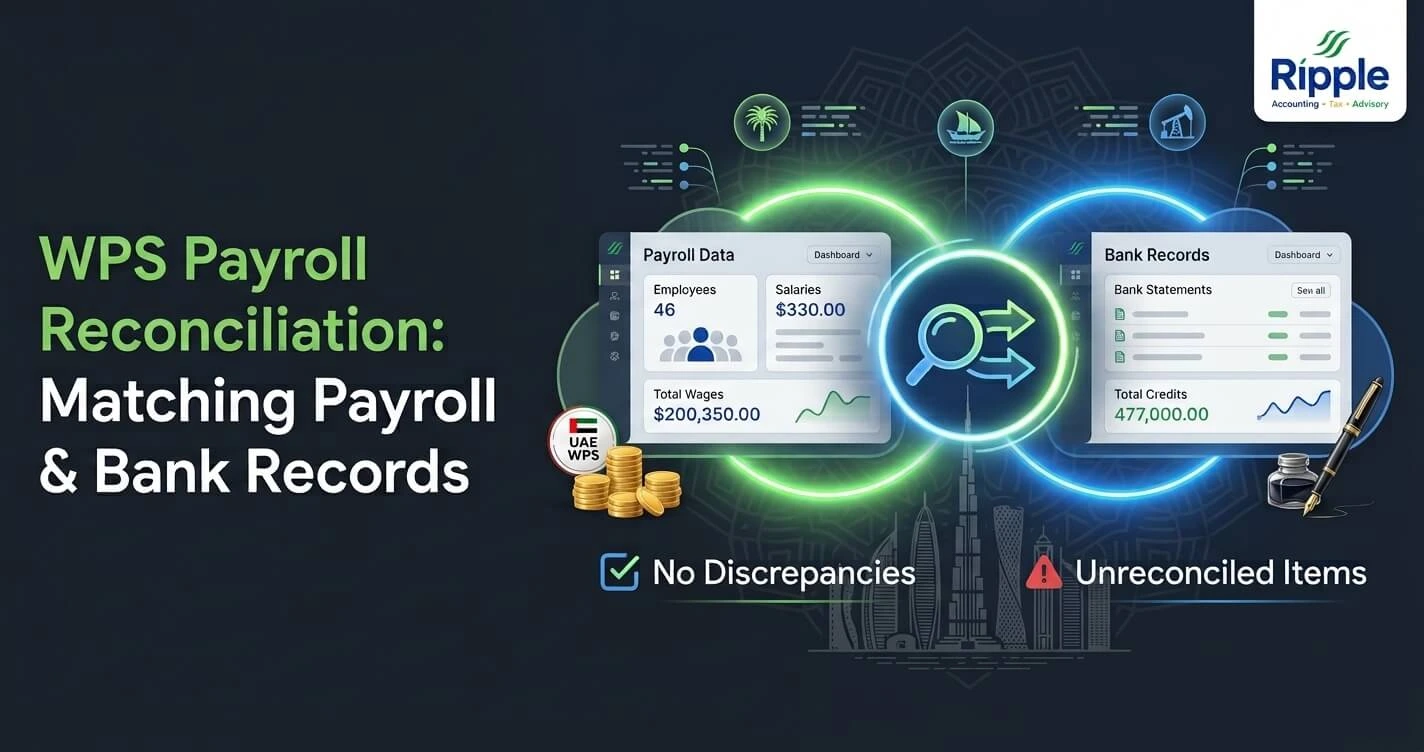
What happens when the payroll amount you approved doesn’t match the amount shown in your bank records? This is where WPS payroll reconciliation comes in.
WPS payroll reconciliation is a critical financial control for businesses that process employee salaries through the Wage Protection System (WPS). By systematically matching payroll records with bank transactions and WPS payment information, we can identify discrepancies, prevent payroll errors, strengthen financial controls, and maintain accurate employee payment records.
The Ministry of Human Resources and Emiratisation reports that WPS covers more than 99% of private-sector workers, with establishments transferring over AED 35 billion in wages each month through the system. With such a large volume of salary payments being processed, having an accurate and well-organized reconciliation process is essential
Read on to understand the complete payroll reconciliation process!
WPS payroll reconciliation is the process of comparing payroll records with WPS submissions, bank payment records, and accounting entries to ensure that all salary transactions are accurate, complete, and properly recorded.
For UAE businesses, payroll reconciliation creates a clear connection between the employee payroll register, the WPS salary file, bank transactions, and the company’s accounting records. Instead of checking only the final payroll total, we can trace each salary payment from calculation through submission, bank processing, and accounting settlement.
A properly reconciled payroll should answer four fundamental questions:
When these records match, we have stronger evidence that payroll has been processed correctly. When they do not match, reconciliation helps us identify the exact point at which the difference occurred.
A reliable payroll reconciliation UAE process depends on having complete records from payroll, banking, WPS, and accounting.
The primary documents normally include the following:
The payroll register provides the employee-level details used to calculate salaries. It may include employee names or IDs, basic salary, allowances, deductions, leave adjustments, overtime, bonuses, and net salary. This becomes the starting point for reconciliation because it represents the approved payroll calculation.
The WPS salary file contains the salary payment information submitted for WPS processing. We should compare it with the approved payroll register before submission. The employee count, employee identifiers, payment amounts, and overall payroll value should be reviewed for consistency.
The Salary Information File (SIF) is the structured electronic file used in the WPS salary payment process. It should be prepared from the finalized payroll data and checked before submission. The SIF should not be treated as an isolated file. It should remain traceable to the approved payroll records.
The bank payment report shows what was actually processed through the company’s banking channel. This is essential because an approved payroll does not necessarily mean that every payment was successfully completed.
The bank statement provides independent evidence of the actual movement of funds. We can use it to confirm salary debits and investigate returned, reversed, or otherwise unusual transactions.
The payroll journal connects payroll processing with accounting. The general ledger payroll accounts should ultimately reflect the appropriate salary expenses, liabilities, deductions, and settlements. Together, these records provide the evidence needed to complete a full reconciliation.
A consistent process makes reconciliation easier and helps finance teams identify the exact point where a discrepancy occurred.
Start with the final approved payroll register. Review employee records, salary amounts, allowances, deductions, and net pay. Check for unusual salary changes, duplicate employees, missing employees, or unexpected deductions. The total net payroll amount should be established as the main control total.
For example:
Approved net payroll = AED 500,000
This amount will then be compared with the payment and accounting records.
Next, compare the SIF with the approved payroll. Check:
If the SIF shows a different amount from the approved payroll, investigate the difference before continuing.
This step helps ensure that the payment information being processed represents the payroll that was actually approved.
After the payment process, compare the approved payroll with the available WPS payment records.
Check whether:
The total payment amount should normally agree with the approved payroll, subject to any legitimate and documented differences.
The next step is payroll vs bank reconciliation. Compare the payment records with the actual transactions appearing in the company’s bank account.
Review:
For example, suppose the approved payroll is AED 500,000, but the bank shows AED 498,000 in related salary transactions.
The AED 2,000 difference should not simply be ignored. The finance team should investigate whether it relates to a failed payment, returned transaction, timing difference, bank charge, or another legitimate adjustment.
Checking only the total payroll amount is not always enough. Individual employee payments should also be matched where practical.
A simple matching process can follow:
Employee ID → Payroll Net Pay → WPS Amount → Bank Amount → Difference → Status
For example:
| Employee ID | Payroll Net Pay | WPS Amount | Bank Amount | Difference | Status |
| EMP001 | AED 4,500 | AED 4,500 | AED 4,500 | AED 0 | Matched |
| EMP002 | AED 6,200 | AED 6,200 | AED 6,200 | AED 0 | Matched |
| EMP003 | AED 5,750 | AED 5,750 | AED 0 | AED 5,750 | Investigate |
Employee-level matching makes it easier to identify exactly which payment requires attention. It is particularly useful when the overall payroll total appears correct but individual transactions contain errors.
Not every difference means there is an error. For example, payroll may be approved on one date, payment may be processed later, and the transaction may appear in the bank account on another date.
Common reasons for differences include:
Each difference should have a clear explanation and supporting evidence.
Once payment records have been checked, compare payroll with the accounting system. Payroll accounting matching confirms that the financial impact of payroll has been recorded correctly.
Check whether:
This step connects the payroll process with financial reporting.
The general ledger payroll account should be compared with the approved payroll and related journal entries.
For example, if the payroll register shows AED 250,000 in payroll expenses but the relevant general ledger account contains only AED 245,000, the AED 5,000 difference needs to be investigated.
The finance team should check for:
Any legitimate adjustment should be properly documented and approved.
The final step is to document the reconciliation results. A simple reconciliation summary could look like this:
| Record | Amount |
| Approved payroll | AED 250,000 |
| SIF total | AED 250,000 |
| Bank payments | AED 249,000 |
The AED 1,000 difference should have a documented explanation and appropriate supporting evidence.
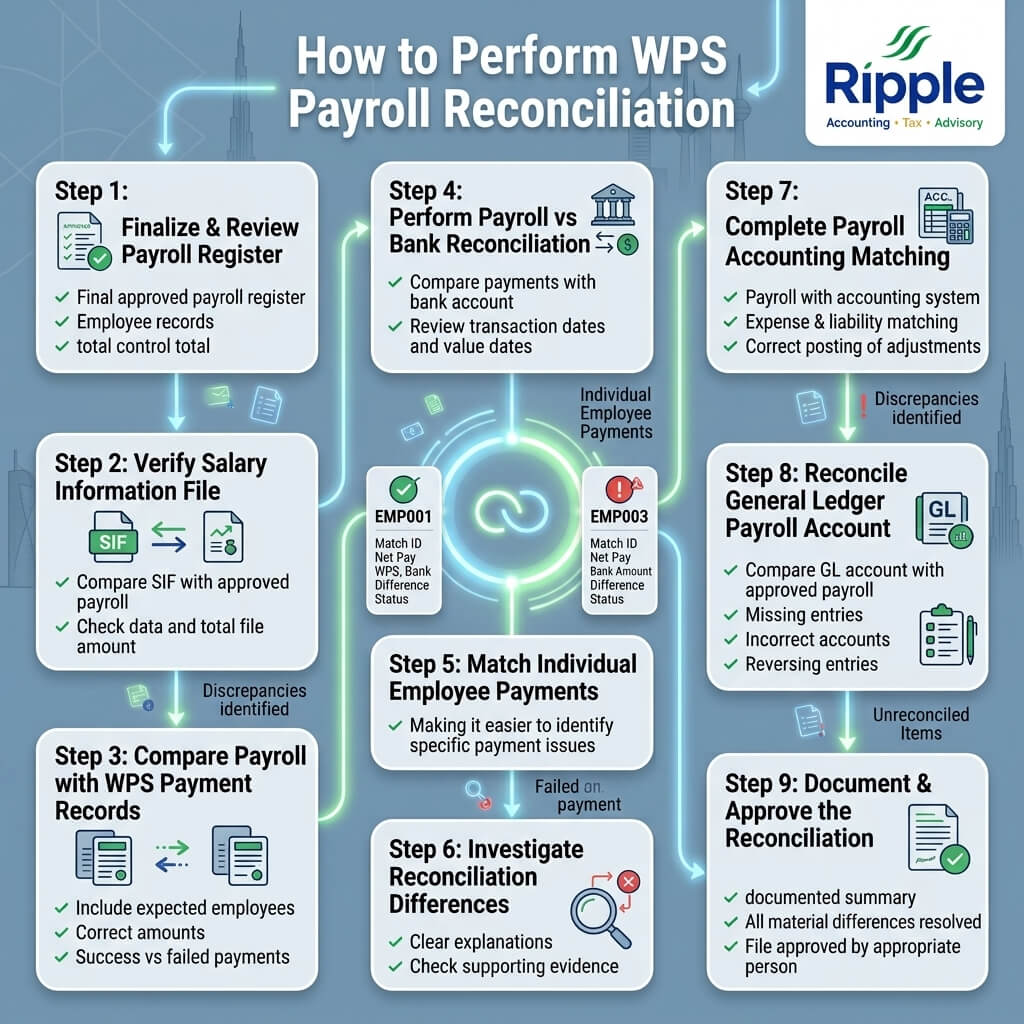
Once all material differences have been resolved or assigned for follow-up, the reconciliation can be reviewed and approved.
Not every reconciliation difference represents an error. Some differences arise from legitimate timing or accounting treatment. The important point is that every unexplained difference should be investigated.
A difference between the payroll register and SIF may result from:
These differences should ideally be identified before WPS submission.
A difference between payroll and bank records can occur when:
The bank report should therefore be reconciled to individual employee payments whenever practical.
Differences between payroll and accounting records may result from:
These issues can affect financial reporting if they remain unresolved.
If you identify payroll fraud, read our comprehensive guide to learn how to prevent payroll fraud: Prevent Payroll Fraud: Ghost Employees & Duplicate Payments
When a reconciliation identifies an exception, we should investigate it systematically rather than making an immediate accounting adjustment. A useful investigation starts by determining where the first difference appears.
For example:
Payroll Register → SIF → Bank → Accounting
This approach reduces investigation time and creates a clearer audit trail. Each exception should ideally include:
| Exception | Difference | Reason | Action | Status |
| Employee payment | AED 500 | Bank rejection | Reprocess payment | Resolved |
| Payroll journal | AED 1,000 | Duplicate posting | Reverse entry | Resolved |
| WPS amount | AED 750 | Incorrect file data | Correct submission | Resolved |
The objective is not simply to eliminate differences. We should understand their origin and maintain evidence showing how they were resolved.
A well-documented payroll audit process depends on reliable supporting evidence. Payroll reconciliation creates an audit trail connecting the employee’s calculated salary to the actual payment and accounting entry.
An auditor or internal reviewer can follow the transaction through:
Employee Payroll → WPS/SIF → Bank Payment → Accounting Entry → General Ledger
This makes it easier to verify whether payroll transactions are:
Reconciliation also helps identify unusual transactions, unexplained balances, duplicate payments, and long-outstanding payroll liabilities.
For audit purposes, we should retain appropriate supporting documentation, including approved payroll registers, WPS files, payment reports, bank statements, journal entries, reconciliation reports, and evidence of corrective actions.
A strong payroll reconciliation UAE process should be consistent, documented, and performed for every payroll cycle.
Modern payroll and accounting systems can significantly reduce manual reconciliation work. Depending on the system’s capabilities, automation can help compare payroll data, generate WPS files, identify mismatches, import bank transactions, and reconcile accounting entries.
However, automation should support, not replace, financial controls.
We should still review exception reports, investigate unusual transactions, verify important changes, and approve the final payroll.
The most effective approach combines automation with human review. Routine matching can be automated, while employees responsible for payroll and finance focus on investigating exceptions and ensuring that the underlying records are accurate.
A well-integrated payroll system can also reduce duplicate data entry. When the same controlled employee and salary information flows into payroll, WPS, banking, and accounting processes, the risk of inconsistent records is reduced.
Managing payroll involves several connected records, from salary calculations and payroll reports to WPS-ready information, payment transactions, and accounting records. Keeping these records consistent can become increasingly difficult as a business grows.
Ripple Accountants supports UAE businesses with payroll services, WPS-ready payroll processing, accounting, and bank reconciliation. These services can help businesses keep salary records, payment transactions, and accounting entries organized and consistent.
If you need professional support with your payroll and accounting processes, you can explore Ripple’s accounting and payroll services. Also, you can contact us; our team will guide you properly.
Contact Ripple Accountants
WPS payroll reconciliation is the process of comparing approved payroll with payment, bank, and accounting records to confirm that employee salaries were processed and recorded correctly.
A Salary Information File (SIF) is an electronic file containing salary-related information used in the WPS payment process. Its information should correspond with the approved payroll records.
Compare the approved payroll and payment records with actual bank transactions. Match amounts, dates, references, and payment status, then investigate any unmatched or unusual transactions.
Common causes include failed or returned payments, duplicate transactions, timing differences, bank charges, incorrect salary amounts, and missing transactions.
Reconciling payroll with the general ledger helps confirm that payroll expenses, liabilities, deductions, and salary payments have been recorded correctly in the accounting system.
Payroll should ideally be reconciled during or immediately after each payroll cycle. Regular reconciliation makes discrepancies easier to identify and resolve.
Reconciliation can support stronger payroll controls and recordkeeping by helping businesses identify differences between approved payroll and salary payment records. Businesses should still follow the latest applicable WPS requirements and official guidance.
A reliable WPS payroll reconciliation process follows payroll from its initial calculation through the WPS submission, bank payment, and accounting records. By bringing these records together, we can identify discrepancies before they develop into larger payroll, financial reporting, or compliance problems.
The strongest approach is not simply to compare total amounts. We should perform employee-level matching, investigate exceptions, reconcile bank transactions, review payroll accounting entries, and ensure that general ledger payroll balances are supported by detailed records.
For UAE businesses, a consistent reconciliation process provides practical control over payroll accuracy while creating valuable documentation for the payroll audit process. When the payroll register, WPS salary file, SIF, bank records, and accounting records all agree or every difference is properly explained the organization has a much stronger foundation for accurate and controlled payroll management.
Disclaimer: This article provides general information about WPS Payroll Reconciliation, accounting, and compliance requirements may vary depending on the employee’s circumstances, employment contract, company policies, and applicable UAE laws and regulations. Businesses should seek professional advice before making payroll, accounting, or compliance decisions.
Tell us a little about your business and our UAE tax experts will get back to you with clear, practical answers — no obligation.
 Corporate Tax
Why might a UAE Tax Residency Certificate application be rejected even when an applicant lives or operates a business in the country?…
Read article Corporate Tax
How much does a UAE Tax Residency Certificate cost, how long does it take to obtain, and when does it expire? Understanding…
Read article Corporate Tax
Are you planning to apply for a UAE Tax Residency Certificate but unsure which documents you need or whether you qualify? Understanding…
Read articlePage 1 of 58
Book a free consultation and get clear answers for your business.
0 Comments