UAE Tax Residency Certificate Fees, Processing Time and Validity
How much does a UAE Tax Residency Certificate cost, how long does it take to obtain, and when does it expire? Understanding…
Read article
Could your payroll be paying employees who don’t exist or paying the same salary twice? You could be losing money to payroll fraud without even knowing it.
Payroll fraud can hide within routine salary processing, particularly when employee records, payroll data, and payment transactions are not regularly reviewed. Ghost employee fraud and duplicate payroll payments are two common schemes that can create unnecessary financial losses for businesses.
According to the ACFE’s 2024 Report to the Nations, organizations lose an estimated 5% of their revenue to fraud each year, highlighting the importance of effective payroll internal controls.
Keep reading to learn how to prevent payroll fraud and reduce financial risks!
Payroll fraud occurs when someone deliberately manipulates payroll records or payment processes to gain an unauthorized financial benefit. Unlike a normal payroll error, which happens accidentally, fraud involves intentional deception or manipulation.
Common examples of employee payroll fraud include:
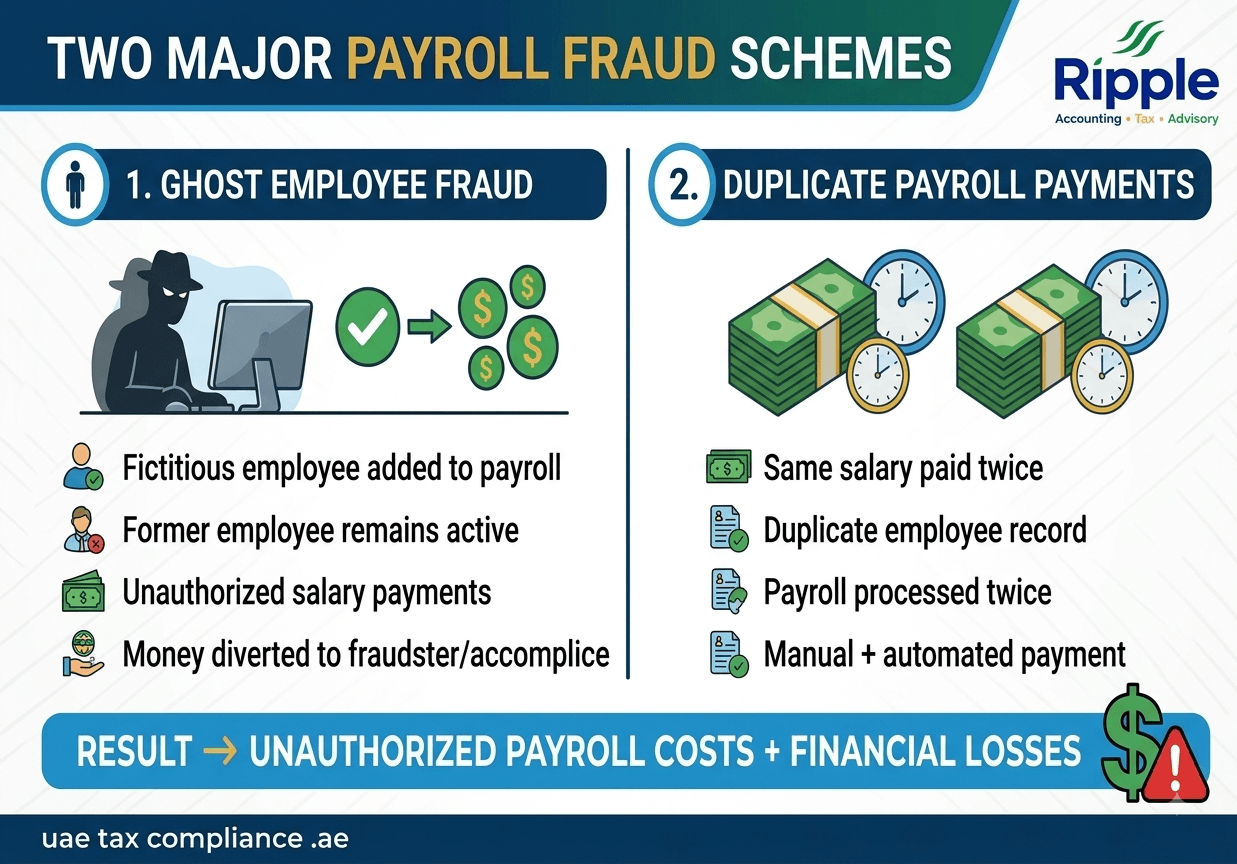
The two major types of payroll fraud schemes are
Both schemes can result in significant financial losses if proper payroll controls are not in place.
A ghost employee is a person who appears in an organization’s payroll records but does not legitimately work for the company.
Ghost employee fraud commonly occurs in two ways:
Example: An employee creates a fake payroll record for a nonexistent worker and assigns it a bank account under their control. The company unknowingly processes the salary each month, allowing the fraudster to collect the payments.
A duplicate payroll payment occurs when an employee receives the same salary or payroll amount more than once for the same pay period.
It can happen accidentally due to duplicate processing, data-entry errors, or duplicate employee records, but it may also result from intentional manipulation.
Duplicate payments may occur when:
Example: An employee’s AED 8,000 salary is processed twice, causing them to receive AED 16,000 instead of the approved AED 8,000.
Payroll fraud can remain unnoticed when companies do not have strong payroll internal controls. Since payroll is processed regularly, fraudulent payments can sometimes blend into normal transactions.
Several factors can make employee payroll fraud difficult to detect:
This is why businesses need strong controls such as segregation of duties, dual approval, payroll data reconciliation, and regular payroll audits to prevent and detect fraud.
Payroll fraud often leaves patterns or inconsistencies across employee records, payroll transactions, and payment data. Regularly reviewing these records can help businesses identify potential fraud early. The following checks can help detect ghost employee fraud, duplicate payroll payments, and other suspicious payroll activity.
Compare payroll records with active HR records to identify employees who cannot be verified as current employees.
Red flags include:
Review payroll transactions for duplicate or highly similar payments. Compare employee IDs, payment amounts, pay periods, and transaction references to identify potential duplication.
Red flags include:
A duplicate payment does not always indicate fraud, as it may result from a processing or data-entry error. However, unexplained or repeated duplicates should be investigated.
Compare employee termination dates with payroll transactions to identify payments made after an employee’s approved final pay period.
Red flags include:
Analyze payroll records for unexpected changes that could indicate unauthorized manipulation.
Red flags include:
Comparing employee information can reveal connections between payroll records that may require further investigation.
Red flags include:
These similarities may have legitimate explanations, so they should be treated as warning signs rather than proof of fraud.
For larger organizations, automated payroll analytics can make this process more efficient by identifying duplicate transactions, unusual changes, and inconsistencies across different records.
Compare approved payroll records with HR information, attendance data, accounting records, and actual bank transactions. Payroll data reconciliation can help identify discrepancies between what was approved and what was actually paid.
The purpose of these checks is not to assume that every anomaly is fraudulent but to identify unusual transactions or employee records that require further investigation. When multiple warning signs appear together, they may indicate a greater risk of payroll fraud.
You may also read: Forensic Accounting: Detecting Fraud in UAE Businesses
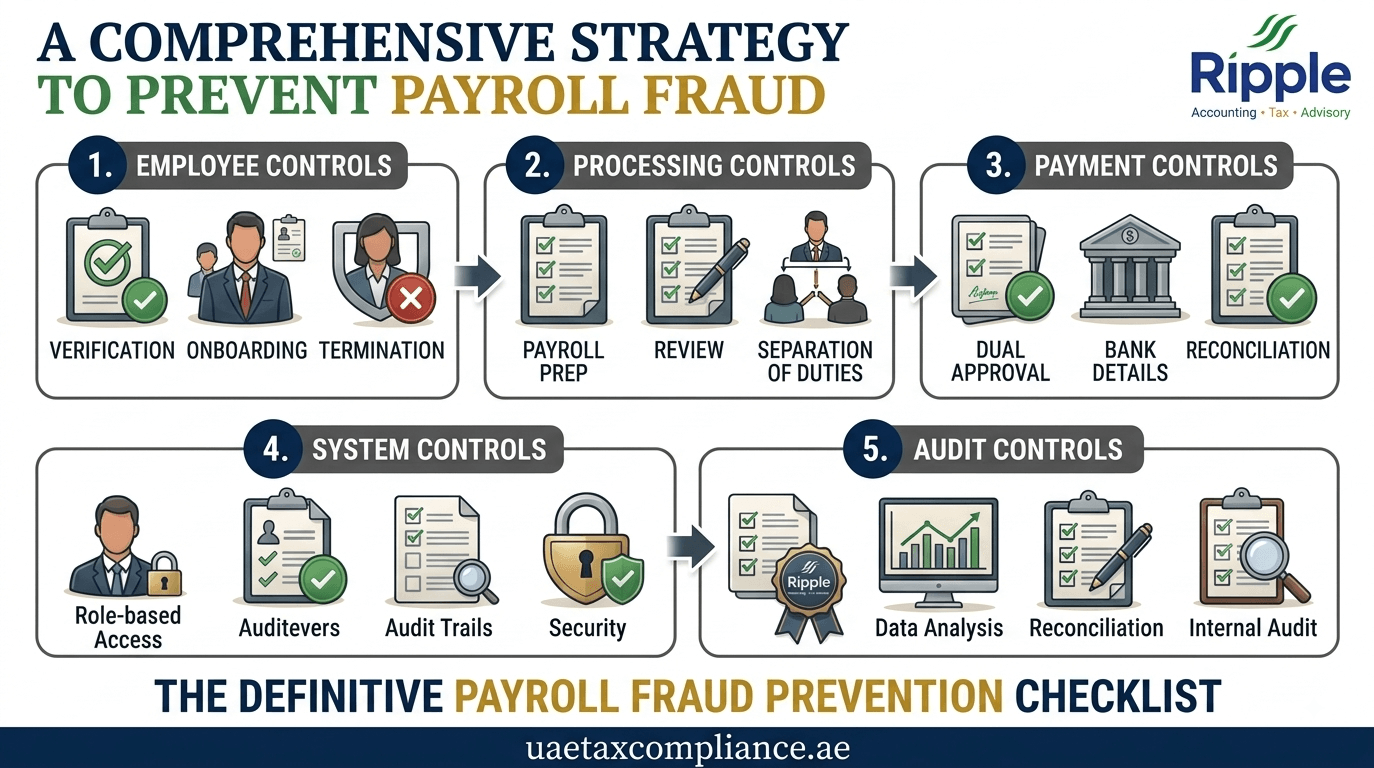
Effective payroll internal controls help businesses reduce the risk of ghost employees, duplicate payments, and other forms of employee payroll fraud. These controls create clear responsibilities, approval procedures, and review processes throughout the payroll cycle.
Periodic internal audit payroll reviews or an independent payroll audit UAE can provide an additional layer of assurance by examining payroll processes, controls, records, and potential areas of risk.
Use this checklist to review whether your payroll process has appropriate controls against ghost employees, duplicate payments, and other payroll fraud risks.
Preventing payroll fraud requires more than processing salaries correctly. Businesses also need accurate records, proper documentation, regular reconciliation, and effective payroll internal controls to reduce the risk of unauthorized payments and payroll errors.
For UAE businesses, Ripple Accountants provides payroll support covering salary calculations, payslips, payroll records, and WPS-ready payroll processing. We help businesses maintain organized payroll records while reducing the administrative burden of managing payroll internally.
Ripple also provides audit & assurance, including internal controls review and compliance review services to help businesses assess their records, documentation, and potential compliance risks. Combined with accounting and bookkeeping support, these services can help you maintain reliable financial records and stronger payroll processes.
For assistance with your UAE accounting and payroll requirements, contact the Ripple team at:
Phone: +971 52 356 5409
WhatsApp: +971 4 250 0833
Email: info@uaetaxcompliance.ae
By combining accurate payroll processing with organized accounting records, regular reviews, and effective controls, businesses can build a stronger framework for preventing and detecting payroll fraud.
Payroll internal controls are policies and procedures designed to ensure payroll is accurate, authorized, secure, and properly recorded. They include employee verification, segregation of duties, payroll approval, access controls, payroll data reconciliation, and regular reviews to reduce the risk of fraud and errors.
Companies can reduce ghost employee fraud by verifying employees before adding them to payroll, maintaining accurate HR records, removing former employees promptly, and separating employee setup from payroll approval. Regular payroll reviews can also help identify employees who cannot be verified as legitimate workers.
Duplicate payroll payments can occur when a payroll file is processed twice, an employee has duplicate records, a manual payment is made alongside an automated payment, or a failed transaction is reprocessed without confirming its status. Data-entry errors and system integration issues can also create duplicate payments.
A payroll audit in the UAE should review employee records, salary calculations, payroll approvals, bank payments, employee additions and terminations, payroll adjustments, and relevant supporting documentation. It should also assess whether payroll procedures and controls are operating consistently and identify discrepancies that require further investigation.
WPS payroll controls help businesses maintain accurate and properly documented salary payments through the UAE’s Wage Protection System. Effective controls can help verify employee salary information, monitor payroll submissions, identify discrepancies, and support timely and compliant wage processing.
Payroll data reconciliation compares payroll records with HR information, accounting records, attendance data, and bank transactions. Differences between these records can reveal duplicate payments, unauthorized employees, payments after termination, or other unusual transactions that require investigation.
Common warning signs include duplicate salary payments, former employees remaining on payroll, employees missing from HR records, shared bank accounts, unexplained salary or bank-detail changes, unusual payroll adjustments, and payroll transactions that do not match approved records.
If a company discovers a potential ghost employee, it should preserve the relevant payroll and employee records, stop unauthorized payments where appropriate, verify how the employee was added, and review related transactions. The organization should then investigate the control failure and strengthen its payroll procedures to prevent recurrence.
Payroll fraud, particularly ghost employees and duplicate payments, can cause significant financial losses when proper controls are missing. Businesses can reduce these risks by verifying employee records, monitoring payroll changes, reconciling payments, and maintaining strong payroll internal controls. Regular reviews, segregation of duties, dual approval, and secure payroll systems can help detect suspicious activity and prevent fraud. For UAE businesses, professional payroll, accounting, audit, and compliance support can provide additional oversight and help maintain accurate payroll records.
Disclaimer: This article provides general information about payroll fraud and its prevention. Payroll, employment, accounting, and compliance requirements may vary depending on the employee’s circumstances, employment contract, company policies, and applicable UAE laws and regulations. Businesses should seek professional advice before making payroll, accounting, or compliance decisions.
Tell us a little about your business and our UAE tax experts will get back to you with clear, practical answers — no obligation.
 Corporate Tax
How much does a UAE Tax Residency Certificate cost, how long does it take to obtain, and when does it expire? Understanding…
Read article Corporate Tax
Are you planning to apply for a UAE Tax Residency Certificate but unsure which documents you need or whether you qualify? Understanding…
Read article Corporate Tax
Do you need a UAE Tax Residency Certificate for a local administrative requirement or to claim benefits under a double taxation agreement?…
Read articlePage 1 of 58
Book a free consultation and get clear answers for your business.
0 Comments