UAE Tax Residency Certificate Requirements: Documents and Eligibility
Are you planning to apply for a UAE Tax Residency Certificate but unsure which documents you need or whether you qualify? Understanding…
Read article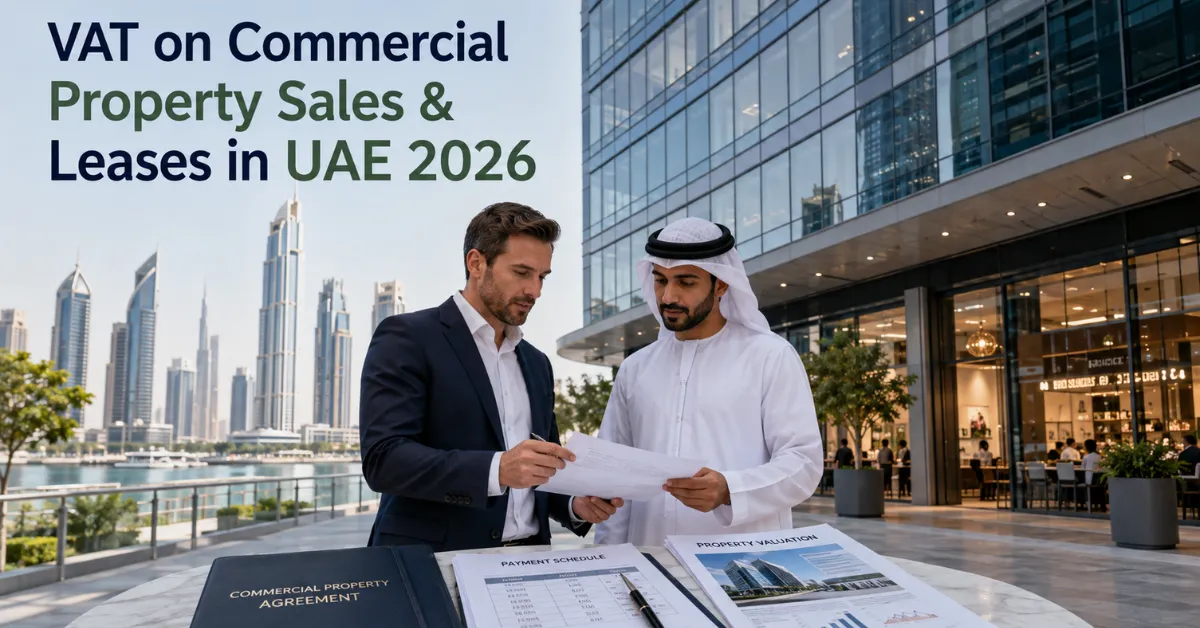
VAT on commercial property sales and leases is an important compliance issue for UAE property owners, landlords, developers, investors, and businesses. The UAE Federal Tax Authority (FTA) generally treats supplies of commercial real estate as taxable at the standard 5% VAT rate. This includes the sale and lease of commercial property.
Yes. The supply of commercial real estate in the UAE is generally subject to VAT at the standard rate of 5%. The FTA defines commercial real estate broadly as land or buildings that do not fall within specified categories such as residential buildings, certain charitable-use buildings, or bare land. The FTA confirms that supplies of commercial properties include both sales and leases. Therefore, VAT can apply when a business sells a taxable commercial property or leases it to a tenant.
The exact VAT treatment should still be assessed based on the facts and structure of the transaction because certain transactions can receive different treatment.
A sale of commercial real estate is generally taxable at 5% where the transaction falls within the standard commercial-property VAT rules.
Before completing the sale, the parties should establish:
Because commercial property transactions can involve millions of dirhams, an incorrect VAT treatment can create a significant tax exposure.
Commercial property leases are generally taxable at 5%. This applies to many common commercial premises, including offices, retail units, warehouses, and other non-residential buildings. A VAT-registered landlord making a taxable commercial-property supply generally needs to charge the applicable VAT, issue the required tax documentation, record the output VAT, and report it through the relevant VAT return.
The tenant should retain the tax invoice and determine whether the VAT qualifies for input tax recovery based on its taxable business activities.

The standard UAE VAT rate for taxable commercial property supplies is 5%. The FTA specifically confirms that commercial real estate sales and leases are subject to VAT at the standard rate. The important point is to distinguish between the VAT rate and the VAT treatment of the transaction.
Commercial property is generally taxable at 5%, while residential property can be zero-rated or exempt depending on the nature and timing of the supply.
Suppose a company rents a commercial office for AED 100,000 per month, excluding VAT.
The calculation is:
The landlord should account for the AED 5,000 output VAT, while the tenant should retain the tax invoice and assess whether the VAT is recoverable.
The sale of commercial real estate is generally subject to VAT at 5%. The FTA’s Real Estate VAT Guide confirms that commercial real estate includes the sale or lease of qualifying commercial property. However, property sellers should not automatically assume that every commercial-property transaction follows exactly the same procedure.
They should first review:
Assume a VAT-taxable commercial property is sold for AED 5 million excluding VAT.
The illustrative calculation is:
This example assumes the AED 5 million represents the consideration before VAT and that the transaction is taxable at 5%.
The parties should confirm the actual VAT treatment before completing the transaction.
Certain taxable sales of commercial real estate are subject to a special VAT payment process through the FTA’s e-Services portal. The FTA’s commercial-property payment guidance states that this process applies to certain sales of commercial property subject to 5% VAT. The VAT payment is completed through the FTA portal as a miscellaneous payment.
This is an important distinction because the special payment process does not apply to every property transaction.
According to the FTA guidance, it does not apply to:
Therefore, a buyer of taxable commercial real estate should check the applicable FTA payment procedure before completing the transaction.
A commercial property transaction can sometimes form part of a transfer of a business rather than being treated simply as an ordinary property sale. For example, a commercial property may be sold together with an operating business and its existing business arrangements. Where the transaction qualifies under the applicable UAE VAT rules as a transfer of a business, the VAT treatment can differ from an ordinary taxable commercial-property sale.
The FTA’s commercial-property payment guidance specifically excludes qualifying transfers of a business involving commercial property with sitting tenants from the special commercial-property payment process.
Businesses should therefore assess the transaction as a whole rather than deciding the VAT treatment solely from the property title or sale price.
Commercial rental income is generally subject to 5% VAT. For landlords, VAT should be considered when preparing lease agreements, setting rental prices, issuing invoices, collecting rent, and preparing VAT records.
The FTA confirms that rent of a commercial building is subject to VAT at 5%, while rent of a residential building is generally exempt.
A landlord making a taxable commercial-property supply should generally charge VAT at 5% if the applicable requirements are met.
Lease agreements should clearly state whether the quoted rent is:
Clear wording can help avoid disputes between landlords and tenants.
Commercial property can include:
The VAT treatment depends on the nature and classification of the property and supply.
For example, a warehouse leased for business operations will generally fall within the taxable commercial-property regime when the applicable conditions are satisfied.
The distinction between commercial and residential property is critical for UAE VAT purposes.
| Property Type | General VAT Treatment |
|---|---|
| Commercial property | Generally taxable at 5% |
| First qualifying residential supply | Generally zero-rated |
| Subsequent residential supply | Generally exempt |
| Mixed-use property | Different treatment can apply to commercial and residential portions |
The FTA confirms that commercial-property supplies are generally taxable at 5%, while residential property follows separate rules.
A mixed-use building can contain both taxable and exempt supplies.
For example, a building could contain:
The commercial portion is generally subject to 5% VAT, while the residential portion receives the applicable residential VAT treatment.
Input tax that cannot be directly attributed may need to be apportioned between taxable and exempt activities. The FTA specifically addresses this treatment for mixed-use buildings.
VAT registration is an important consideration for owners of commercial buildings. The FTA states that an owner of a non-residential building must consider VAT registration where the value of taxable supplies exceeds the mandatory registration threshold of AED 375,000 over the preceding 12 months or is expected to exceed that amount within the coming 30 days.
The general voluntary VAT registration threshold is AED 187,500, subject to the applicable UAE VAT rules.
The registration assessment should focus on the relevant taxable supplies and other amounts included under the VAT registration rules, rather than simply looking at gross property value.
The FTA’s current VAT registration service also lists supporting documents such as ownership deeds, contracts, invoices, completion certificates, and lease agreements where applicable.
Once the landlord is required to charge VAT on taxable commercial supplies, it should:
Instalment arrangements require particular attention. The FTA’s Real Estate VAT Guide states that where consideration for the supply of commercial real estate is payable by instalments, VAT is due on each instalment paid.
For example, suppose a taxable commercial property is sold for AED 5 million plus VAT under a payment plan.
The seller should not simply ignore VAT until the full AED 5 million has been received. The VAT treatment must follow the applicable date-of-supply and payment rules, including the treatment of instalments.
Businesses should therefore map the payment schedule against their VAT reporting obligations before entering into a large property transaction.
A VAT-registered business may generally recover input VAT where the expense relates to taxable business activities and the applicable input tax recovery conditions are satisfied. The FTA states that an owner of a commercial building is generally able to recover VAT incurred in relation to the taxable supply of the commercial building.
However, businesses should not assume that every property-related expense automatically qualifies for full recovery.
They should consider:
Depending on the circumstances, qualifying costs can include VAT incurred on:
For mixed-use or partially exempt activities, the recoverable amount may need to be calculated using the applicable apportionment rules.
Commercial leases can include charges in addition to basic rent.
Examples include:
Businesses should determine the VAT treatment based on the actual nature of each supply and the contractual arrangement. A property owner should not automatically assume that every amount appearing on a tenant’s statement has identical VAT treatment.
The contract, invoice, and underlying supply should be reviewed before determining how VAT should be charged and reported.
Correct tax invoicing is essential for both landlords and tenants. A VAT invoice should contain the information required under the UAE VAT rules, including relevant supplier and customer details, invoice identification, dates, description of the supply, amounts, VAT rate, and VAT payable.
For commercial property transactions, businesses should check that invoices contain relevant information such as:
Correct invoicing helps the seller report output VAT accurately and gives the buyer appropriate supporting documentation when assessing input VAT recovery.
The VAT liability does not depend only on when the final payment is made. Businesses need to consider the applicable date-of-supply rules and the specific structure of the property transaction.
This becomes particularly important for:
For commercial real estate, the FTA specifically confirms that where consideration is payable by instalments, VAT is due on each instalment paid.
Suppose a landlord leases an office for AED 100,000 per month plus VAT. Each monthly rental supply needs to be accounted for under the applicable VAT rules and recorded in the landlord’s VAT records.
The tenant should retain the corresponding tax invoice and assess whether the input VAT qualifies for recovery.
Property transactions can sometimes be cancelled after the buyer has made a full or partial payment. The FTA Real Estate VAT Guide explains that where a real estate supply is cancelled and the supplier refunds amounts previously received, a tax credit note may be required to reverse the output tax previously accounted for.
The VAT treatment can depend on why the amount is retained if the supplier does not refund it.
This makes proper documentation particularly important when a property transaction is cancelled, terminated, or materially changed.

Businesses commonly encounter VAT problems when they treat every property transaction in the same way.
Common mistakes include:
The key risk is not simply applying the wrong percentage. A business can also face problems by applying the correct 5% rate through the wrong procedure or reporting it in the wrong VAT period.
The following examples illustrate a taxable commercial-property sale and a commercial lease.
| Transaction | Amount Before VAT | VAT at 5% | Total |
|---|---|---|---|
| Commercial property sale | AED 5,000,000 | AED 250,000 | AED 5,250,000 |
| Monthly commercial rent | AED 100,000 | AED 5,000 | AED 105,000 |
These figures are illustrative and assume that the stated amounts are exclusive of VAT and that the relevant supplies are taxable at 5%.
The actual VAT treatment should be confirmed based on the transaction’s facts, contractual terms, payment structure, and applicable UAE VAT rules.
A structured process can help property owners and businesses manage VAT more effectively.
Managing VAT on commercial property requires more than simply applying the 5% rate. Property owners, landlords, investors, and businesses may need support with VAT registration, tax invoices, VAT returns, input VAT recovery, property-related accounting, and transaction-specific VAT treatment.
Ripple Accountants provides accounting, bookkeeping, VAT, and tax support for UAE businesses, helping maintain accurate and VAT-ready financial records. Its accounting team supports businesses with bookkeeping, VAT registration and advisory, VAT return filing, financial reporting, and compliance support.
For businesses involved in commercial property, Ripple can help with:
If you own, lease, sell, or manage commercial property in the UAE, getting the VAT treatment right from the beginning can help reduce compliance risks and avoid costly errors.
For professional assistance with commercial property VAT, accounting, or UAE tax compliance, contact Ripple for a consultation.
Yes. The supply of commercial property, including sales and leases, is generally taxable at the standard UAE VAT rate of 5%.
Yes. Rent of commercial buildings is generally subject to VAT at 5%.
The standard VAT rate for taxable commercial-property supplies is 5%.
Generally, input VAT may be recoverable where it relates to taxable supplies and the applicable recovery requirements are satisfied. A commercial-property owner can generally recover VAT related to taxable commercial supplies, subject to the applicable rules.
Generally, yes. Commercial real estate sales are normally subject to 5% VAT, although the specific transaction should be reviewed for applicable exceptions or different VAT treatments.
Yes. The FTA has a special payment process for certain taxable sales of commercial real estate. The process does not apply to commercial-property leases and certain transactions that qualify as a transfer of a business.
No. The FTA’s commercial-property payment guide specifically states that the special process does not apply to leases of commercial property.
Yes. The FTA’s Real Estate VAT Guide states that where consideration for a taxable commercial-property supply is payable by instalments, VAT is due on each instalment paid.
A warehouse that qualifies as commercial real estate will generally be subject to VAT at 5% when the applicable conditions are satisfied.
The treatment depends on the underlying supply and contractual arrangement. Businesses should review what the service charge actually represents instead of automatically applying the same VAT treatment to every property-related charge.
VAT-registered businesses should record taxable property supplies in their VAT accounting records and report them through the relevant VAT return in accordance with the applicable UAE VAT rules.
VAT on commercial property sales and leases in the UAE is generally based on the standard 5% VAT rate, but the compliance process can involve more than simply adding 5% to a property’s sale price or monthly rent. Businesses need to consider the property’s classification, VAT registration, date of supply, instalment payments, tax invoices, input VAT recovery, mixed-use arrangements, and, for certain commercial-property sales, the FTA’s special VAT payment process.
Disclaimer: This article provides general information about UAE VAT treatment of commercial property and does not constitute legal or tax advice. VAT treatment can depend on the facts, contractual structure, property classification, and applicable legislation. Businesses should consult the latest Federal Tax Authority guidance and UAE VAT legislation or obtain professional tax advice before completing significant property transactions.
Tell us a little about your business and our UAE tax experts will get back to you with clear, practical answers — no obligation.
 Corporate Tax
Are you planning to apply for a UAE Tax Residency Certificate but unsure which documents you need or whether you qualify? Understanding…
Read article Corporate Tax
Do you need a UAE Tax Residency Certificate for a local administrative requirement or to claim benefits under a double taxation agreement?…
Read article Bookkeeping
How can UAE businesses ensure employees receive the correct salary every month? Payroll involves more than adding basic pay and allowances. Employers…
Read articlePage 1 of 58
Book a free consultation and get clear answers for your business.
0 Comments