UAE Tax Residency Certificate Fees, Processing Time and Validity
How much does a UAE Tax Residency Certificate cost, how long does it take to obtain, and when does it expire? Understanding…
Read article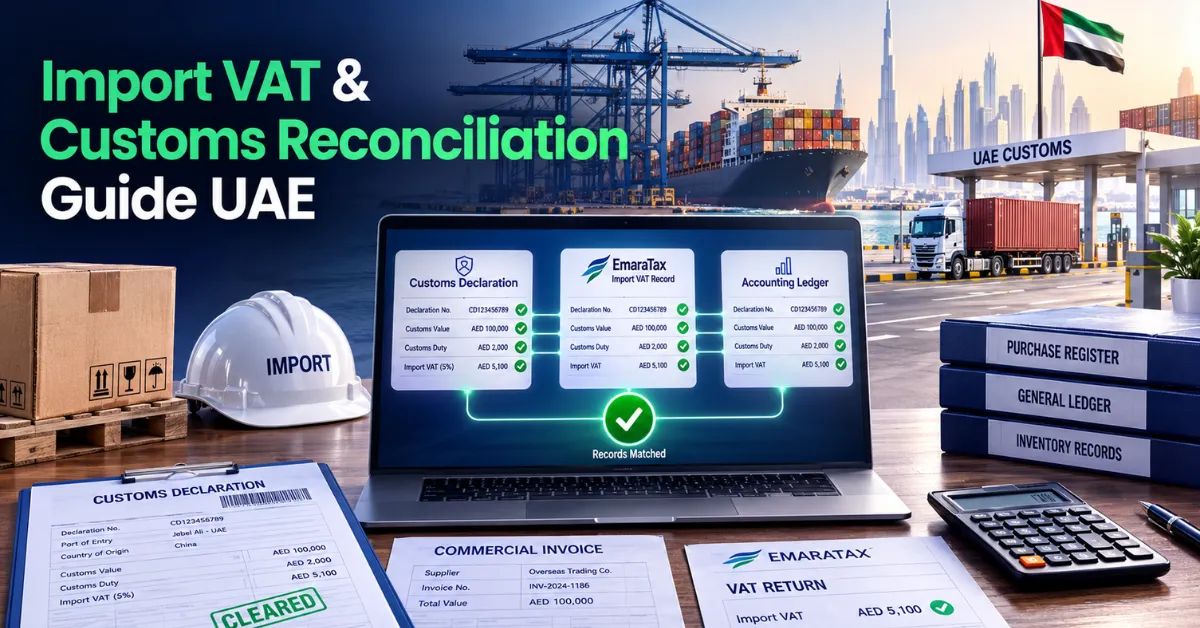
Businesses that import goods into the UAE must ensure their Import VAT records match their Customs declarations and accounting records. Accurate reconciliation helps businesses file correct VAT returns, recover eligible input tax, reduce compliance risks, and prepare for Federal Tax Authority (FTA) audits. Since the introduction of EmaraTax, VAT reporting has become more digital, making it even more important to reconcile import transactions regularly.
Whether you operate a trading company, manufacturing business, e-commerce store, or logistics company, matching EmaraTax records with Customs data should be a standard monthly compliance process. This guide explains how Import VAT and Customs Reconciliation works in the UAE, why it matters, and how businesses can establish an efficient reconciliation process.
Import VAT is the Value Added Tax that applies when goods enter the UAE from outside the GCC implementing states. Under the UAE VAT system, imported goods are generally subject to 5% VAT unless they qualify for a zero-rated or exempt treatment under applicable tax laws.
Businesses registered for VAT may recover eligible Import VAT if the imported goods are used for taxable business activities and all documentary requirements are satisfied.
Import VAT is the VAT due on goods imported into the UAE. The tax is calculated on the customs value of the goods together with customs duties and other applicable charges that form part of the taxable value under UAE VAT legislation.
The Import VAT process generally follows these steps:
The exact reporting mechanism may vary depending on the import arrangement, the importer’s VAT status, and the applicable customs procedures.
Import VAT obligations commonly apply to:
Businesses should confirm that the importer of record is correctly identified because this affects VAT reporting and recovery.

Depending on the applicable UAE VAT rules and import procedures, Import VAT may be accounted for through Customs processes or under the reverse charge mechanism available to eligible VAT-registered importers. Businesses should understand which treatment applies to their imports to ensure VAT is reported correctly in EmaraTax and reflected accurately in their accounting records.
The Federal Tax Authority (FTA) administers VAT compliance, while UAE Customs authorities oversee the importation of goods and customs declarations. Information from Customs plays an important role in supporting VAT reporting and compliance.
Businesses should ensure that:
Customs Reconciliation is the process of comparing Customs import records with accounting records and VAT data to verify that every import transaction has been recorded accurately.
The reconciliation process helps businesses identify discrepancies before VAT Returns are filed or before an FTA audit takes place.
A complete reconciliation normally compares:
Customs Reconciliation confirms that the information submitted to Customs matches the financial records maintained by the business.
The objective is to ensure consistency between:
Regular reconciliation helps businesses:
Businesses that reconcile transactions regularly are generally better prepared to respond to FTA information requests and audits.
Many businesses perform reconciliation every month because it allows issues to be identified before VAT Returns are submitted.
Monthly reconciliation offers several advantages:
Businesses with high import volumes may benefit from more frequent reconciliation as part of their internal financial controls.
Accurate Customs Reconciliation supports both accounting and tax compliance by ensuring that imported goods are reflected correctly in financial records.
Key benefits include:
Matching EmaraTax records with Customs declarations is one of the most important VAT compliance activities for UAE importers. Differences between Customs records, accounting systems, and VAT Returns can lead to reporting errors, delayed VAT recovery, and increased audit exposure.
An effective reconciliation process helps businesses identify discrepancies before VAT Returns are submitted and ensures that tax records accurately reflect imported goods.
Key reasons to perform regular reconciliation include:
Businesses should not wait until the end of the financial year to perform reconciliation. Monthly reviews help identify issues early, making corrections easier and reducing the risk of cumulative reporting errors.
Understanding the complete import process helps businesses maintain accurate accounting records and reconcile Import VAT efficiently.
The importer places an order with an overseas supplier. The purchase agreement should clearly define product descriptions, quantities, pricing, delivery terms, and shipping responsibilities.
The supplier dispatches the goods to the UAE using air, sea, or land transport. Shipping documents such as the commercial invoice, packing list, and transport documents are prepared to support Customs clearance.
When the shipment arrives in the UAE, a Customs declaration is submitted through the relevant Customs authority. The declaration includes details such as:
Accurate declaration data is essential because it forms the basis for customs assessment and subsequent VAT reporting.
Customs reviews the declaration, verifies supporting documents where required, assesses any applicable customs duties, and authorizes the release of the goods once all import requirements have been satisfied.
Import VAT is calculated based on the applicable taxable value in accordance with UAE VAT legislation. Businesses should verify that the assessed VAT aligns with their supporting documentation and accounting records before reconciliation.
Eligible VAT-registered businesses account for Import VAT through the applicable reporting mechanism within EmaraTax. The information reported should be supported by Customs documentation and the business’s accounting records to ensure consistency across all systems.
The final step is to include eligible Import VAT in the relevant VAT Return, ensuring that:
Completing these steps accurately creates a strong foundation for effective Import VAT and Customs Reconciliation while reducing the risk of reporting errors, compliance issues, and audit challenges.
Accurate reconciliation depends on maintaining complete and organized documentation. Every import transaction should be supported by records that can be matched with Customs declarations, accounting entries, and EmaraTax reporting. Missing or inconsistent documents can delay VAT recovery and increase compliance risks during an FTA audit.
The Customs declaration is the primary document used to verify imported goods. It includes the declaration number, importer details, goods description, customs value, HS codes, customs duty, and Import VAT information.
The Bill of Entry confirms that goods have been officially declared for import into the UAE and provides key information required for reconciliation.
The supplier’s commercial invoice confirms the value of imported goods, supplier details, quantities, and product descriptions. It should match the Customs declaration and accounting records.
A packing list provides information about the shipment contents, including quantities, package details, and weights. It supports verification during Customs clearance.
Transport documents confirm the movement of goods into the UAE and provide shipment references used during reconciliation.
This document confirms any customs duties assessed on the imported goods and supports the calculation of the taxable value for Import VAT purposes.
Businesses should retain evidence showing the Import VAT reported through the applicable UAE VAT process and ensure it matches Customs information.
Supplier invoices should be reviewed to verify prices, currency, quantities, and payment terms.
Freight and insurance costs may affect the customs value depending on the applicable valuation rules. These documents should be retained to support calculations where relevant.
Delivery notes and warehouse receiving reports confirm that imported goods were received by the business.
Bank payment confirmations help verify that supplier invoices relate to genuine business transactions.
Businesses should maintain:
Maintain copies of:
A structured reconciliation process reduces reporting errors and improves VAT compliance. The following process can be performed monthly or before filing each VAT Return.
Obtain import reports from the relevant UAE Customs authority covering the reconciliation period.
Review:
Extract the relevant Import VAT information reported through EmaraTax for the same tax period.
Verify:
Generate reports from the accounting or ERP system, including:
Compare declaration numbers recorded in accounting records against Customs reports.
Check for:
Verify that supplier invoice values agree with:
Investigate any significant differences.
Ensure customs duty recorded in accounting records matches the duty assessed by Customs.
Review:
Compare Import VAT amounts across:
All amounts should reconcile after considering any legitimate adjustments.
Investigate discrepancies such as:
Review supporting documentation to determine the cause of each difference.
Confirm:
Where errors are identified, update accounting records with appropriate journal entries while maintaining supporting documentation.
If reconciliation identifies VAT reporting errors, businesses should assess whether corrections are required under the applicable UAE VAT rules.
Keep documentation showing:
Maintaining a clear audit trail improves transparency and supports compliance during FTA reviews.
The following information should be verified for every import transaction.
| Field | Why It Matters |
|---|---|
| Customs Declaration Number | Matches Customs and accounting records |
| Import Date | Confirms correct VAT reporting period |
| Supplier Name | Verifies supplier consistency |
| Commercial Invoice Number | Matches supplier documentation |
| Goods Description | Confirms imported products |
| HS Code | Verifies Customs classification |
| Country of Origin | Supports Customs documentation |
| Customs Value | Basis for VAT calculation |
| Customs Duty | Confirms duty assessment |
| Import VAT Amount | Ensures correct VAT reporting |
| Currency | Verifies transaction values |
| Exchange Rate | Confirms conversion accuracy where applicable |
| Purchase Order Number | Links procurement records |
| Accounting Entry Reference | Supports financial reconciliation |
| Inventory Record | Confits goods were recorded correctly |
Even well-managed businesses may encounter differences between Customs records, accounting systems, and EmaraTax. Identifying the root cause quickly helps maintain accurate VAT reporting.
| Common Difference | Explanation |
|---|---|
| Missing Customs Declaration | Import transaction not recorded completely |
| Duplicate Accounting Entry | Same shipment recorded more than once |
| Incorrect HS Code | Wrong classification affecting valuation |
| Incorrect Customs Value | Value differs from supporting documents |
| Exchange Rate Differences | Currency conversion inconsistencies |
| Timing Differences | Shipment recorded in different reporting periods |
| Incorrect VAT Treatment | Import VAT reported incorrectly |
| Manual Data Entry Errors | Typographical or posting mistakes |
| Freight Allocation Errors | Freight costs allocated incorrectly |
| Customs Amendments | Declaration updated after initial submission |
| ERP Integration Errors | Data transfer issues between systems |
| Missing Supporting Documents | Incomplete reconciliation evidence |

Businesses should establish a formal process for resolving discrepancies before submitting VAT Returns.
Determine whether the difference originated from:
Update accounting entries where necessary while maintaining appropriate supporting documentation.
Confirm that Import VAT has been reported under the correct VAT treatment and in the correct reporting period.
If Customs documentation contains errors, work with the relevant parties to ensure records are corrected where permitted under applicable procedures.
Maintain documents supporting every correction, including:
Record:
This log supports internal controls and demonstrates a consistent compliance process.
Businesses can strengthen VAT compliance by adopting consistent reconciliation procedures.
Recovering Import VAT requires accurate documentation and proper VAT reporting. Errors can result in delayed recovery, adjustments during an FTA review, or administrative penalties where applicable. Businesses should review their import transactions regularly to ensure compliance with the UAE VAT framework.
Common mistakes include:
Avoiding these issues helps businesses improve VAT accuracy and reduce audit risks.
The following example illustrates how a reconciliation process works in practice.
A UAE trading company imports electronic products from an overseas supplier.
Transaction details:
The finance team performs its monthly reconciliation by comparing:
During the review, the team discovers that one shipment was recorded with an incorrect invoice value in the accounting system. The accounting records are corrected before the VAT Return is finalized, ensuring consistency between Customs records, financial records, and VAT reporting.
Regular reconciliations like this help businesses identify discrepancies before they affect VAT compliance.
EmaraTax provides a centralized digital platform for managing VAT obligations in the UAE. When used alongside accurate accounting records and Customs documentation, it supports more efficient VAT reporting and reconciliation.
Key compliance benefits include:
Businesses should ensure that information submitted through EmaraTax is supported by complete accounting records and Customs documentation.
Businesses with frequent import transactions can reduce manual work by using accounting software and ERP systems that support automated reconciliation processes.
Useful features include:
Automation reduces manual errors and allows finance teams to focus on investigating exceptions rather than performing repetitive data matching.
The UAE VAT legislation requires businesses to maintain complete records supporting VAT transactions, including imported goods. Proper record keeping is essential for demonstrating compliance during an FTA review or audit.
Businesses should retain:
Businesses should maintain records in an organized and accessible format for the retention period required under applicable UAE tax legislation.
Managing Import VAT and Customs Reconciliation requires coordination between accounting, VAT reporting, and Customs documentation. Ripple Accountants supports businesses by helping establish accurate financial processes that align with UAE compliance requirements.
Its professional services include:
Professional support can help businesses improve reporting accuracy, strengthen internal controls, and maintain consistent VAT compliance as import volumes grow.
Contact Ripple Accountants
Phone: +971 52 356 5409
WhatsApp: +971 4 250 0833
Email: info@uaetaxcompliance.ae
Import VAT is the VAT that applies when goods are imported into the UAE. Eligible VAT-registered businesses may recover Import VAT if they meet the applicable conditions under UAE VAT legislation.
Compare Customs declarations, accounting records, supplier invoices, and EmaraTax reporting for the same reporting period. Verify declaration numbers, import values, customs duties, and Import VAT amounts before filing the VAT Return.
Key documents include Customs declarations, commercial invoices, Bill of Entry, transport documents, Customs Duty assessments, accounting records, VAT Returns, and EmaraTax reports.
Eligible VAT-registered businesses may recover Import VAT where the imported goods are used for taxable business activities and all documentary and legal requirements are satisfied.
Differences should be investigated immediately. Businesses should identify the cause, correct accounting records where necessary, and determine whether VAT reporting requires adjustment in accordance with UAE VAT requirements.
Monthly reconciliation is generally considered a best practice because it helps identify discrepancies before VAT Returns are submitted and supports stronger internal controls.
Import VAT is generally calculated on the taxable value determined under the UAE VAT rules, which may include Customs Duty and other applicable charges forming part of the taxable amount.
Businesses should maintain Customs declarations, invoices, accounting records, VAT Returns, EmaraTax reports, payment records, reconciliation reports, and other supporting documentation required under UAE tax legislation.
Many ERP and accounting systems provide automation features such as invoice matching, reconciliation reporting, exception reporting, and document management that help improve reconciliation efficiency.
Incorrect reporting may lead to delayed VAT recovery, reporting adjustments, increased compliance risks, and administrative penalties where applicable under UAE tax legislation.
Import VAT and Customs Reconciliation is an essential part of VAT compliance for businesses importing goods into the UAE. Regularly matching EmaraTax records with Customs declarations and accounting data helps ensure accurate VAT Returns, supports eligible input tax recovery, strengthens financial reporting, and improves readiness for FTA reviews.
Disclaimer: This article is for general informational purposes only and does not constitute legal, tax, or financial advice. UAE VAT and Customs regulations may change over time. Businesses should refer to the latest guidance issued by the Federal Tax Authority (FTA) and the relevant UAE Customs authority or consult a qualified tax professional for advice specific to their circumstances.
Tell us a little about your business and our UAE tax experts will get back to you with clear, practical answers — no obligation.
 Corporate Tax
How much does a UAE Tax Residency Certificate cost, how long does it take to obtain, and when does it expire? Understanding…
Read article Corporate Tax
Are you planning to apply for a UAE Tax Residency Certificate but unsure which documents you need or whether you qualify? Understanding…
Read article Corporate Tax
Do you need a UAE Tax Residency Certificate for a local administrative requirement or to claim benefits under a double taxation agreement?…
Read articlePage 1 of 58
Book a free consultation and get clear answers for your business.
0 Comments