UAE Tax Residency Certificate Fees, Processing Time and Validity
How much does a UAE Tax Residency Certificate cost, how long does it take to obtain, and when does it expire? Understanding…
Read article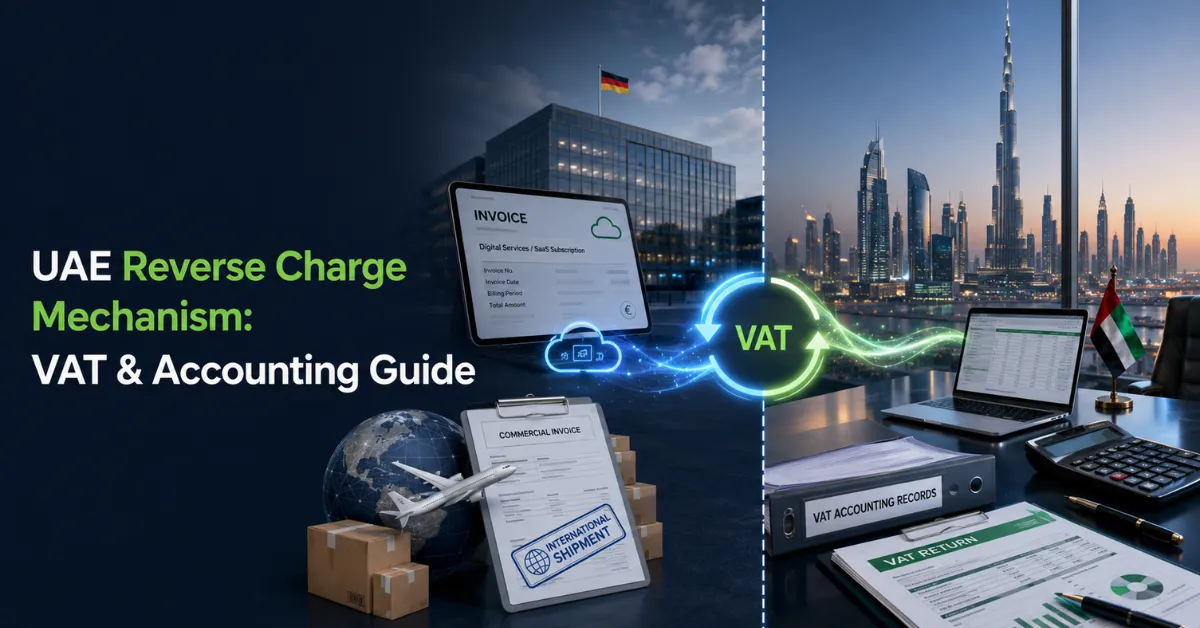
Businesses in the UAE regularly purchase goods and services from overseas suppliers. While these suppliers may not charge UAE Value Added Tax (VAT), the transaction may still be subject to VAT under the UAE Reverse Charge Mechanism (RCM). Understanding how the reverse charge works is essential for maintaining accurate accounting records, filing VAT returns correctly, and complying with the requirements of the UAE’s Federal Tax Authority (FTA).
The Reverse Charge Mechanism shifts the responsibility for accounting for VAT from the foreign supplier to the UAE VAT-registered recipient. Instead of paying VAT to the supplier, the UAE business records both output VAT and, where eligible, recoverable input VAT in its accounting records and VAT return.
The UAE Reverse Charge Mechanism is a VAT accounting method under which the responsibility for accounting for VAT shifts from the supplier to the recipient of goods or services. Instead of the overseas supplier charging UAE VAT, the VAT-registered business in the UAE calculates and reports the VAT itself.
The mechanism is designed to ensure that imported goods and services are taxed consistently with locally supplied goods and services. It also prevents foreign suppliers that are not registered for UAE VAT from having to register solely because they supply goods or services to UAE businesses.
When the reverse charge applies, the UAE business must calculate the VAT due on the transaction at the applicable UAE VAT rate. If the business is entitled to recover input VAT under the UAE VAT rules, it may claim the same amount as recoverable input tax in the same VAT period, subject to the normal recovery conditions.
This process helps maintain VAT neutrality for fully taxable businesses while ensuring compliance with UAE VAT legislation.
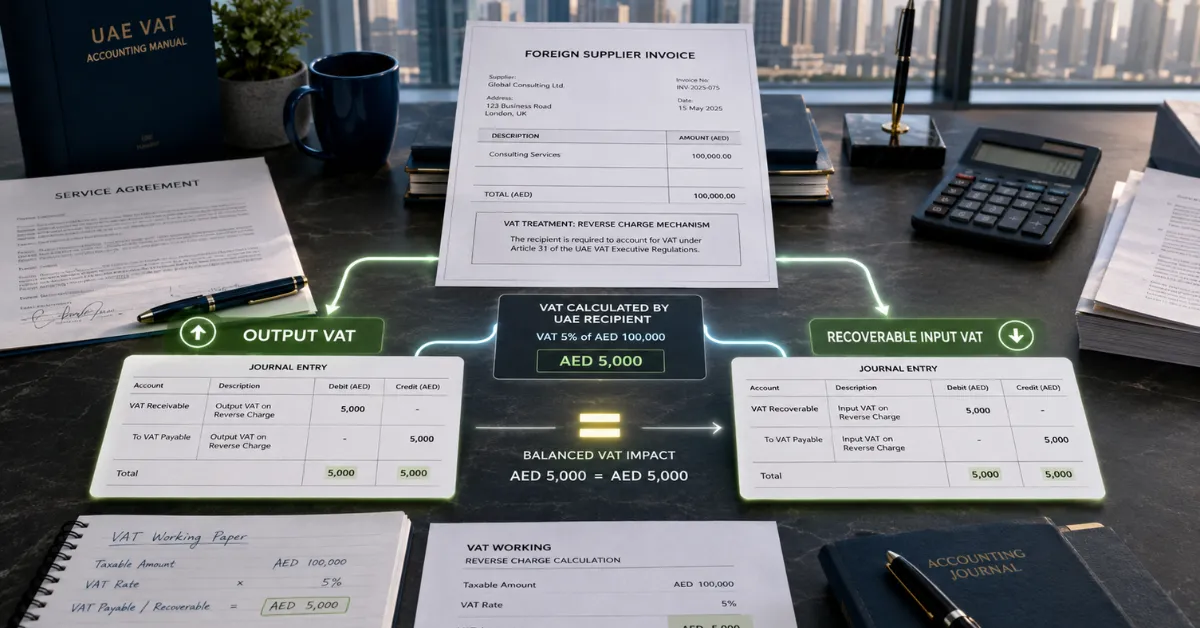
The Reverse Charge Mechanism supports the UAE VAT system by ensuring imported transactions receive the same VAT treatment as domestic supplies. Without this mechanism, overseas suppliers would often need to register for UAE VAT, creating unnecessary administrative burdens.
The objectives of the reverse charge include:
For UAE businesses, the reverse charge simplifies cross-border purchasing while placing greater responsibility on finance teams to account for VAT correctly.
The Reverse Charge Mechanism applies only in specific situations defined under the UAE VAT framework. Businesses should review every overseas purchase to determine whether reverse charge accounting is required.
The reverse charge commonly applies when a UAE VAT-registered business purchases services from suppliers located outside the UAE that are not required to charge UAE VAT.
Common examples include:
In these situations, the UAE business generally accounts for VAT under the reverse charge rules instead of paying VAT to the supplier.
The reverse charge may also apply to imported goods in circumstances specified under UAE VAT and customs regulations.
Examples include:
Businesses should distinguish between customs procedures and VAT reporting requirements, as import VAT treatment can vary depending on the import process and applicable regulations.
Businesses frequently purchase products and services from suppliers established outside the UAE. If the supplier is not charging UAE VAT and the transaction falls within the UAE reverse charge rules, the recipient is generally responsible for accounting for the VAT.
Examples include:
The UAE VAT legislation also provides for reverse charge treatment in certain domestic transactions specified by law, including particular supplies of precious metals and other qualifying transactions where the applicable legal conditions are met.
Businesses involved in these industries should review the relevant VAT rules carefully before determining the correct VAT treatment.
The reverse charge does not apply to every purchase from outside the UAE. Businesses should assess each transaction individually before applying reverse charge accounting.
It generally does not apply in the following situations:
Applying the reverse charge incorrectly can result in inaccurate VAT returns and unnecessary compliance risks.
The Reverse Charge Mechanism follows a straightforward accounting process, but each step should be completed accurately to remain compliant with FTA requirements.
The overseas supplier issues an invoice without charging UAE VAT because it is not responsible for collecting UAE VAT on the transaction.
The invoice should clearly identify the supplier, describe the services or goods supplied, and include the transaction value.
Before recording the transaction, the business should confirm:
This assessment helps ensure the transaction is recorded correctly from the outset.
If the reverse charge applies, the business calculates VAT using the applicable UAE VAT rate based on the taxable value of the supply.
The calculated amount is treated as output VAT for reporting purposes.
The business records:
For businesses making fully taxable supplies, the output VAT and recoverable input VAT often offset each other within the same VAT period. However, businesses making exempt or partially exempt supplies may only recover input VAT to the extent permitted under the applicable VAT recovery rules.
The transaction must be reported accurately in the relevant sections of the UAE VAT return based on FTA reporting requirements. Incorrect reporting may lead to discrepancies during VAT reviews or audits, making proper bookkeeping and recordkeeping an essential part of ongoing VAT compliance.
Accurate accounting entries are essential when applying the UAE Reverse Charge Mechanism. Since the overseas supplier does not charge UAE VAT, the VAT-registered business must record both the output VAT and, where eligible, the recoverable input VAT in its accounting records.
The journal entries depend on the nature of the transaction, but the accounting principle remains the same. Businesses should ensure that all entries are supported by supplier invoices, contracts, and other relevant documents.
A UAE VAT-registered company receives management consultancy services from an overseas supplier.
Invoice Value: AED 20,000
VAT Rate: 5%
VAT Amount: AED 1,000
Journal Entry
| Account | Debit (AED) | Credit (AED) |
|---|---|---|
| Consultancy Expense | 20,000 | |
| Input VAT Recoverable | 1,000 | |
| Accounts Payable | 20,000 | |
| Output VAT Payable | 1,000 |
If the consultancy service is used solely for taxable business activities, the business may generally recover the input VAT subject to the UAE VAT recovery rules.
A UAE company purchases an annual cloud-based accounting software subscription from a foreign supplier.
Invoice Value: AED 12,000
VAT Rate: 5%
VAT Amount: AED 600
Journal Entry
| Account | Debit (AED) | Credit (AED) |
|---|---|---|
| Software Subscription Expense | 12,000 | |
| Input VAT Recoverable | 600 | |
| Accounts Payable | 12,000 | |
| Output VAT Payable | 600 |
Businesses should retain the supplier agreement and invoice as evidence supporting the VAT treatment.
A manufacturing company imports machinery from an overseas supplier for business operations.
Invoice Value: AED 100,000
VAT Rate: 5%
VAT Amount: AED 5,000
Journal Entry
| Account | Debit (AED) | Credit (AED) |
|---|---|---|
| Machinery | 100,000 | |
| Input VAT Recoverable | 5,000 | |
| Accounts Payable | 100,000 | |
| Output VAT Payable | 5,000 |
The VAT treatment for imported goods should also be reconciled with customs documentation where applicable to ensure accurate accounting and VAT reporting.
Recording the accounting entry alone is not sufficient. Businesses must also report reverse charge transactions correctly in their UAE VAT return.
Incorrect VAT return reporting may result in errors, delayed VAT assessments, or administrative penalties. Finance teams should reconcile accounting records with VAT return figures before submission.
The taxable value of supplies subject to the reverse charge should be reported in the relevant section of the UAE VAT return designated for reverse charge transactions.
Businesses should ensure that:
The VAT calculated under the Reverse Charge Mechanism must be reported as output VAT in the appropriate section of the VAT return.
Businesses should verify that:
Where the business is entitled to recover VAT, the same VAT amount may generally be claimed as recoverable input tax, subject to the normal recovery conditions.
Input VAT recovery depends on factors such as:
Before submitting the VAT return, businesses should reconcile:
Regular reconciliations reduce the risk of reporting errors and improve audit readiness.
The following example illustrates how reverse charge VAT is calculated.
Scenario
A UAE VAT-registered business purchases digital marketing services from a supplier established outside the UAE.
Invoice Value: AED 20,000
Applicable VAT Rate: 5%
| Description | Amount (AED) |
|---|---|
| Service Value | 20,000 |
| Output VAT (5%) | 1,000 |
| Recoverable Input VAT | 1,000 |
| Net VAT Payable | 0* |
*The net VAT impact may be nil where the business is fully entitled to recover the input VAT. Businesses making exempt or partially exempt supplies may not be able to recover the full amount.
This example demonstrates that the Reverse Charge Mechanism is primarily an accounting and reporting requirement rather than an additional VAT cost for businesses with full input tax recovery rights.
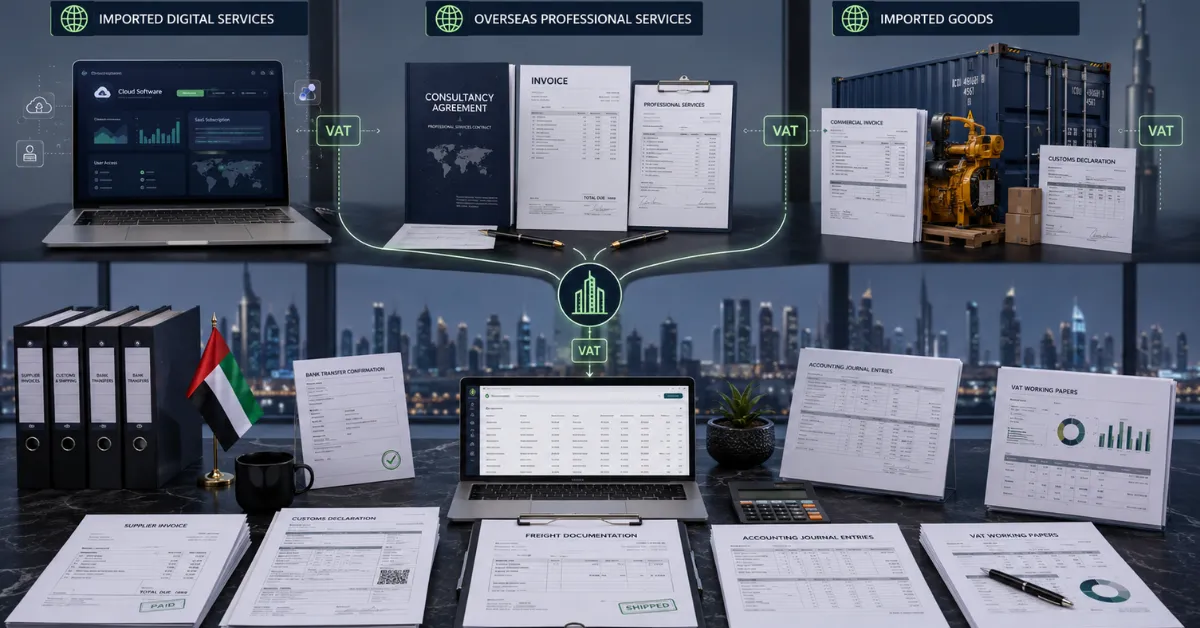
Maintaining complete documentation is essential for demonstrating compliance with UAE VAT requirements. Businesses should keep records for the retention period required under applicable UAE tax legislation.
The following documents should be maintained:
Complete documentation helps support the VAT treatment during FTA reviews or audits.
Many VAT errors arise because businesses overlook reverse charge obligations or apply the rules incorrectly. Identifying these issues early helps reduce compliance risks.
Common mistakes include:
Implementing strong accounting controls and periodic VAT reviews can significantly reduce the likelihood of reporting errors and improve overall compliance with UAE VAT requirements.
The UAE Reverse Charge Mechanism can improve cash flow for businesses that are fully entitled to recover input VAT. Instead of paying UAE VAT to an overseas supplier, the business accounts for both output VAT and recoverable input VAT through its VAT return.
For many fully taxable businesses, this means there is no immediate cash outflow relating to VAT on qualifying reverse charge transactions. However, the accounting and reporting obligations remain significant, and inaccurate reporting can result in penalties.
Businesses should regularly review reverse charge transactions to ensure:
| Feature | Reverse Charge Mechanism | Standard VAT |
|---|---|---|
| Supplier Location | Outside the UAE or qualifying specified transactions | UAE VAT-registered supplier |
| Who Accounts for VAT | UAE recipient | Supplier |
| VAT on Invoice | No UAE VAT charged by overseas supplier | UAE VAT charged on the invoice |
| Output VAT | Recorded by the recipient | Collected and reported by the supplier |
| Input VAT Recovery | Subject to eligibility under UAE VAT rules | Subject to eligibility under UAE VAT rules |
| Accounting Responsibility | Recipient | Supplier |
| VAT Return Reporting | Reported by the recipient | VAT recovered from supplier invoice |
| Compliance Responsibility | Higher for the recipient | Shared between supplier and recipient |
Understanding these differences helps businesses apply the correct VAT treatment and avoid reporting errors.
Businesses should establish clear internal procedures for reviewing overseas purchases and recording VAT accurately.
Recommended best practices include:
Following these practices reduces compliance risks and supports accurate VAT reporting.
The Reverse Charge Mechanism is a VAT rule that transfers the responsibility for accounting for VAT from the supplier to the VAT-registered recipient in qualifying transactions.
It generally applies to VAT-registered businesses in the UAE that receive qualifying goods or services from overseas suppliers or enter into other transactions specified under UAE VAT legislation.
Yes. Many imported business services, such as consultancy, software subscriptions, cloud services, digital advertising, and professional services supplied by overseas providers, may fall within the Reverse Charge Mechanism, depending on the facts of the transaction.
Businesses may recover input VAT if the purchase is used for taxable business activities and the recovery conditions under the UAE VAT legislation are satisfied.
Businesses should report qualifying reverse charge transactions in the appropriate sections of the UAE VAT return and maintain supporting accounting records and documentation.
Businesses should keep:
Incorrect reporting may lead to VAT adjustments, administrative penalties, additional tax assessments, or increased scrutiny during an FTA review or audit.
Managing reverse charge transactions requires more than recording accounting entries. Businesses must ensure that every qualifying transaction is assessed correctly, reported accurately, and supported by complete documentation. A proactive approach helps reduce compliance risks and prepares businesses for future VAT reviews or audits.
Ripple Accountants provides practical support for businesses across the UAE through:
Whether your business regularly imports services, purchases software from overseas providers, or manages international supplier relationships, professional VAT support can help ensure accurate reporting and compliance with UAE tax requirements.
If you need assistance with UAE VAT compliance, reverse charge accounting, or bookkeeping, Ripple Accountants can help you establish reliable accounting processes and meet your VAT obligations with confidence.
Contact Ripple Accountants
The UAE Reverse Charge Mechanism is an essential component of the country’s VAT system and plays a significant role in the taxation of imported goods and services. Businesses that purchase from overseas suppliers must understand when the reverse charge applies, how to record the correct accounting entries, and how to report transactions accurately in their VAT returns.
Disclaimer: This article is for general informational purposes only and does not constitute legal, tax, or financial advice. UAE VAT laws and Federal Tax Authority (FTA) guidance may change over time. Businesses should consult a qualified VAT professional or tax advisor for advice specific to their circumstances.
Tell us a little about your business and our UAE tax experts will get back to you with clear, practical answers — no obligation.
 Corporate Tax
How much does a UAE Tax Residency Certificate cost, how long does it take to obtain, and when does it expire? Understanding…
Read article Corporate Tax
Are you planning to apply for a UAE Tax Residency Certificate but unsure which documents you need or whether you qualify? Understanding…
Read article Corporate Tax
Do you need a UAE Tax Residency Certificate for a local administrative requirement or to claim benefits under a double taxation agreement?…
Read articlePage 1 of 58
Book a free consultation and get clear answers for your business.
0 Comments