UAE Tax Residency Certificate for Individuals: Eligibility and Application Guide
Are you living in the UAE and need proof of your tax residency for a foreign tax authority, bank or tax-related process?…
Read article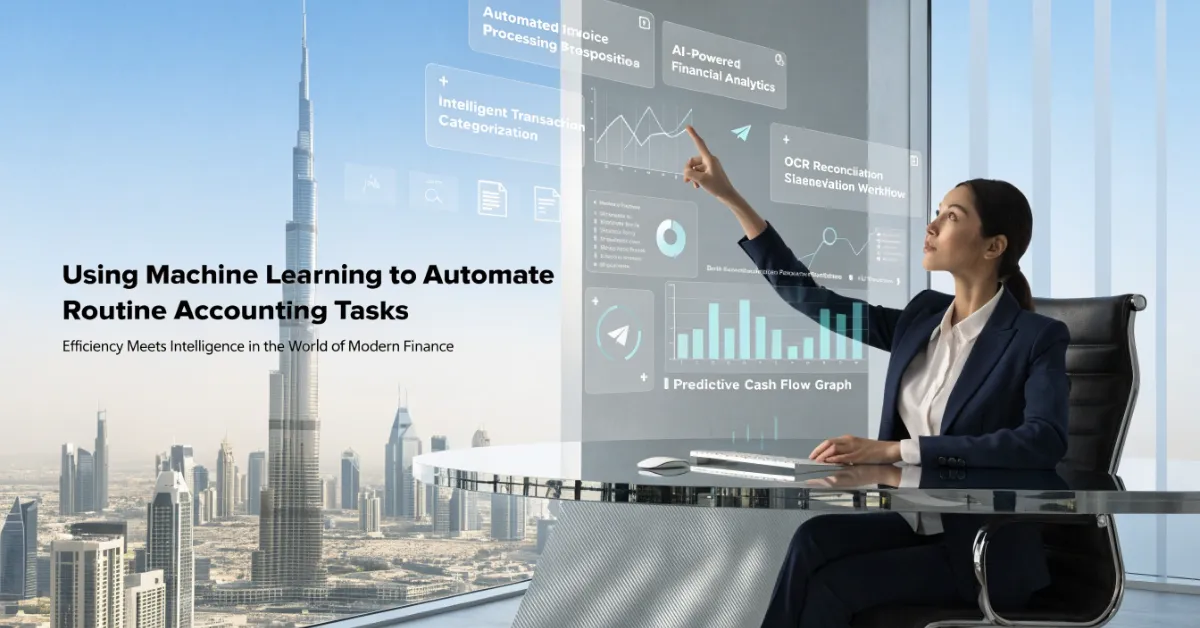
Businesses are under constant pressure to process financial data faster, reduce manual work, and improve accuracy. Traditional accounting methods often rely on repetitive tasks that consume valuable time and increase the risk of human error. This is where machine learning, automation, and accounting tasks come together to transform financial operations. Machine learning is a branch of artificial intelligence (AI) that enables software to learn from historical financial data and improve its performance without being manually programmed for every scenario. Unlike traditional automation, machine learning can recognize patterns, classify transactions, predict outcomes, and continuously improve its accuracy over time.
Machine learning in accounting refers to the use of intelligent algorithms that analyze financial data, recognize patterns, and automate routine accounting processes. Instead of relying solely on predefined rules, machine learning systems learn from previous transactions and continuously improve their performance as they process more information. Modern accounting software combines cloud technology, artificial intelligence, and machine learning to simplify financial management. These systems can automatically categorize transactions, identify duplicate invoices, detect unusual spending patterns, and generate financial insights in real time.
The goal is not to replace accountants but to eliminate repetitive work so finance professionals can focus on strategic planning, financial analysis, compliance, and business advisory services.
Traditional accounting software operates using fixed rules created by users. If a new situation occurs outside those predefined rules, manual intervention becomes necessary.
Machine learning works differently. It studies historical accounting records, identifies recurring patterns, and gradually learns how similar transactions should be handled in the future. As more data becomes available, the system becomes smarter and more accurate.
Some key differences include:
| Traditional Accounting Software | Machine Learning Accounting Software |
|---|---|
| Rule-based automation | Learns from historical data |
| Requires frequent manual updates | Continuously improves accuracy |
| Handles repetitive predefined tasks | Adapts to changing financial patterns |
| Limited forecasting abilities | Predictive analytics and forecasting |
| Static reports | Real-time intelligent insights |
This ability to learn makes machine learning particularly valuable for businesses handling thousands of financial transactions every month.
Machine learning follows a structured process to automate accounting tasks effectively.
The system gathers financial information from invoices, receipts, payroll records, bank statements, accounting software, and enterprise resource planning (ERP) systems.
Algorithms analyze historical transactions to identify recurring behaviors, spending trends, customer payment habits, and vendor relationships.
The software automatically categorizes expenses, revenue, invoices, and journal entries based on previous accounting records.
Machine learning predicts cash flow, flags potential errors, recommends account classifications, and identifies unusual financial activities before they become major issues.
Unlike traditional automation, machine learning models improve continuously as they process new financial data, reducing errors and increasing efficiency over time.

The volume of financial data generated by modern businesses continues to grow every year. Processing invoices, reconciling bank statements, recording transactions, and preparing reports manually is no longer efficient for many organizations. Accounting automation helps businesses reduce repetitive work while improving financial accuracy and operational efficiency. Several factors are driving this shift toward automation.
Businesses process hundreds or even thousands of financial transactions every month. Manual bookkeeping becomes increasingly difficult as companies grow. Machine learning can automatically process large datasets without sacrificing speed or accuracy.
Manual data entry often leads to duplicate records, incorrect account classifications, and calculation mistakes. Machine learning reduces these risks by validating financial information against historical records and predefined accounting standards.
Executives require timely financial information to make informed business decisions. Automated accounting systems generate reports much faster than manual processes, allowing management to access real-time financial insights whenever needed.
Automation reduces the need for repetitive manual work, enabling finance teams to focus on higher-value responsibilities such as budgeting, forecasting, and financial strategy. This often leads to lower administrative costs while increasing productivity.
Machine learning helps maintain consistent accounting practices by following predefined accounting policies and identifying transactions that may require additional review.
This supports more accurate financial records and simplifies audits.
One of the biggest advantages of machine learning is its ability to automate repetitive accounting tasks while maintaining high accuracy. Instead of spending hours entering data manually, finance teams can rely on intelligent systems to complete routine processes automatically.
Invoice processing is one of the most common applications of machine learning in accounting. AI-powered software extracts information from invoices using Optical Character Recognition (OCR), verifies vendor details, matches purchase orders, identifies duplicate invoices, and routes documents for approval automatically.
This significantly reduces invoice processing time and minimizes manual errors.
Machine learning streamlines accounts payable by:
This creates a faster and more reliable payment process.
Machine learning improves receivables management by monitoring customer payment behavior and predicting late payments.
Businesses can automate:
These improvements help maintain healthier cash flow.
Expense reporting traditionally requires employees to submit receipts manually. Machine learning automates this process by extracting receipt information, categorizing expenses, verifying policy compliance, and identifying duplicate reimbursement claims. Employees spend less time preparing reports, while finance teams review fewer manual submissions.
Reconciling bank statements manually is often time-consuming. Machine learning automatically compares accounting records with bank transactions, identifies matching entries, highlights discrepancies, and suggests corrective actions. This shortens month-end closing cycles and improves financial accuracy.
Payroll involves salary calculations, overtime, tax deductions, bonuses, and employee benefits. Machine learning automates payroll calculations, validates employee records, identifies unusual payroll transactions, and reduces processing errors. Finance teams can complete payroll faster while maintaining compliance with company policies.
Preparing tax-related financial information requires organizing large amounts of transaction data.
Machine learning assists by:
This helps accountants prepare more accurate tax documentation.
Machine learning automatically compiles financial information into reports such as:
Because reports are generated automatically, management receives faster access to up-to-date financial information.
Advanced accounting systems can recommend journal entries based on previous transactions. Instead of creating every journal entry manually, accountants review AI-generated suggestions before approving them. This improves consistency while reducing repetitive work.
Categorizing financial transactions manually can consume considerable time. Machine learning studies historical accounting records and automatically assigns transactions to the appropriate accounts with increasing accuracy over time. This improves bookkeeping efficiency and helps maintain cleaner financial records.
Machine learning combined with OCR technology extracts information directly from scanned receipts.
The system captures:
This eliminates manual data entry while improving record accuracy.
Machine learning continuously analyzes incoming and outgoing cash movements. It identifies spending trends, predicts future cash shortages, monitors customer payment behavior, and alerts finance teams to unusual financial activity before it impacts business operations.
By providing real-time visibility into cash flow, businesses can make faster financial decisions and maintain stronger financial stability.
Machine learning has become a valuable tool for businesses looking to improve accounting efficiency. By automating repetitive processes and analyzing financial data intelligently, organizations can reduce costs, improve accuracy, and make better business decisions. Below are the most significant benefits of using machine learning accounting software.
Manual accounting often leads to data entry mistakes, duplicate records, and incorrect transaction classifications. Machine learning minimizes these errors by learning from historical financial data and applying consistent accounting rules.
Greater accuracy improves the reliability of financial statements and reduces the need for time-consuming corrections.
Routine accounting tasks such as invoice processing, expense categorization, and bank reconciliation can consume many hours every week. Machine learning automates these activities, allowing finance professionals to focus on financial planning, analysis, and business strategy.
This improves productivity without increasing workload.
Automation reduces the amount of manual effort required to manage accounting operations. Businesses spend less time on repetitive work, lowering labor costs while improving operational efficiency. The savings can be reinvested into growth initiatives and business development.
Machine learning continuously monitors financial transactions and identifies unusual patterns that may indicate fraud or financial irregularities. For example, the system can detect duplicate invoices, unexpected payment amounts, or suspicious vendor activity before these issues become serious financial risks.
Traditional financial reporting often requires manual data collection and reconciliation. Machine learning generates financial reports automatically using live accounting data, giving business owners immediate access to:
Real-time reporting supports faster and more informed decision-making.
Machine learning analyzes historical financial information and predicts future business performance.
These insights help organizations make better decisions regarding:
Modern accounting systems help businesses follow accounting standards and internal financial policies consistently. Machine learning also identifies transactions that require further review, making compliance management more efficient and reducing the likelihood of reporting errors.
Automation accelerates invoice generation, payment processing, and customer account updates. Customers receive accurate invoices more quickly, payments are processed efficiently, and billing disputes decrease because financial records are more accurate.
Machine learning provides more than automation. It transforms financial data into valuable business insights that support smarter decision-making across the organization.
Machine learning analyzes customer payment history, seasonal trends, supplier payments, and operational expenses to forecast future cash flow.
Business owners can anticipate cash shortages, improve liquidity management, and plan future investments more confidently.
Historical financial data allows machine learning to recommend more realistic budgets based on actual business performance. Instead of relying solely on assumptions, finance teams can develop budgets supported by data-driven insights.
Machine learning identifies revenue trends by analyzing previous sales performance, customer behavior, and market conditions.
These forecasts help businesses prepare inventory, staffing, and marketing strategies more effectively.
Predictive analytics estimates future operating expenses using historical spending patterns. Businesses can identify opportunities to reduce unnecessary costs while improving financial planning.
Modern accounting platforms present financial information through interactive dashboards.
These dashboards provide real-time visibility into:
Executives can monitor business performance without manually compiling reports.
Machine learning evaluates financial risks by analyzing transaction history, customer payment behavior, and operational data. Businesses can identify potential financial problems early and take corrective action before they impact profitability.
Although both approaches improve efficiency, machine learning provides greater flexibility and intelligence than traditional automation.
| Traditional Automation | Machine Learning Automation |
|---|---|
| Follows predefined rules | Learns from historical data |
| Requires manual updates | Continuously improves over time |
| Limited decision-making | Provides intelligent recommendations |
| Processes repetitive tasks only | Identifies patterns and predicts outcomes |
| Static reporting | Real-time analytics and insights |
| Cannot adapt to new scenarios | Improves with additional data |
Traditional automation is effective for simple repetitive processes. Machine learning extends automation by recognizing patterns, making predictions, detecting anomalies, and adapting to changing financial conditions.
Businesses handling large transaction volumes benefit most from machine learning because the system becomes more accurate as it processes more financial information.
Almost every industry can improve efficiency by automating accounting tasks with machine learning.
While machine learning offers significant advantages, businesses should prepare for several implementation challenges.
Machine learning depends on accurate financial data. Poor-quality or incomplete records reduce prediction accuracy and limit automation performance. Businesses should clean and organize financial data before implementation.
Finance professionals need training to understand AI-powered accounting systems and interpret machine-generated recommendations effectively. Continuous learning helps teams maximize the benefits of automation.
Some organizations use multiple accounting platforms, ERP systems, and payroll applications. Successful implementation requires smooth integration between these systems to ensure consistent data flow.
Financial information is highly sensitive. Businesses should implement strong security measures, including encryption, multi-factor authentication, role-based access controls, and regular security audits to protect accounting data.
Implementing machine learning software may require investments in technology, employee training, and system integration. However, many organizations recover these costs through increased productivity and long-term operational savings.
Accounting software must support applicable accounting standards, tax regulations, and financial reporting requirements. Businesses should regularly review automated processes to ensure continued compliance.
Following best practices helps organizations maximize the value of machine learning while minimizing implementation risks.
Selecting the right accounting software is essential for successful automation. The best platforms combine cloud accounting, artificial intelligence, and machine learning to streamline bookkeeping, financial reporting, and business management.
| Tool | Best For | Machine Learning Features | Cloud Support | Suitable Business Size |
|---|---|---|---|---|
| QuickBooks Online | Small Businesses | Smart expense categorization, cash flow insights | Yes | Small |
| Xero | SMEs | Bank reconciliation, invoice matching | Yes | Small to Medium |
| Sage Intacct | Growing Businesses | AI-powered financial reporting | Yes | Medium |
| Oracle NetSuite | Enterprises | Predictive analytics, financial forecasting | Yes | Medium to Large |
| Microsoft Dynamics 365 Finance | Large Organizations | Intelligent automation and reporting | Yes | Medium to Large |
| Zoho Books | Startups & SMEs | Automated workflows and expense tracking | Yes | Small to Medium |
| FreshBooks | Freelancers & Service Businesses | Automated invoicing and payment reminders | Yes | Small |
| SAP S/4HANA Finance | Global Enterprises | Machine learning and predictive financial analysis | Yes | Large Enterprises |
QuickBooks Online uses machine learning to categorize expenses, reconcile bank transactions, and provide real-time cash flow insights. It is ideal for small businesses that want to reduce manual bookkeeping while maintaining accurate financial records.
Xero offers intelligent bank reconciliation, invoice processing, and automated transaction matching. Its cloud-based platform makes collaboration between accountants and business owners simple and efficient.
Sage Intacct helps growing organizations automate financial consolidation, reporting, and compliance. Machine learning features improve reporting accuracy and reduce month-end closing time.
Oracle NetSuite is designed for businesses with complex financial operations. Its AI-powered capabilities support financial forecasting, budgeting, revenue recognition, and intelligent business analytics.
Microsoft Dynamics 365 Finance combines automation with advanced analytics. It helps organizations optimize financial processes, improve cash flow management, and strengthen financial decision-making.
Zoho Books offers affordable automation for startups and SMEs. Features include automated workflows, recurring invoices, bank feeds, expense tracking, and financial reporting.
FreshBooks focuses on freelancers and service-based businesses. It simplifies invoicing, expense management, time tracking, and payment collection while reducing manual administrative work.
SAP S/4HANA Finance provides enterprise-grade machine learning capabilities, predictive analytics, automated financial planning, and real-time reporting for multinational organizations.

Machine learning continues to evolve rapidly, introducing smarter solutions that improve financial management and reduce administrative work. Businesses adopting these technologies today will be better prepared for future financial challenges.
Generative AI is beginning to assist accountants by preparing financial summaries, drafting management reports, explaining financial trends, and answering accounting-related questions using natural language. This technology reduces reporting time while improving access to financial insights.
Future accounting software will automatically capture transactions, categorize expenses, reconcile accounts, and prepare journal entries with minimal human intervention. Accountants will focus more on reviewing exceptions than performing routine data entry.
Virtual AI assistants will help finance teams by answering accounting questions, retrieving financial reports, scheduling payments, and providing real-time financial recommendations. These assistants improve productivity and make financial information easier to access.
Voice technology is becoming increasingly useful in finance. Business owners may soon approve invoices, request financial reports, or check cash flow simply by using voice commands.
Machine learning can analyze historical financial data and estimate future tax obligations. Businesses can plan ahead, improve cash flow, and reduce last-minute tax preparation.
Instead of conducting audits periodically, AI-powered systems continuously monitor financial transactions, identify unusual activities, and flag compliance issues in real time. This approach improves transparency and reduces financial risks.
Hyperautomation combines machine learning, robotic process automation (RPA), artificial intelligence, and workflow automation into one integrated system. Businesses can automate complete financial processes from invoice receipt to payment reconciliation without manual intervention.
Future accounting systems will generate increasingly accurate forecasts by analyzing historical data, market trends, customer behavior, and operational performance. These insights help businesses make better strategic decisions with greater confidence.
Adopting machine learning and automation in accounting requires the right expertise and technology partner. Ripple Accountants helps businesses streamline financial operations through professional accounting, bookkeeping, VAT, corporate tax, audit support, and business advisory services. Whether you’re looking to improve financial accuracy, automate routine accounting tasks, or strengthen compliance, Ripple Accountants provides tailored solutions to support your business growth. To learn more or discuss your accounting requirements, contact Ripple Accountants at +971 52 356 5409, email info@uaetaxcompliance.ae, or connect via WhatsApp: +971 4 250 0833.
Machine learning in accounting uses artificial intelligence to analyze financial data, recognize patterns, automate repetitive accounting tasks, and continuously improve accuracy. It helps accountants save time while producing more reliable financial information.
Machine learning automates tasks such as invoice processing, bank reconciliation, transaction categorization, expense management, payroll processing, and financial reporting by learning from historical accounting data and identifying recurring patterns.
No. AI and machine learning are designed to support accountants rather than replace them. Automation handles repetitive tasks, while accountants continue providing professional judgment, strategic planning, financial analysis, compliance oversight, and business advisory services.
Yes. Many cloud accounting platforms provide affordable automation features for startups and small businesses. Automating bookkeeping, invoicing, and reporting improves efficiency while allowing business owners to focus on growth.
AI can automate invoice processing, accounts payable, accounts receivable, payroll, expense management, bank reconciliation, financial reporting, receipt scanning, transaction categorization, cash flow monitoring, and journal entry recommendations.
Most modern accounting platforms use encryption, access controls, multi-factor authentication, and continuous monitoring to protect financial information. Businesses should also follow cybersecurity best practices and choose trusted software providers.
Popular accounting platforms with machine learning capabilities include QuickBooks Online, Xero, Sage Intacct, Oracle NetSuite, Microsoft Dynamics 365 Finance, Zoho Books, FreshBooks, and SAP S/4HANA Finance.
The savings depend on business size and existing processes. Many organizations reduce administrative workloads, minimize manual errors, shorten reporting cycles, and improve overall productivity, leading to meaningful long-term cost savings.
Machine learning is transforming the way businesses manage accounting tasks by reducing manual work, improving accuracy, and delivering real-time financial insights. From invoice processing and bank reconciliation to payroll, financial reporting, and predictive forecasting, intelligent automation helps finance teams work more efficiently while supporting better business decisions.
Disclaimer: This article is for general informational purposes only and should not be considered accounting, tax, legal, or financial advice. Businesses should consult qualified professionals for guidance specific to their circumstances and applicable regulations.
Tell us a little about your business and our UAE tax experts will get back to you with clear, practical answers — no obligation.
 Corporate Tax
Are you living in the UAE and need proof of your tax residency for a foreign tax authority, bank or tax-related process?…
Read article Corporate Tax
Why might a UAE Tax Residency Certificate application be rejected even when an applicant lives or operates a business in the country?…
Read article Corporate Tax
How much does a UAE Tax Residency Certificate cost, how long does it take to obtain, and when does it expire? Understanding…
Read articlePage 1 of 59
Book a free consultation and get clear answers for your business.
0 Comments