Why UAE Tax Residency Certificate Applications Get Rejected: Common Mistakes to Avoid
Why might a UAE Tax Residency Certificate application be rejected even when an applicant lives or operates a business in the country?…
Read article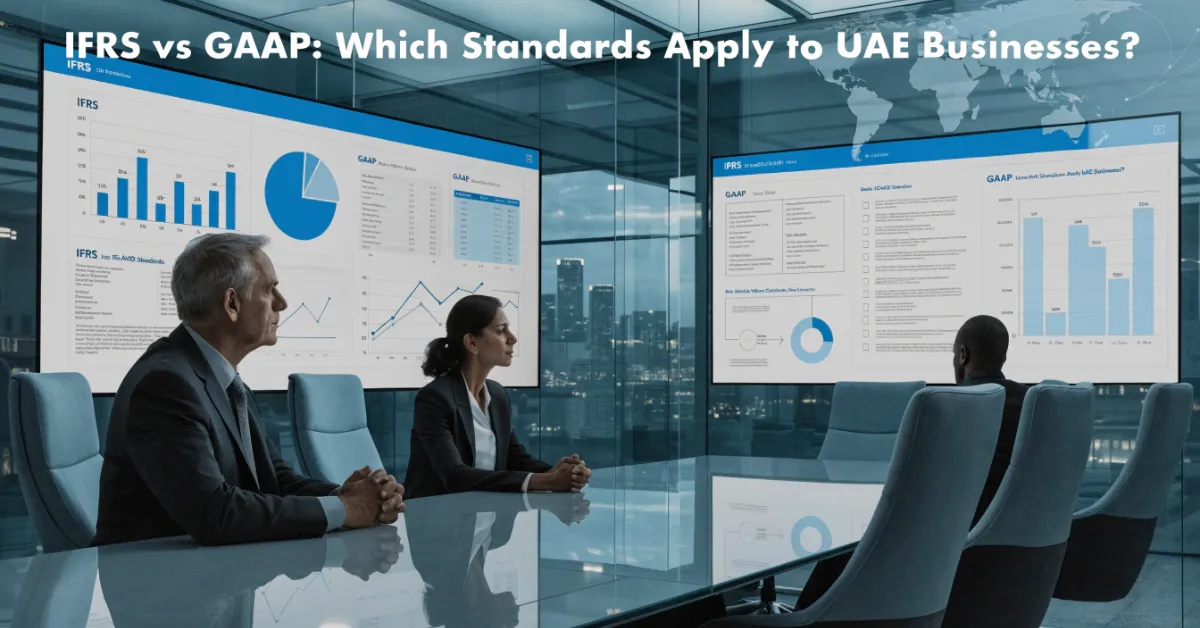
Choosing the right accounting standards is essential for every business operating in the UAE. Financial statements prepared under the correct framework improve transparency, support regulatory compliance, and help business owners make informed decisions. They also build confidence among investors, lenders, auditors, and other stakeholders. Many business owners compare IFRS vs GAAP when establishing a company, expanding internationally, or preparing financial reports. While both frameworks aim to improve the quality of financial reporting, they differ in their approach, application, and regulatory acceptance.
Accounting standards are a set of rules and guidelines that determine how businesses record, measure, present, and disclose financial information. They create consistency in financial reporting, allowing stakeholders to compare the performance of different organizations accurately.
Using recognized accounting standards helps businesses:
Without standardized reporting, financial statements could vary significantly between businesses, making comparisons difficult and reducing confidence in reported financial information.

International Financial Reporting Standards (IFRS) are globally recognized accounting standards used by businesses in more than 140 jurisdictions. They are designed to improve consistency, transparency, and comparability in financial reporting across international markets.
The UAE has adopted IFRS as the primary accounting framework for most businesses, making it the standard used for preparing financial statements in many sectors.
The International Accounting Standards Board (IASB) develops and maintains IFRS. The board regularly updates the standards to reflect changes in business practices, financial markets, and emerging accounting issues.
Its objective is to provide a high-quality global accounting framework that supports reliable financial reporting and enhances investor confidence.
IFRS aims to:
These objectives help businesses communicate their financial performance clearly while meeting the expectations of regulators and investors.
Some of the most important characteristics of IFRS include:
Because IFRS focuses on principles rather than detailed rules, businesses apply professional judgment while remaining within the framework’s requirements.
Generally Accepted Accounting Principles (GAAP) refer to the accounting framework primarily used in the United States. It provides detailed rules for recording financial transactions and preparing financial statements. GAAP is commonly followed by U.S. companies, organizations listed on U.S. stock exchanges, and businesses required to report under U.S. regulatory requirements.
GAAP is generally used by:
Although multinational companies may prepare reports under GAAP for group reporting, businesses operating in the UAE typically follow IFRS for local financial reporting.
GAAP is built around several accounting principles that promote consistency and accuracy, including:
These principles help businesses prepare financial statements that comply with U.S. accounting regulations.
GAAP supports detailed financial reporting requirements established by U.S. regulators. Its rules-based structure reduces interpretation differences by providing specific guidance for many accounting situations. This approach helps create consistency among organizations operating within the U.S. financial reporting system.
Although IFRS and GAAP share the goal of producing reliable financial information, they differ in several important areas.
| Feature | IFRS | GAAP |
|---|---|---|
| Approach | Principle-based | Rules-based |
| Primary Use | International | United States |
| Global Adoption | Widely adopted worldwide | Primarily used in the U.S. |
| Inventory Method | LIFO not allowed | LIFO permitted |
| Asset Valuation | Greater use of fair value | More historical cost-based |
| Development Costs | May be capitalized when criteria are met | Usually expensed |
| Financial Statement Presentation | More flexible | More detailed guidance |
| Professional Judgment | Higher | Lower due to detailed rules |
IFRS focuses on accounting principles that allow businesses to apply professional judgment based on the economic substance of transactions. GAAP relies on detailed accounting rules that provide specific guidance for many reporting situations.
Both frameworks now follow similar revenue recognition models in many areas. However, differences may still exist in implementation, industry-specific guidance, and documentation requirements. Businesses should carefully evaluate contracts to ensure compliance with the applicable framework.
Inventory valuation is one of the most well-known differences.
Under IFRS:
Under GAAP:
This difference can affect inventory valuation, reported profits, and tax calculations in certain jurisdictions.
IFRS allows businesses to revalue certain assets to fair value when permitted by the standards. GAAP generally places greater emphasis on historical cost, with fewer opportunities for asset revaluation.
IFRS allows qualifying development costs to be capitalized when strict recognition criteria are satisfied. GAAP generally requires research and development costs to be recognized as expenses when incurred, with limited exceptions.
The UAE primarily follows International Financial Reporting Standards (IFRS) for financial reporting. Most companies operating in the country prepare their financial statements using IFRS to support transparency, regulatory compliance, and internationally accepted reporting practices.
The accounting requirements generally vary depending on the business structure, industry, and applicable regulations, but IFRS remains the dominant reporting framework.
Businesses that commonly apply IFRS include:
Companies that are subsidiaries of U.S.-based organizations may also prepare GAAP financial reports for internal group reporting or consolidation. However, their local financial reporting obligations in the UAE generally remain aligned with IFRS where applicable.
The UAE has positioned itself as a global business and investment hub. Adopting IFRS supports this objective by providing an internationally recognized accounting framework that improves financial transparency and enables investors, lenders, and multinational organizations to compare financial statements across different countries.
Using IFRS also helps businesses:
For businesses operating in the UAE, understanding and applying IFRS correctly is essential for accurate financial reporting, regulatory compliance, and long-term business growth.
In most cases, UAE businesses prepare their statutory financial statements using IFRS because it is the widely accepted accounting framework in the country. However, some companies may also prepare financial reports under U.S. GAAP for internal purposes.
This situation commonly applies to:
For example, a UAE subsidiary of a U.S. corporation may maintain IFRS-compliant financial statements for local reporting while converting its accounts to GAAP for the parent company’s consolidated financial statements.
Businesses should ensure that any GAAP reporting does not conflict with local regulatory and financial reporting obligations in the UAE.
Accounting requirements can vary depending on the legal structure and regulatory obligations of a business.
Small sole establishments should maintain accurate accounting records and prepare financial information that supports tax compliance, business management, and regulatory requirements.
LLCs generally prepare financial statements in accordance with IFRS, particularly when audits, financing, or regulatory reporting are required.
Mainland businesses commonly use IFRS for financial reporting to maintain transparency and meet audit, banking, and regulatory expectations.
Many free zone authorities require businesses to maintain proper accounting records and, where applicable, prepare IFRS-compliant financial statements.
Holding companies typically prepare consolidated financial statements using IFRS when they control one or more subsidiaries.
Branches of foreign companies usually prepare financial information that satisfies both local reporting requirements and the reporting needs of the parent company.
Listed companies are generally expected to prepare high-quality IFRS financial statements that provide comprehensive disclosures for shareholders and regulators.
Multinational organizations often prepare IFRS financial statements for UAE operations while meeting additional reporting requirements imposed by their headquarters.
The IFRS for SMEs is a simplified accounting framework designed for small and medium-sized businesses that do not have public accountability. It reduces reporting complexity while maintaining high-quality financial reporting.
Businesses may benefit from this framework through:
For many growing businesses, IFRS for SMEs provides a practical balance between compliance and administrative efficiency.
Financial statements prepared under IFRS play an important role in determining taxable income under the UAE Corporate Tax framework. Accurate accounting records help businesses calculate taxable profits correctly and support compliance during tax return preparation.
Areas where IFRS influences Corporate Tax include:
Businesses should maintain complete accounting records throughout the financial year to reduce errors during Corporate Tax calculations and reporting.
Although VAT regulations are governed separately from accounting standards, IFRS supports accurate VAT reporting by ensuring transactions are recorded consistently. Proper accounting records make it easier to prepare VAT returns and maintain supporting documentation.
IFRS helps businesses with:
Maintaining organized accounting records also simplifies VAT audits and reduces the risk of reporting errors.

Many businesses experience challenges when implementing or maintaining IFRS compliance, especially during periods of growth or operational changes.
Common challenges include:
Addressing these challenges early helps businesses improve reporting quality and reduce compliance risks.
Using IFRS offers several advantages for businesses operating in local and international markets.
Key benefits include:
Following IFRS also strengthens corporate governance by providing reliable financial information for management and external stakeholders.
Errors in applying accounting standards can lead to inaccurate financial statements, compliance issues, and unnecessary audit adjustments.
Some of the most common mistakes include:
Avoiding these mistakes helps businesses produce accurate financial statements, support regulatory compliance, and improve overall financial management.
Consider a UAE-based software company that signs a one-year subscription agreement worth AED 120,000 with a customer.
The company recognizes revenue over the 12-month service period because the customer receives the service continuously. Revenue is recorded monthly based on the transfer of the service to the customer.
U.S. GAAP follows a similar five-step revenue recognition model. However, differences may arise in contract interpretation, industry-specific guidance, and certain implementation requirements depending on the nature of the agreement.
Although both standards often produce similar outcomes, differences in accounting treatment, disclosures, and professional judgment can affect reported profits, financial ratios, and the presentation of financial statements. For UAE businesses, IFRS is generally the framework used for statutory financial reporting, while GAAP may be applied only for internal reporting or consolidation by multinational groups.
Businesses expanding into the UAE or becoming part of an international group may need to transition from GAAP to IFRS. A structured approach helps minimize reporting errors and ensures compliance.
Compare current accounting policies with IFRS requirements to identify areas that require changes.
Assess differences in revenue recognition, lease accounting, inventory valuation, asset measurement, and financial disclosures.
Prepare the necessary accounting adjustments so financial statements comply with IFRS presentation and measurement requirements.
Ensure accounting staff understand IFRS principles, reporting requirements, and updates that may affect financial reporting.
Review accounting software and ERP systems to confirm they support IFRS reporting and required disclosures.
Evaluate how accounting adjustments may affect Corporate Tax calculations, deferred tax, and other financial reporting requirements.
Perform an internal review or independent assessment before issuing financial statements to identify and correct compliance gaps.
Maintaining compliance requires consistent accounting processes and regular financial reviews.
Businesses should:
These practices help improve reporting accuracy and reduce compliance risks.
Applying IFRS correctly requires technical knowledge and ongoing attention to changes in accounting standards. Professional accounting support helps businesses prepare accurate financial statements while reducing the risk of reporting errors.
Professional accountants can assist with:
Ripple Accountants provides accounting, bookkeeping, Corporate Tax, VAT, audit support, and financial reporting services for businesses across the UAE. With experienced professionals and practical guidance, businesses can maintain IFRS compliance while focusing on growth and day-to-day operations.
Understanding IFRS vs GAAP is only the first step toward maintaining accurate financial reporting and regulatory compliance. Ripple Accountants supports businesses across the UAE with professional accounting, bookkeeping, financial statement preparation, Corporate Tax, VAT, audit support, and compliance services aligned with IFRS requirements. Whether you are a startup, SME, or established company, our experienced team helps you maintain accurate financial records and meet your reporting obligations with confidence. Contact Ripple Accountants at 971 52 356 5409, email info@uaetaxcompliance.ae, or WhatsApp +971 4 250 0833 to discuss your accounting and compliance requirements.
The UAE primarily uses International Financial Reporting Standards (IFRS) for financial reporting. Most businesses prepare their financial statements using IFRS.
Many businesses are expected to maintain financial records and prepare financial statements in accordance with IFRS where required by applicable regulations, licensing authorities, contractual obligations, or audit requirements.
A UAE company may prepare GAAP financial reports for internal purposes or group consolidation if required by a U.S.-based parent company. However, local reporting generally follows IFRS.
The main difference is that IFRS is principle-based, allowing more professional judgment, while GAAP is rules-based with more detailed accounting guidance.
Yes. Financial statements prepared under IFRS are commonly used as the basis for determining accounting profits, which play an important role in Corporate Tax calculations, subject to adjustments required under UAE tax legislation.
Yes. IFRS for SMEs provides a simplified financial reporting framework for eligible small and medium-sized businesses.
Many accounting solutions support IFRS reporting, including QuickBooks, Xero, Zoho Books, Microsoft Dynamics 365 Business Central, Oracle NetSuite, SAP Business One, and Odoo. Businesses should select software that meets their reporting and compliance requirements.
The International Accounting Standards Board (IASB) periodically updates IFRS to address changes in business practices and financial reporting. Businesses should monitor these updates to maintain compliance.
Understanding the differences between IFRS vs GAAP helps businesses choose the correct accounting framework and prepare reliable financial statements. While both standards promote high-quality financial reporting, IFRS is the primary accounting framework used by businesses across the UAE.
Disclaimer: This article is for general informational purposes only and should not be considered accounting, tax, financial, or legal advice. Accounting and compliance requirements may vary depending on your business structure and applicable UAE regulations. Consult a qualified professional before making financial or compliance decisions.
Tell us a little about your business and our UAE tax experts will get back to you with clear, practical answers — no obligation.
 Corporate Tax
Why might a UAE Tax Residency Certificate application be rejected even when an applicant lives or operates a business in the country?…
Read article Corporate Tax
How much does a UAE Tax Residency Certificate cost, how long does it take to obtain, and when does it expire? Understanding…
Read article Corporate Tax
Are you planning to apply for a UAE Tax Residency Certificate but unsure which documents you need or whether you qualify? Understanding…
Read articlePage 1 of 58
Book a free consultation and get clear answers for your business.
0 Comments