UAE Tax Residency Certificate Fees, Processing Time and Validity
How much does a UAE Tax Residency Certificate cost, how long does it take to obtain, and when does it expire? Understanding…
Read article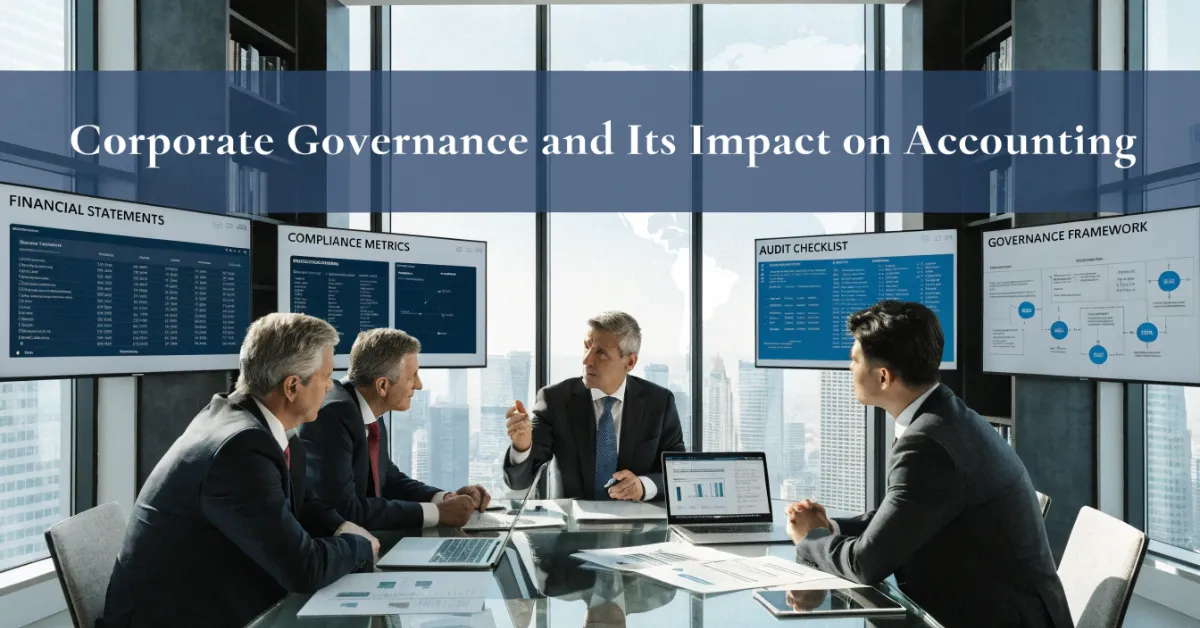
Corporate governance and accounting are closely connected because both help businesses operate with honesty, transparency, and accountability. A strong governance framework ensures that financial information is accurate, reliable, and prepared according to established accounting standards. Whether a company is a startup, SME, or multinational corporation, effective corporate governance builds trust among investors, regulators, employees, and customers.
In today’s competitive business environment, financial transparency is more important than ever. Businesses that follow strong governance practices reduce financial risks, improve decision-making, and maintain compliance with legal and regulatory requirements. On the other hand, weak governance can lead to inaccurate financial reporting, fraud, penalties, and reputational damage.

Corporate governance is the system of rules, policies, processes, and practices that guide how a company is directed and managed. It defines the responsibilities of the board of directors, executives, shareholders, and other stakeholders while promoting ethical decision-making and financial accountability. A strong corporate governance framework ensures that business decisions align with the company’s objectives while protecting the interests of investors, employees, customers, and regulatory authorities.
Good governance is not only about following laws. It also creates a culture of integrity, transparency, and responsible leadership that supports long-term business success.
Corporate governance refers to the framework through which organizations are controlled and directed. It establishes clear responsibilities for company leaders, sets performance expectations, and ensures that financial reporting reflects the company’s actual financial position.
An effective governance framework includes:
Together, these elements create a reliable foundation for financial accountability and business sustainability.
The primary objectives of corporate governance include:
When these objectives are consistently applied, businesses develop stronger financial governance and greater credibility in the marketplace.
Accounting governance refers to the policies, procedures, and internal controls that ensure financial information is accurate, complete, and prepared according to accepted accounting standards. It supports corporate governance by making financial reporting reliable and transparent. Accounting governance covers every stage of the financial reporting process, including recording transactions, maintaining accounting records, preparing financial statements, conducting audits, and ensuring regulatory compliance.
Strong accounting governance helps organizations:
Without proper accounting governance, even profitable businesses can face financial misstatements, audit issues, and compliance risks.
| Feature | Corporate Governance | Accounting Governance |
|---|---|---|
| Purpose | Oversees the entire organization | Oversees financial reporting and accounting practices |
| Main Focus | Leadership, ethics, strategy, and accountability | Financial records, reporting accuracy, and compliance |
| Decision Makers | Board of directors and senior management | Finance team, CFO, accountants, and auditors |
| Scope | Organization-wide | Finance and accounting functions |
| Compliance | Corporate laws and governance regulations | Accounting standards and financial regulations |
| Goal | Long-term business success | Reliable financial reporting and financial integrity |
Although these concepts differ in scope, they work together to strengthen organizational performance and improve financial accountability.
Corporate governance directly influences how financial information is prepared, reviewed, and presented. Strong governance practices reduce errors, encourage ethical behavior, and ensure that accounting policies are applied consistently throughout the organization. Businesses with effective governance frameworks typically produce more reliable financial statements, experience fewer compliance issues, and attract greater investor confidence.
Reliable accounting supports every major business decision, including budgeting, investment planning, expansion, financing, and risk management.
Effective corporate governance provides several important accounting benefits:
These advantages contribute to stronger financial performance and long-term organizational stability.
Corporate governance is built on several core principles that directly influence accounting quality, financial reporting, and business integrity. Applying these principles consistently helps organizations maintain transparency and strengthen stakeholder trust.
Transparency means providing complete, accurate, and timely financial information to shareholders, regulators, lenders, and other stakeholders.
Transparent accounting practices include:
When businesses operate transparently, stakeholders can make informed decisions based on reliable financial information.
Accountability means that individuals responsible for financial decisions must answer for their actions and the results they produce.
In most organizations, accountability extends to:
Clearly defined responsibilities reduce confusion, improve oversight, and strengthen financial governance.
Every employee involved in financial management has specific responsibilities that contribute to accurate accounting and regulatory compliance.
Financial responsibilities include:
Responsible financial management reduces operational risks and improves organizational performance.
Fairness requires businesses to treat all stakeholders equally and avoid biased financial reporting.
Fair accounting practices include:
Fair governance strengthens stakeholder relationships and supports long-term business credibility.
Independence is essential for maintaining objectivity in financial reporting and auditing.
Independent oversight reduces conflicts of interest and ensures unbiased financial evaluations.
Examples include:
Organizations with greater independence are generally more effective at identifying financial risks, preventing fraud, and maintaining compliance with accounting standards.
Corporate governance and financial reporting work together to create a transparent and accountable business environment. While corporate governance establishes the rules and responsibilities for managing a company, financial reporting communicates the company’s financial performance to shareholders, investors, regulators, lenders, and other stakeholders.
Reliable financial reporting depends on effective governance. When management follows established accounting policies and strong internal controls, financial statements become more accurate, consistent, and trustworthy. This improves decision-making and reduces financial risks.
Companies with strong governance frameworks are also more likely to comply with International Financial Reporting Standards (IFRS) and local regulatory requirements. Consistent compliance minimizes legal issues and strengthens investor confidence.
Effective governance supports high-quality financial reporting by:
Imagine two companies operating in the same industry.
This comparison shows how strong governance directly improves the quality and reliability of accounting information.
Several governance components work together to strengthen accounting systems, improve financial reporting, and reduce organizational risks.
The board of directors provides strategic direction while overseeing financial management and corporate accountability. One of its key responsibilities is ensuring that financial reporting reflects the company’s actual financial position.
The board typically:
An active and independent board creates stronger financial governance throughout the organization.
The audit committee serves as an independent oversight body responsible for monitoring accounting practices and financial reporting.
Its responsibilities include:
A well-functioning audit committee significantly improves financial transparency and accountability.
Internal controls are the policies and procedures designed to protect company assets, ensure accurate accounting, and reduce financial risks.
Examples of effective internal controls include:
Strong internal controls reduce the likelihood of errors and fraudulent activities.
Internal auditors evaluate whether accounting processes, financial controls, and operational procedures are working effectively. Their work helps management identify weaknesses before they become serious financial problems.
Internal auditors typically:
Their independent assessments strengthen the overall accounting environment.
External auditors provide an independent opinion on whether financial statements fairly represent the company’s financial position.
They help:
Independent external audits enhance trust among shareholders, lenders, and regulatory authorities.
Every business faces financial, operational, legal, and strategic risks. Corporate governance ensures that these risks are identified, evaluated, and managed effectively.
Accounting plays an essential role by providing financial data that helps management:
Effective risk management protects business stability while supporting informed decision-making.
Financial fraud can damage a company’s reputation, reduce investor confidence, and result in significant legal penalties. Strong corporate governance creates multiple layers of oversight that reduce opportunities for fraud. Governance encourages ethical behavior, strengthens financial controls, and ensures that accounting records accurately reflect business transactions.
Businesses with strong governance systems are more likely to detect suspicious activities early and respond before losses become significant.
Effective governance includes several fraud prevention practices:
Strong governance reduces the risk of:
Preventing fraud protects both financial performance and corporate reputation.
Poor corporate governance weakens financial reporting and increases operational risks. Without proper oversight, accounting processes become inconsistent, financial errors increase, and compliance problems become more common. Weak governance often results in inaccurate financial information, making it difficult for management to make informed business decisions.
Over time, poor governance can seriously affect profitability, investor confidence, and long-term sustainability.
Organizations with poor governance frequently experience:
A growing manufacturing company allowed one employee to manage purchasing, approve invoices, and process supplier payments without independent review. Over several years, the employee created fake supplier accounts and approved fraudulent payments. The fraud remained undetected because internal controls were weak and no regular audits were performed.
After implementing stronger governance measures, including segregation of duties, internal audits, and independent approval processes the company significantly reduced financial risks and improved accounting accuracy.
This example illustrates why governance is essential for protecting financial integrity.
Strong corporate governance creates value far beyond regulatory compliance. It supports better financial management, improves operational efficiency, and strengthens stakeholder confidence. Organizations that prioritize governance often outperform competitors because they make better financial decisions and manage risks more effectively.
Strong governance helps businesses:
These advantages contribute to stronger organizational performance across every department.
Building an effective governance framework requires continuous improvement rather than a one-time effort. Businesses should regularly review policies, evaluate financial controls, and adapt to changing regulations.
The following best practices help organizations strengthen accounting governance while supporting long-term success.
Document governance responsibilities, reporting procedures, approval authorities, and ethical standards.
Assign different employees to authorize transactions, process payments, and reconcile accounts to reduce fraud risk.
Internal audits identify weaknesses before they become major financial or compliance issues.
Independent directors provide objective oversight and improve financial accountability.
Use accepted accounting standards consistently to improve reporting quality and regulatory compliance.
Keep organized records for transactions, contracts, invoices, tax filings, and audit reports.
Regular training ensures finance teams understand governance policies, accounting standards, and compliance requirements.
Cloud-based accounting systems improve reporting accuracy, automate routine tasks, and strengthen internal controls.
Regularly review financial performance, operational risks, and compliance issues to address problems early.
Governance frameworks should evolve as businesses grow, regulations change, and new financial risks emerge. Annual reviews help maintain effective oversight and support continuous improvement.

Even businesses with well-defined governance frameworks face challenges that can affect accounting accuracy and financial transparency. Identifying these issues early allows organizations to strengthen internal controls and improve compliance.
When companies fail to disclose accurate financial information, stakeholders lose confidence. Poor transparency can result in incorrect financial reporting, reduced investor trust, and regulatory scrutiny.
An inactive or inexperienced board may fail to monitor financial performance effectively. Without proper oversight, accounting errors and governance failures are more likely to occur.
Weak internal controls increase the risk of accounting mistakes, unauthorized transactions, and financial fraud. Businesses should regularly review and improve their control procedures.
Accounting regulations and reporting standards continue to evolve. Companies that fail to stay updated may face penalties, audits, and reputational damage.
As businesses rely more on digital accounting systems, cybersecurity threats, data breaches, and system failures become significant governance concerns. Strong IT governance is essential for protecting financial information.
Environmental, Social, and Governance (ESG) reporting is becoming increasingly important. Businesses must ensure that ESG disclosures are accurate, measurable, and supported by reliable data.
Financial data is a valuable target for cybercriminals. Effective governance includes cybersecurity policies, access controls, employee training, and regular security assessments to safeguard sensitive accounting information.
Corporate governance is evolving alongside technology, regulatory changes, and stakeholder expectations. Businesses that embrace these trends will be better positioned to maintain financial transparency and improve decision-making.
AI-powered accounting tools automate repetitive tasks such as invoice processing, bank reconciliations, and expense management. They also improve fraud detection by identifying unusual financial patterns.
Automation reduces manual errors, increases efficiency, and allows finance teams to focus on strategic analysis rather than routine administrative work.
Investors increasingly evaluate companies based on their ESG performance. Strong governance ensures that sustainability reporting is accurate, transparent, and aligned with reporting standards.
Modern auditing technologies use data analytics and continuous monitoring to improve audit quality, reduce risks, and identify anomalies more efficiently.
Cloud-based accounting platforms enable businesses to access up-to-date financial information, supporting faster and more informed decision-making.
Cloud accounting systems improve collaboration, data security, remote access, and automatic software updates while supporting governance through better record management.
Advanced analytics help businesses identify financial trends, monitor key performance indicators (KPIs), and make data-driven strategic decisions.
As cyber threats continue to increase, organizations are integrating cybersecurity into corporate governance to protect financial systems and confidential business information.
Strong corporate governance starts with accurate accounting, reliable financial reporting, and ongoing compliance. Ripple Consultants helps businesses streamline their accounting processes, maintain proper financial records, comply with VAT and Corporate Tax regulations, and establish effective financial management practices. Whether you are launching a new business or improving your existing accounting systems, our experienced professionals can provide practical guidance tailored to your business needs.
To learn more about our services, contact Ripple Accountants at +971 52 356 5409, email info@uaetaxcompliance.ae, or connect with us on WhatsApp at +971 4 250 0833.
Corporate governance in accounting refers to the policies, processes, and oversight mechanisms that ensure financial reporting is accurate, transparent, ethical, and compliant with applicable accounting standards and regulations.
Corporate governance promotes accountability, strengthens internal controls, improves financial reporting, reduces fraud risks, and builds trust among investors, regulators, lenders, and other stakeholders.
It establishes clear responsibilities, strengthens oversight, enforces accounting policies, and ensures that financial statements accurately represent the company’s financial performance and position.
An audit committee reviews financial statements, monitors internal controls, oversees internal and external audits, and ensures compliance with accounting standards and governance policies.
Strong governance introduces segregation of duties, approval processes, internal controls, independent audits, continuous monitoring, and whistleblower mechanisms that help detect and prevent fraudulent activities.
The key principles include transparency, accountability, responsibility, fairness, and independence. Together, these principles promote ethical business practices and reliable financial reporting.
Internal controls protect company assets, ensure accurate transaction recording, reduce accounting errors, prevent unauthorized activities, and improve financial reporting reliability.
Poor governance can lead to inaccurate financial statements, fraud, compliance violations, financial losses, legal penalties, damaged reputation, and reduced investor confidence.
Yes. Small businesses can adopt governance practices such as documenting financial policies, separating accounting responsibilities, conducting regular reviews, and maintaining transparent financial records.
Corporate governance establishes the framework for responsible management and ethical decision-making, while compliance focuses on following applicable laws, regulations, and accounting standards.
Corporate governance is more than a regulatory requirement; it is a foundation for reliable accounting, responsible leadership, and sustainable business growth. By implementing strong governance practices, businesses can improve financial reporting, strengthen internal controls, reduce fraud risks, and build long-term trust with stakeholders.
Disclaimer: This article is intended for general informational purposes only and should not be considered legal, accounting, tax, or financial advice. Regulations and accounting standards may change over time and vary depending on your jurisdiction. Always consult a qualified accounting or business advisory professional before making financial or compliance-related decisions.
Tell us a little about your business and our UAE tax experts will get back to you with clear, practical answers — no obligation.
 Corporate Tax
How much does a UAE Tax Residency Certificate cost, how long does it take to obtain, and when does it expire? Understanding…
Read article Corporate Tax
Are you planning to apply for a UAE Tax Residency Certificate but unsure which documents you need or whether you qualify? Understanding…
Read article Corporate Tax
Do you need a UAE Tax Residency Certificate for a local administrative requirement or to claim benefits under a double taxation agreement?…
Read articlePage 1 of 58
Book a free consultation and get clear answers for your business.
0 Comments