UAE Tax Residency Certificate Fees, Processing Time and Validity
How much does a UAE Tax Residency Certificate cost, how long does it take to obtain, and when does it expire? Understanding…
Read article
Lease accounting has become one of the most important areas of financial reporting for businesses that rent offices, warehouses, vehicles, machinery, or equipment. Since the introduction of IFRS 16, organizations must recognize most lease agreements on their balance sheets, providing a clearer and more transparent picture of their financial position.
In 2026, IFRS 16 remains the globally accepted lease accounting standard for businesses that prepare financial statements under IFRS Accounting Standards. Although the International Accounting Standards Board (IASB) continues to review the practical application of the standard through its Post-implementation Review (PIR), the core lease accounting requirements remain unchanged. Businesses must continue to recognize a Right-of-Use (ROU) Asset and a Lease Liability for most leases.
IFRS 16 is an accounting standard issued by the International Accounting Standards Board (IASB) that establishes how businesses should recognize, measure, present, and disclose lease transactions in their financial statements.
The standard became effective on 1 January 2019, replacing IAS 17 Leases. It was introduced to improve transparency by ensuring that most lease obligations appear directly on the balance sheet instead of remaining off-balance sheet.
Under IFRS 16, lessees generally recognize two key accounting elements:
This accounting approach provides investors, lenders, regulators, and management with a more accurate understanding of a company’s financial commitments.
Before IFRS 16, businesses applied IAS 17, which classified leases as either operating leases or finance leases. Many operating leases were excluded from the balance sheet, making it difficult for stakeholders to evaluate a company’s actual financial obligations.
For example, a company could lease multiple office buildings for several years without reporting the associated liabilities on its balance sheet. Although the company had significant future payment obligations, its financial position appeared stronger than it actually was.
IFRS 16 addressed these shortcomings by introducing a single lessee accounting model that requires most leases to be recognized on the balance sheet.
The standard aims to:
IFRS 16 applies to organizations that prepare financial statements under IFRS Accounting Standards and enter into lease agreements.
Industries commonly affected include:
Any organization leasing offices, warehouses, company vehicles, IT equipment, production machinery, or commercial property should assess its lease contracts under IFRS 16.

The introduction of IFRS 16 represented one of the most significant accounting changes in recent years because it fundamentally changed how businesses report lease obligations.
Under IAS 17, leases were divided into:
While finance leases appeared on the balance sheet, operating leases generally remained off the balance sheet. Businesses only recognized lease expenses in the income statement while future payment obligations were disclosed in the notes to the financial statements.
This created several challenges:
IFRS 16 solves these issues by requiring businesses to recognize most lease obligations directly on the balance sheet.
The benefits include:
As a result, financial statements provide a more complete picture of an organization’s assets, liabilities, and financial performance.
Lease accounting under IFRS 16 follows a structured process that helps businesses recognize and measure lease transactions consistently.
The first step is determining whether a contract contains a lease.
A contract qualifies as a lease when it:
Examples of leased assets include:
If these conditions are not met, the agreement is generally treated as a service contract rather than a lease.
Once a lease has been identified, the lessee records two items on the commencement date.
The Right-of-Use Asset represents the lessee’s right to use the leased asset throughout the agreed lease term. The asset is initially recognized at cost and subsequently depreciated over the lease term or the asset’s useful life, depending on the lease arrangement.
The Lease Liability represents the present value of future lease payments that the lessee is obligated to make under the lease agreement.
Lease payments generally include:
At the lease commencement date, businesses calculate the present value of future lease payments.
To determine the present value, the lessee uses:
The initial cost of the Right-of-Use Asset normally includes:
Accurate initial measurement ensures reliable financial reporting throughout the lease term.
After initial recognition, businesses must update both the Lease Liability and the Right-of-Use Asset throughout the lease period.
The Lease Liability is adjusted by:
The Right-of-Use Asset is subsequently measured by:
Regular monitoring helps organizations maintain compliance and ensures financial statements remain accurate year after year.
Understanding the main components of lease accounting makes it easier to apply IFRS 16 correctly and maintain accurate financial records.
| Component | Description | Why It Matters |
|---|---|---|
| Lease Liability | Present value of future lease payments | Records the company’s contractual lease obligation. |
| Right-of-Use (ROU) Asset | Asset representing the right to use the leased property or equipment | Appears as a non-current asset on the balance sheet. |
| Lease Term | Non-cancellable lease period plus renewal options that are reasonably certain | Determines depreciation and liability calculations. |
| Discount Rate | Interest rate used to calculate the present value of lease payments | Directly affects lease valuation and financial reporting. |
| Lease Payments | Fixed payments and qualifying variable payments made during the lease | Forms the basis for measuring the lease liability. |
| Lease Incentives | Benefits received from the lessor, such as rent-free periods or reimbursements | Reduce the initial cost of the Right-of-Use Asset. |
| Residual Value Guarantee | Amount guaranteed by the lessee at the end of the lease | May increase the lease liability depending on the contract terms. |
| Lease Modifications | Changes to lease scope, payments, or duration after commencement | Require reassessment and updated accounting entries. |
A solid understanding of these components helps businesses comply with IFRS 16, produce reliable financial statements, and reduce the risk of accounting errors. As organizations continue to adopt digital accounting systems in 2026, maintaining an accurate lease register and regularly reviewing lease agreements has become an essential part of effective lease management.
One of the most significant changes introduced by IFRS 16 is the accounting treatment for lessees. Instead of classifying most leases as either operating or finance leases, lessees now follow a single accounting model for nearly all lease agreements.
At the lease commencement date, the lessee recognizes:
These two elements remain the foundation of lease accounting under IFRS 16.
On the commencement date, the lease liability is measured at the present value of future lease payments, while the Right-of-Use Asset is generally measured at cost.
The initial cost of the Right-of-Use Asset includes:
Accurate initial recognition reduces future reporting errors and helps maintain compliance with IFRS Accounting Standards.
After initial recognition, businesses must update both balances throughout the lease term. The Lease Liability increases due to interest expense and decreases as lease payments are made. The Right-of-Use Asset is depreciated systematically over the lease term unless ownership transfers to the lessee.
Regular reassessment is also required when:
Keeping lease records updated ensures accurate financial reporting and supports successful audits.
A company leases office space for five years.
At the commencement date, the company records:
Each year, the company:
This method provides a clearer picture of the company’s assets and long-term obligations.
Unlike lessee accounting, lessor accounting remains largely unchanged from IAS 17. Lessors continue to classify leases into two categories:
In an operating lease:
Examples include:
A finance lease transfers substantially all risks and rewards of ownership to the lessee.
In this case:
| Area | Lessee | Lessor |
|---|---|---|
| Accounting model | Single accounting model | Operating and finance lease model |
| Balance sheet | Recognizes ROU Asset and Lease Liability | Depends on lease classification |
| Depreciation | Records depreciation | Only for operating leases |
| Interest recognition | Yes | Finance leases only |
Understanding these differences helps both parties account for lease contracts correctly.
Although IFRS 16 requires most leases to appear on the balance sheet, it provides practical relief for certain lease arrangements. Businesses may choose not to recognize a Right-of-Use Asset and Lease Liability for qualifying leases.
A lease qualifies if:
Lease payments are recognized as an expense over the lease term.
Businesses may also apply an exemption for leases involving low-value assets.
Common examples include:
These leases can usually be expensed instead of being recognized on the balance sheet.
To simplify implementation, IFRS 16 also allows certain practical expedients.
Examples include:
Before applying any exemption, businesses should ensure it is appropriate for their specific lease agreements and accounting policies.
The following example demonstrates how lease accounting works under IFRS 16.
ABC Manufacturing leases warehouse space.
Lease details
The company calculates the present value of future lease payments using the applicable discount rate.
Assume the present value equals:
Lease Liability = $252,742 (illustrative)
Since there are no initial direct costs or lease incentives:
Right-of-Use Asset = $252,742
Each reporting period, ABC Manufacturing:
This approach reflects both the company’s right to use the warehouse and its obligation to make future payments.
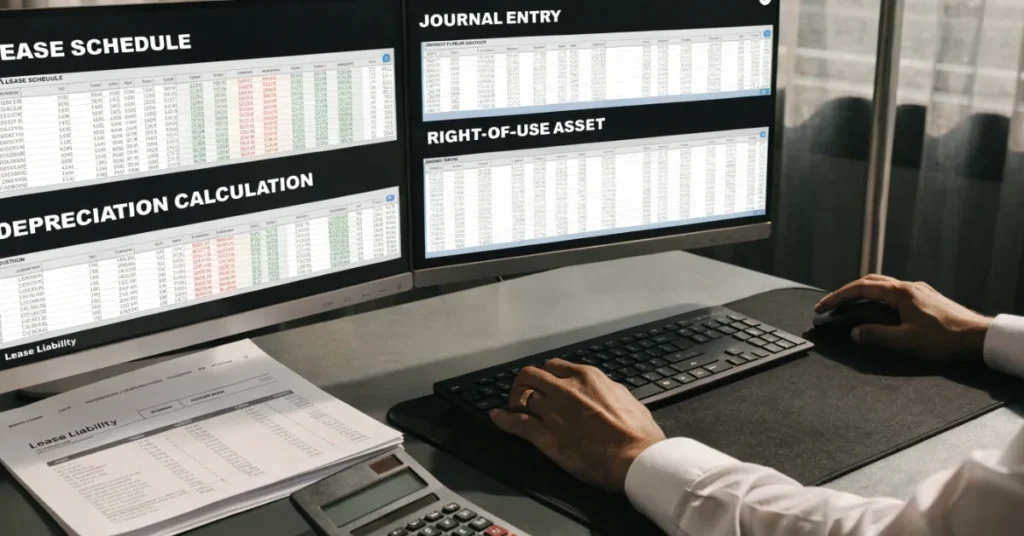
The following journal entries illustrate a typical lease under IFRS 16.
| Account | Debit | Credit |
|---|---|---|
| Right-of-Use Asset | $252,742 | |
| Lease Liability | $252,742 |
| Account | Debit | Credit |
|---|---|---|
| Interest Expense | XXXX | |
| Lease Liability | XXXX |
| Account | Debit | Credit |
|---|---|---|
| Lease Liability | XXXX | |
| Cash | XXXX |
| Account | Debit | Credit |
|---|---|---|
| Depreciation Expense | XXXX | |
| Accumulated Depreciation – Right-of-Use Asset | XXXX |
These entries continue throughout the lease term until the lease liability is settled and the Right-of-Use Asset is fully depreciated or derecognized.
Recognizing leases on the balance sheet changes several areas of financial reporting.
| Financial Statement | Impact of IFRS 16 |
|---|---|
| Balance Sheet | Assets and liabilities increase because businesses recognize the Right-of-Use Asset and Lease Liability. |
| Income Statement | Lease expense is replaced by depreciation expense and interest expense. |
| Cash Flow Statement | Principal lease payments are generally reported as financing activities, while interest payments follow the applicable accounting policy under IFRS. |
| EBITDA | EBITDA often increases because depreciation and interest replace operating lease expenses. |
| Debt Ratios | Total liabilities increase, which may affect leverage ratios and loan covenants. |
| Return on Assets (ROA) | ROA may decrease because total assets increase after recognizing the Right-of-Use Asset. |
Businesses should evaluate how IFRS 16 affects:
Finance teams should also review lease agreements regularly, monitor lease modifications, and maintain complete documentation to support accurate financial reporting and compliance.
Applying IFRS 16 correctly requires careful planning and ongoing monitoring. Even experienced finance teams can make mistakes that lead to inaccurate financial statements, compliance issues, or audit findings.
Here are some of the most common lease accounting errors and how to avoid them.
Not every contract is clearly labeled as a lease. Some service agreements include an identified asset and give the customer control over its use, making them embedded leases under IFRS 16.
How to avoid it:
Businesses sometimes overlook renewal, extension, or termination options when determining the lease term.
How to avoid it:
The discount rate has a significant impact on the measurement of lease liabilities. Using an incorrect rate can materially affect financial statements.
How to avoid it:
Lease agreements often change during their term. Rent revisions, lease extensions, and changes in leased space require reassessment under IFRS 16.
How to avoid it:
Incomplete documentation makes audits more difficult and increases compliance risks.
How to avoid it:
Strong internal controls and consistent processes make lease accounting more accurate and efficient.
Consider implementing the following best practices.
Following these practices helps businesses improve compliance, reduce manual errors, and streamline financial reporting.
Effective lease accounting is more than a compliance exercise. It provides valuable financial insights that support better decision-making and long-term business performance.
Recognizing lease assets and liabilities gives stakeholders a clearer understanding of the company’s financial position.
Proper lease accounting reduces reporting errors and ensures financial statements reflect the organization’s actual obligations.
Reliable lease information helps management evaluate future investments, negotiate lease agreements, and plan capital expenditures.
Applying IFRS 16 consistently reduces the risk of regulatory issues, audit adjustments, and financial statement restatements.
Transparent reporting improves credibility with banks, investors, and other stakeholders, making it easier to secure financing and build long-term business relationships.
Maintaining accurate lease records allows businesses to monitor renewal dates, payment schedules, and contract changes more effectively.
Implementing IFRS 16 can be challenging, particularly for businesses with multiple lease agreements or complex contract terms. Professional accounting support can help you identify lease obligations, calculate Right-of-Use Assets and Lease Liabilities, prepare compliant journal entries, and ensure your financial statements meet the latest IFRS Accounting Standards.
If your business needs assistance with lease accounting, financial reporting, bookkeeping, or IFRS compliance, Ripple Accountants can provide expert guidance tailored to your organization’s needs. Contact Ripple Accountants at +971 52 356 5409 or email info@uaetaxcompliance.ae to learn how experienced professionals can support your accounting and compliance requirements.
Lease accounting under IFRS 16 requires lessees to recognize most lease agreements by recording a Right-of-Use Asset and a Lease Liability on the balance sheet. This approach provides a more complete representation of lease obligations.
A Right-of-Use Asset represents a company’s right to use a leased asset during the lease term. It is initially measured at cost and depreciated over the lease period or the asset’s useful life, depending on the lease arrangement.
A Lease Liability is the present value of future lease payments that the lessee is obligated to make under the lease agreement.
Businesses may elect exemptions for:
IFRS 16 increases both assets and liabilities by recognizing the Right-of-Use Asset and Lease Liability. As a result, businesses present a more accurate picture of their financial commitments.
IAS 17 allowed many operating leases to remain off the balance sheet. IFRS 16 introduced a single lessee accounting model that requires most leases to be recognized on the balance sheet.
Lease payments are measured using their present value, calculated with the interest rate implicit in the lease or the lessee’s incremental borrowing rate when the implicit rate cannot be determined.
IFRS 16 applies to any organization preparing financial statements under IFRS Accounting Standards, regardless of size. However, the practical impact depends on the number and type of lease agreements the business has.
Understanding lease accounting under IFRS 16 is essential for producing accurate financial statements and maintaining compliance with IFRS Accounting Standards. By recognizing Right-of-Use Assets and Lease Liabilities, businesses provide greater transparency to investors, lenders, auditors, and other stakeholders.
Disclaimer: This article is for general informational purposes only and should not be considered accounting, tax, audit, or legal advice. While every effort has been made to ensure accuracy as of 2026, businesses should consult qualified accounting professionals or refer to the
Tell us a little about your business and our UAE tax experts will get back to you with clear, practical answers — no obligation.
 Corporate Tax
How much does a UAE Tax Residency Certificate cost, how long does it take to obtain, and when does it expire? Understanding…
Read article Corporate Tax
Are you planning to apply for a UAE Tax Residency Certificate but unsure which documents you need or whether you qualify? Understanding…
Read article Corporate Tax
Do you need a UAE Tax Residency Certificate for a local administrative requirement or to claim benefits under a double taxation agreement?…
Read articlePage 1 of 58
Book a free consultation and get clear answers for your business.
0 Comments