UAE Tax Residency Certificate Fees, Processing Time and Validity
How much does a UAE Tax Residency Certificate cost, how long does it take to obtain, and when does it expire? Understanding…
Read article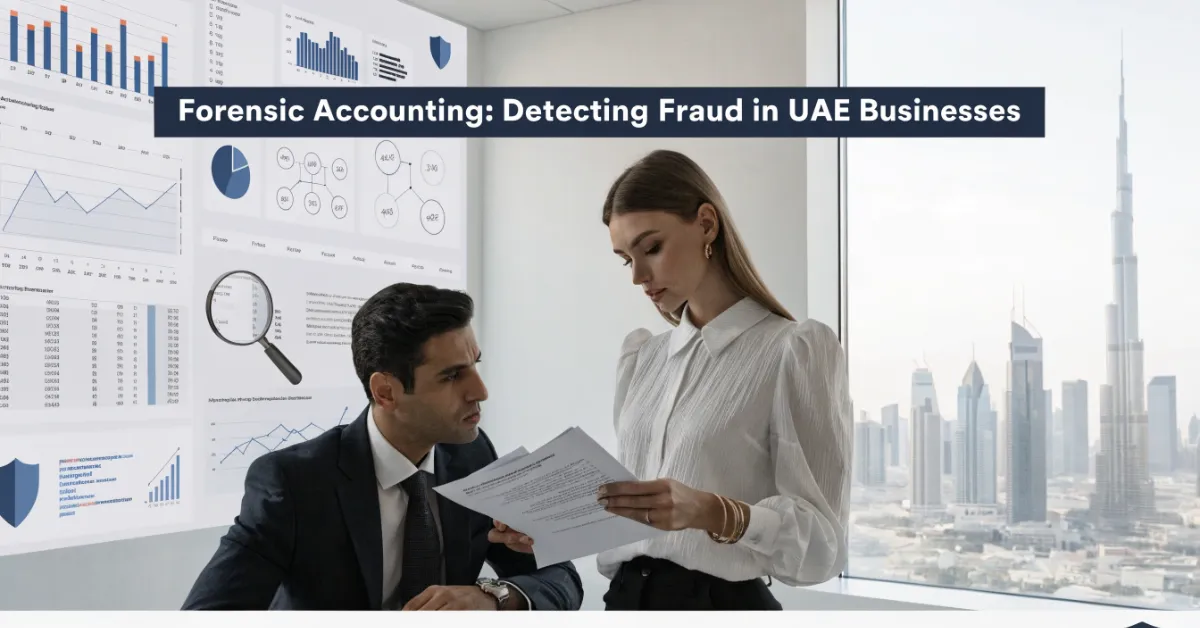
Financial fraud can happen in businesses of any size, from startups to multinational corporations. As the UAE continues to strengthen its regulatory environment and promote transparency, organizations are placing greater emphasis on forensic accounting, fraud detection, and financial compliance. Fraud not only causes financial losses but can also damage a company’s reputation, disrupt operations, and lead to legal consequences.
Forensic accounting combines accounting expertise, investigative techniques, and financial analysis to uncover fraudulent activities, identify financial irregularities, and provide evidence that can support legal proceedings. Whether a business suspects employee theft, financial statement manipulation, or procurement fraud, forensic accountants play a vital role in protecting business assets and ensuring compliance with UAE regulations.
Forensic accounting is a specialized branch of accounting that focuses on investigating financial records to detect fraud, financial misconduct, and accounting irregularities. Unlike traditional accounting, which records and reports financial transactions, forensic accounting examines financial information to determine whether intentional wrongdoing has occurred.
Forensic accountants combine accounting knowledge with investigative skills, data analysis, and legal understanding. Their findings often serve as evidence during legal disputes, regulatory investigations, insurance claims, shareholder conflicts, or criminal proceedings.
Businesses across the UAE increasingly rely on forensic accounting services to identify suspicious transactions, recover lost assets, strengthen internal controls, and maintain regulatory compliance.

Traditional accounting focuses on maintaining accurate financial records, preparing financial statements, and supporting day-to-day business operations.
Forensic accounting goes a step further by investigating unusual financial activities. It seeks to answer questions such as:
Instead of simply recording transactions, forensic accountants analyze financial evidence and reconstruct events to uncover hidden misconduct.
Many business owners assume that auditing and forensic accounting serve the same purpose. While both involve reviewing financial records, their objectives differ significantly.
| Auditing | Forensic Accounting |
|---|---|
| Reviews financial statements for accuracy | Investigates suspected fraud and financial crimes |
| Conducted regularly | Performed when fraud or disputes are suspected |
| Focuses on compliance | Focuses on evidence collection |
| Provides reasonable assurance | Identifies specific fraudulent activities |
| Supports financial reporting | Supports legal proceedings and investigations |
An external audit may identify weaknesses in financial reporting, but a forensic accounting investigation digs deeper to uncover the root cause of suspicious activities.
A forensic accountant performs several important functions, including:
These professionals help businesses respond quickly to financial misconduct while minimizing further losses.
The UAE has become one of the world’s leading business destinations, attracting investors and entrepreneurs from across the globe. As businesses grow, financial transactions become more complex, increasing the risk of fraud.
At the same time, UAE authorities continue to strengthen financial regulations related to corporate governance, Anti-Money Laundering (AML), Value Added Tax (VAT), and Corporate Tax. Businesses are expected to maintain accurate records and demonstrate financial transparency.
Effective fraud detection helps companies protect their financial health while meeting these regulatory expectations.
Fraud can result in substantial financial losses through theft, false invoices, payroll manipulation, or unauthorized payments. Early detection reduces the financial impact and allows businesses to recover assets before losses escalate.
A fraud incident can damage customer trust, investor confidence, and relationships with suppliers. Even after financial losses are recovered, reputational damage may take years to repair.
Strong forensic accounting practices demonstrate that a business takes financial integrity seriously.
Businesses operating in the UAE must comply with various financial reporting and tax regulations. Fraudulent accounting practices can lead to penalties, regulatory investigations, or legal action.
Forensic accounting helps organizations identify compliance issues before regulators discover them.
Good corporate governance depends on transparency, accountability, and reliable financial reporting. Fraud investigations often reveal weaknesses in internal controls, allowing businesses to improve governance practices and reduce future risks.
Investors prefer companies with strong financial controls and transparent reporting. Effective fraud prevention demonstrates responsible financial management and increases confidence among shareholders and lenders.
Financial fraud takes many forms. Understanding the most common schemes helps businesses recognize risks before they become significant problems.
Employee fraud is one of the most common forms of business fraud. It often occurs when internal controls are weak or financial responsibilities are concentrated in one individual.
Common examples include:
Even trusted employees may exploit weaknesses in financial systems if oversight is limited.
Financial statement fraud involves intentionally altering accounting records to present a misleading picture of a company’s financial position.
Examples include:
This type of fraud often aims to secure financing, attract investors, or improve reported business performance.
Procurement fraud affects purchasing processes and supplier relationships.
Common schemes include:
Businesses without proper approval procedures are particularly vulnerable to procurement fraud.
Invoice fraud occurs when fraudulent or duplicate invoices are submitted for payment.
Typical examples include:
Regular invoice reviews and supplier verification significantly reduce these risks.
Asset misappropriation refers to the theft or misuse of company resources.
This may involve:
Although individual losses may appear small, repeated incidents can create significant financial damage over time.
As businesses increasingly adopt digital accounting systems, cyber-related financial fraud continues to rise.
Examples include:
Cybersecurity and financial controls must work together to protect sensitive financial information.
Fraud rarely happens without warning. Business owners and managers should monitor for these common red flags:
One warning sign does not necessarily indicate fraud, but multiple indicators should prompt a detailed financial investigation.

Detecting fraud requires more than reviewing financial statements. Forensic accountants use structured investigative techniques to uncover hidden financial misconduct and gather evidence that supports their findings.
The investigation begins with a detailed review of accounting records, bank statements, invoices, contracts, payroll data, tax filings, and supporting documentation.
The objective is to identify inconsistencies, missing records, unusual transactions, or patterns that suggest fraudulent activity.
Forensic accountants test individual transactions to verify whether they are genuine, properly authorized, and accurately recorded.
This process may reveal:
Every questionable transaction is examined carefully to determine whether it resulted from an error or intentional fraud.
Modern forensic accounting relies heavily on data analytics to examine thousands of financial transactions quickly and accurately. Instead of reviewing records manually, forensic accountants use specialized software to identify unusual patterns, duplicate payments, unexpected changes in spending, and irregular accounting entries.
For example, if multiple payments are made to the same supplier within a short period or invoices are repeatedly approved just below an authorization limit, data analytics can flag these transactions for further investigation. This proactive approach enables businesses to detect fraud earlier and reduce financial losses.
Most financial information is now stored electronically, making digital evidence a crucial part of fraud investigations. Forensic accountants collect and analyze electronic records while maintaining the integrity of the evidence.
Digital evidence may include:
Proper handling of digital evidence ensures that it remains admissible if legal action becomes necessary.
Financial records alone do not always reveal the full story. Forensic accountants often conduct structured interviews with employees, managers, suppliers, and other relevant parties to clarify inconsistencies and understand how transactions were authorized.
These interviews help investigators:
A professional and confidential interview process encourages cooperation while protecting the integrity of the investigation.
Once the investigation is complete, forensic accountants prepare detailed reports that summarize their findings, explain how the fraud occurred, quantify financial losses, and recommend corrective actions.
These reports may be used for:
Clear documentation and evidence-based conclusions help businesses resolve disputes more efficiently and strengthen their legal position when required.
Technology has transformed the way financial fraud is detected. Businesses in the UAE increasingly use advanced tools that improve accuracy, speed, and risk management.
Artificial intelligence can analyze vast amounts of financial data and identify unusual transaction patterns that may indicate fraudulent activity. AI continuously learns from historical data, allowing it to detect emerging fraud risks more effectively than traditional manual reviews.
Advanced analytics enables forensic accountants to compare financial transactions across departments, suppliers, employees, and accounting periods. This helps uncover hidden relationships, duplicate payments, and abnormal spending trends that might otherwise go unnoticed.
Many organizations manage their financial operations through ERP systems. Forensic accountants review ERP data to identify unauthorized changes, unusual user activity, approval overrides, and inconsistencies between departments.
Digital forensic tools recover deleted files, examine system logs, trace electronic communications, and verify transaction histories. These capabilities are particularly valuable in cases involving cyber fraud, unauthorized access, or financial data manipulation.
Rather than waiting for annual audits, many businesses now implement continuous monitoring systems that review financial transactions in real time. These systems automatically flag suspicious activities, allowing management to respond before fraud escalates.
Investing in forensic accounting offers long-term value beyond fraud investigations. It helps businesses strengthen financial management, improve compliance, and build trust with stakeholders.
Key benefits include:
Businesses that adopt proactive fraud detection measures are generally better prepared to manage financial risks and respond to regulatory requirements.
Preventing fraud is more effective and less costly than investigating it after losses occur. A strong fraud prevention strategy combines robust internal controls, employee awareness, and regular financial oversight.
Internal controls form the foundation of fraud prevention. Every financial transaction should follow documented approval procedures, with clear responsibilities assigned to authorized personnel.
Effective controls reduce opportunities for unauthorized payments, accounting manipulation, and asset misappropriation.
No single employee should control an entire financial process from beginning to end. Separating responsibilities for authorizing, recording, and reviewing transactions minimizes the risk of fraud and increases accountability.
Internal audits help identify control weaknesses before they become serious problems. Routine reviews of financial records, procurement activities, payroll, and inventory management improve transparency and strengthen governance.
Regular monitoring enables businesses to identify unusual transactions promptly. Management should review financial reports, bank reconciliations, supplier payments, and expense claims throughout the year rather than relying solely on annual audits.
Employees are often the first to notice suspicious activities. Regular fraud awareness training helps staff recognize warning signs, understand reporting procedures, and appreciate the importance of ethical business practices.
A confidential whistleblower program encourages employees to report suspected misconduct without fear of retaliation. Early reporting can prevent small issues from developing into significant financial losses.
Modern accounting systems offer features such as user access controls, audit trails, automated approvals, and real-time monitoring. Keeping software updated and restricting system access reduces cybersecurity risks and protects sensitive financial information.
Businesses should perform due diligence before working with new suppliers. Regular verification of vendor details, banking information, and contractual documentation helps prevent procurement fraud and payments to fictitious companies.
Consider a medium-sized trading company operating in the UAE. Despite reporting steady sales growth, management noticed declining profit margins and increasing operating expenses. Concerned about these inconsistencies, the company engaged forensic accountants to conduct a detailed financial investigation.
The investigation revealed that an employee had created duplicate supplier accounts and approved multiple payments for the same invoices over several months. Because approval responsibilities were concentrated in one department, the fraudulent transactions went unnoticed.
Using data analytics and transaction testing, the forensic accounting team identified the duplicate payments, traced the flow of funds, and calculated the total financial loss.
Following the investigation, the company implemented stronger internal controls, introduced dual approval processes, enhanced vendor verification procedures, and adopted continuous transaction monitoring.
As a result, financial transparency improved, fraud risks were significantly reduced, and management restored confidence among shareholders and business partners.
This example highlights how early fraud detection and proactive financial controls can protect businesses from substantial financial and reputational damage.
Many business owners believe forensic accounting is only necessary after major fraud occurs. In reality, early intervention often prevents losses from escalating and helps organizations resolve issues more efficiently.
You should consider hiring a forensic accountant if your business experiences any of the following:
Engaging a forensic accountant at the earliest stage allows businesses to preserve evidence, limit financial damage, and identify the root cause of potential fraud before it affects long-term growth.
The business landscape in the UAE continues to evolve with stricter regulatory requirements, increasing digital transactions, and greater expectations for corporate transparency. While these developments create opportunities for growth, they also expose businesses to more sophisticated financial risks.
Fraud today extends beyond cash theft or falsified invoices. Organizations must also guard against cyber fraud, procurement fraud, financial statement manipulation, payroll irregularities, and unauthorized access to accounting systems. As businesses expand, manual oversight alone is no longer enough to detect these complex schemes.
Professional forensic accounting provides a proactive approach to fraud detection by combining financial expertise, investigative techniques, and advanced technology. Rather than responding only after losses occur, businesses can identify vulnerabilities, strengthen internal controls, and improve governance before fraud causes significant damage.
Forensic accountants also support organizations during legal disputes, regulatory reviews, shareholder disagreements, and insurance claims by providing evidence-based findings and professionally documented reports.
Businesses that invest in fraud prevention demonstrate a commitment to transparency, accountability, and responsible financial management. These qualities not only reduce financial risks but also strengthen relationships with investors, customers, financial institutions, and regulatory authorities.
Protecting your business from financial fraud requires more than routine bookkeeping or annual audits. It requires a proactive approach that identifies risks, strengthens financial controls, and supports compliance with UAE regulations. At Ripple Accountants, our experienced accounting professionals help businesses improve financial transparency through comprehensive accounting, bookkeeping, compliance support, and financial reviews. We assist organizations in identifying accounting irregularities, strengthening internal controls, supporting fraud risk assessments, and maintaining compliance with UAE VAT, Corporate Tax, and other regulatory requirements.
For professional assistance, contact Ripple Accountants at +971 52 356 5409 or email info@uaetaxcompliance.ae to discuss how our experts can help safeguard your business and strengthen financial governance.
Forensic accounting is a specialized field of accounting that investigates financial records to identify fraud, financial misconduct, accounting irregularities, and disputes. It combines accounting knowledge with investigative skills and legal procedures to uncover financial wrongdoing.
Forensic accountants analyze financial statements, bank records, invoices, payroll data, contracts, and digital transactions. They use transaction testing, data analytics, interviews, and digital forensic tools to identify suspicious activities and gather evidence.
Common fraud schemes include employee theft, payroll fraud, procurement fraud, fake vendor payments, financial statement manipulation, invoice fraud, asset misappropriation, expense reimbursement fraud, and cyber-related financial crimes.
Yes. An audit primarily evaluates whether financial statements are fairly presented and comply with accounting standards. Forensic accounting focuses on investigating suspected fraud, identifying responsible parties, calculating financial losses, and collecting evidence that may support legal proceedings.
Businesses should seek forensic accounting support when they suspect fraud, experience unexplained financial losses, face shareholder disputes, undergo regulatory investigations, require litigation support, or want to strengthen fraud prevention measures.
Yes. Forensic accountants prepare detailed investigation reports, calculate financial damages, organize financial evidence, and may provide expert witness testimony in civil or criminal court cases.
The duration depends on the complexity of the case, the volume of financial records, and the level of cooperation from involved parties. Some investigations may conclude within a few weeks, while larger or more complex cases can take several months.
Absolutely. Small and medium-sized businesses often have limited internal controls, making them vulnerable to fraud. Periodic forensic reviews can help identify risks early, improve financial controls, and prevent significant financial losses.
Financial fraud can affect businesses of every size, industry, and stage of growth. Even a single fraudulent transaction can result in significant financial losses, legal complications, and long-term reputational damage. As the UAE continues to strengthen its regulatory environment, organizations must adopt proactive measures to protect their financial assets and maintain stakeholder confidence.
Disclaimer: The information provided in this article is for general educational and informational purposes only and should not be considered legal, tax, financial, or professional advice. While every effort has been made to ensure the accuracy of the content, regulations and business requirements in the UAE may change over time. Businesses should consult qualified accounting, legal, or financial professionals before making decisions based on the information provided.
Tell us a little about your business and our UAE tax experts will get back to you with clear, practical answers — no obligation.
 Corporate Tax
How much does a UAE Tax Residency Certificate cost, how long does it take to obtain, and when does it expire? Understanding…
Read article Corporate Tax
Are you planning to apply for a UAE Tax Residency Certificate but unsure which documents you need or whether you qualify? Understanding…
Read article Corporate Tax
Do you need a UAE Tax Residency Certificate for a local administrative requirement or to claim benefits under a double taxation agreement?…
Read articlePage 1 of 58
Book a free consultation and get clear answers for your business.
0 Comments